
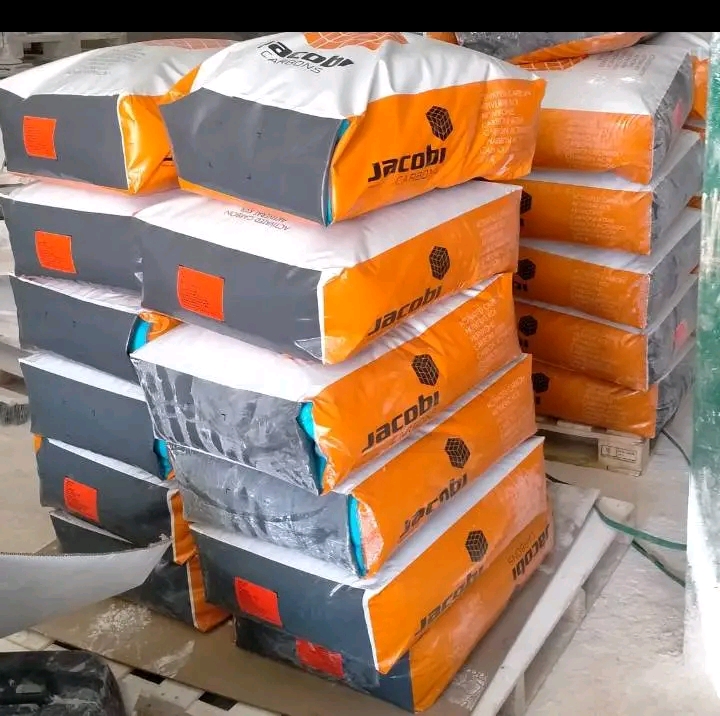
Activated Carbon Supplier in Nairobi, Kenya, Tanzania and Uganda
Are you looking for a reliable supplier of Activated Carbon in Nairobi, Kenya, or a source for industrial filtration and purification applications across East Africa? Olinc Chemical Suppliers provides a point of contact for businesses looking to source Activated Carbon for water treatment, wastewater processing, air purification, food processing, manufacturing and other industrial applications.
Activated Carbon, also known as Activated Charcoal, is a highly porous carbon-based material designed to attract and hold certain unwanted substances on its internal surface. It has an extensive network of tiny pores that gives it a large surface area and makes it an effective adsorbent in many purification processes.
It is widely used in municipal and industrial water treatment plants, borehole water filtration systems, wastewater treatment facilities, food and beverage factories, pharmaceutical production, chemical manufacturing, mining operations and air filtration systems.
However, choosing the right Activated Carbon is important. Powdered Activated Carbon is used differently from Granular Activated Carbon, while coconut-shell, coal-based and wood-based products have different pore structures and performance characteristics.
At Olinc Chemical Suppliers, we understand that industrial buyers need more than just the product name. They need to understand the available types, specifications, applications, packaging and suitability for their processes. This guide provides detailed information to help you make an informed purchasing decision.
Contact Olinc Chemical Suppliers for current prices, product specifications, packaging options and bulk-order enquiries.
What Is Activated Carbon?
Activated Carbon is a specially processed carbonaceous material with a highly developed porous structure. It is manufactured from carbon-rich raw materials such as coconut shells, coal, wood, peat and other suitable organic materials.
The material undergoes carbonisation and activation to develop numerous pores throughout its structure. These pores provide an extensive internal surface where certain molecules can attach.
The resulting material can adsorb a wide range of organic compounds, colour-causing substances, odour compounds and other contaminants, depending on its raw material, pore structure, surface chemistry and application.
Activated Carbon is commonly supplied as:
- Fine black powder.
- Black granules.
- Small cylindrical pellets.
- Specialised or chemically impregnated carbon.
It is generally insoluble in water and is used as a filtration or purification medium rather than as a chemical that dissolves into the treated liquid.
Chemical identity
| Property | Description |
|---|---|
| Product name | Activated Carbon |
| Alternative name | Activated Charcoal |
| Chemical name | Carbon |
| Chemical formula | C |
| CAS number | 7440-44-0 |
| Appearance | Black powder, granules or pellets |
| Odour | Generally odourless |
| Solubility | Insoluble in water |
| Chemical nature | Porous carbonaceous adsorbent |
| Main function | Adsorption of selected contaminants |
| Common sources | Coconut shell, coal and wood |
Activated Carbon does not have one fixed molecular weight or one universal technical specification because it is a porous material produced from different raw materials and activation processes.
How Does Activated Carbon Work?
Activated Carbon works mainly through a process called adsorption.
Adsorption occurs when molecules from a liquid or gas attach to the surface of a solid material. Activated Carbon has a large internal surface area because of its extensive network of pores. This allows it to hold many types of substances on its surface.
During water treatment, for example, water passes through a bed of Activated Carbon. Certain dissolved organic compounds, chlorine-related substances, colour-causing materials and odour compounds attach to the carbon surface.
The treated water then passes out of the filter, while the captured substances remain on the carbon until the material is regenerated or replaced.
The adsorption process
- Contaminated water or air comes into contact with Activated Carbon.
- Target molecules move towards the carbon surface and into accessible pores.
- The molecules attach to the internal surfaces of the carbon.
- The treated liquid or gas leaves the filtration system.
- Over time, adsorption sites become occupied and the carbon’s remaining capacity decreases.
The performance depends on the contaminant, carbon grade, pore-size distribution, contact time, temperature, flow rate, concentration and competing substances.
Adsorption versus absorption
These terms are sometimes confused:
- Adsorption: A substance attaches to the surface of another material. This is the principal mechanism of Activated Carbon.
- Absorption: A substance enters and is taken up into the bulk of another material.
Activated Carbon is valued for adsorption, not simply because it soaks up liquid like a sponge.
Types of Activated Carbon
Choosing the correct type is one of the most important purchasing decisions. Activated Carbon is available in several physical forms and raw-material categories.
Powdered Activated Carbon (PAC)
Powdered Activated Carbon is a finely ground black powder with a large available surface area and relatively short diffusion distances.
It is commonly used where carbon needs to be mixed directly into a liquid, allowed to adsorb contaminants and then separated through clarification, filtration or another suitable solid-liquid separation process.
Common applications:
- Drinking-water treatment.
- Industrial wastewater treatment.
- Removal of unwanted colour from liquids.
- Reduction of unpleasant taste and odour.
- Treatment of certain organic contaminants.
- Sugar and food-processing decolourisation, where an appropriate grade is used.
- Batch purification processes.
- Emergency treatment when contaminant levels temporarily increase.
Advantages:
- Can be dosed into an existing treatment process.
- Offers rapid contact with the liquid when properly mixed.
- Suitable for batch treatment and variable contaminant loads.
- Available in different particle sizes and adsorption characteristics.
Important consideration: PAC must be separated from the treated liquid after use. It is not normally retained in a conventional fixed carbon filter bed because its fine particles can pass through or block unsuitable filtration systems.
Granular Activated Carbon (GAC)
Granular Activated Carbon consists of larger particles designed for use in filter vessels, columns and fixed-bed filtration systems.
Water or gas passes through the carbon bed, allowing target substances to attach to the carbon surface.
Common applications:
- Borehole water filtration.
- Municipal drinking-water treatment.
- Industrial water purification.
- Removal of chlorine and certain organic compounds.
- Taste and odour improvement.
- Wastewater polishing.
- Treatment of selected industrial process liquids.
- Aquarium and swimming-pool filtration, where the correct grade and system are used.
Advantages:
- Suitable for fixed-bed filtration systems.
- Can be retained in filter vessels.
- Often easier to separate from water than powdered carbon.
- Certain grades can be regenerated and reused through suitable industrial processes.
GAC particle sizes must match the filter design. The wrong size can cause excessive pressure drop, poor flow distribution, carbon loss or inadequate contact time.
Extruded or Pelletised Activated Carbon
Extruded Activated Carbon is manufactured into cylindrical pellets of controlled dimensions.
It is particularly useful in applications involving air and gas treatment, although suitable specialised grades may also be used in other industrial systems.
Common applications:
- Industrial air purification.
- Removal of selected volatile organic compounds (VOCs).
- Solvent vapour recovery.
- Odour-control systems.
- Biogas treatment.
- Selected gas purification processes.
- Industrial ventilation and exhaust treatment.
Pellet diameter, length, hardness, pressure drop and adsorption characteristics are important when selecting this type.
Impregnated Activated Carbon
Impregnated Activated Carbon is treated with selected chemicals to improve its ability to capture particular contaminants that ordinary carbon may not remove effectively.
Depending on the impregnation, it may be designed for specialised gas treatment, such as removal of hydrogen sulphide, mercury or certain acidic gases.
Applications include:
- Hydrogen sulphide removal.
- Biogas purification.
- Mercury removal from selected gas streams.
- Specialised industrial odour control.
- Selected chemical vapour treatment.
The impregnating chemical must be matched to the contaminant and operating conditions. Not every impregnated carbon is suitable for every gas.
Reactivated or Regenerated Activated Carbon
Some spent granular carbon can be processed through controlled thermal reactivation to remove accumulated adsorbed substances and restore part of its adsorption capacity.
Regenerated carbon can be used in suitable applications when its performance, purity and contamination history meet the required standards.
It should not automatically be treated as equivalent to virgin carbon, particularly in food, pharmaceutical or drinking-water applications.
Activated Carbon by Raw Material
Activated Carbon can also be classified according to the material used in its manufacture.
Coconut Shell Activated Carbon
This type is manufactured from coconut shells and is commonly used in water filtration and other purification applications.
It generally has a high proportion of micropores, making it useful for adsorption of many relatively small molecules.
Typical applications:
- Drinking-water filtration.
- Borehole water treatment.
- Removal of chlorine and certain organic compounds.
- Taste and odour control.
- Household and commercial water filters.
- Selected high-purity filtration applications.
- Gold recovery in suitable mining processes.
Coconut-shell carbon is often selected for its hardness and particle durability, although actual performance depends on the manufacturer’s process and technical specification.
Coal-Based Activated Carbon
Coal-based Activated Carbon is manufactured from suitable grades of coal.
Depending on the coal source and activation process, it can offer a combination of micropores and mesopores.
Typical applications:
- Industrial wastewater treatment.
- Municipal water purification.
- Industrial liquid filtration.
- Removal of certain organic pollutants.
- Air and gas treatment.
- Industrial decolourisation.
- Selected solvent and chemical purification processes.
Wood-Based Activated Carbon
Wood-based Activated Carbon can be manufactured with a pore structure that is useful for adsorption of relatively large molecules.
It is often available in powdered form.
Typical applications:
- Sugar decolourisation.
- Food-processing purification, with suitable food-grade material.
- Colour removal from industrial liquids.
- Chemical processing.
- Selected pharmaceutical purification processes.
- Wastewater treatment.
The choice between coconut-shell, coal-based and wood-based Activated Carbon should be based on the target contaminant and required performance rather than the raw material name alone.
Main Industrial Applications of Activated Carbon
Activated Carbon is used in many industries because it can remove selected unwanted substances without requiring the carbon to dissolve into the treated material.
Water Treatment and Purification
One of the most recognised applications of Activated Carbon is water purification.
It is used in water treatment systems to reduce certain organic contaminants, chlorine, taste and odour compounds, and other substances that can affect water quality.
Applications include:
- Municipal water treatment.
- Borehole water filtration.
- Industrial process-water purification.
- Commercial water filtration.
- Drinking-water treatment, with an appropriately approved grade.
- Pre-treatment in selected water purification systems.
- Polishing of treated water.
Activated Carbon is particularly useful when the treatment objective involves adsorption of substances that conventional sediment filters do not remove.
Important: Activated Carbon does not automatically remove dissolved salts, hardness, nitrates, fluoride, all heavy metals or microorganisms. These require suitable treatment technologies or specialised carbon products. A complete water analysis is recommended before selecting a treatment system.
Wastewater Treatment
Industrial wastewater may contain dissolved organic compounds, dyes, chemicals and substances that cause colour or odour.
Activated Carbon can be used as a treatment or polishing medium to adsorb suitable contaminants.
Industries that may use it include:
- Textile factories.
- Chemical manufacturers.
- Food-processing plants.
- Pharmaceutical facilities.
- Paint and coating manufacturers.
- Industrial washing facilities.
- General manufacturing operations.
It can support the reduction of certain organic pollutants and improve wastewater quality, depending on the wastewater composition.
Activated Carbon should not be assumed to remove all COD or BOD. Its effectiveness must be established through laboratory testing or treatment trials.
Food and Beverage Processing
Suitable food-grade Activated Carbon is used in certain purification and decolourisation operations.
Applications may include:
- Sugar refining and decolourisation.
- Purification of selected edible liquids.
- Removal of unwanted colour compounds.
- Processing of certain beverage ingredients.
- Purification of selected food-processing solutions.
The grade must meet the applicable food-safety requirements for the intended process. Ordinary industrial Activated Carbon should not be used in food processing simply because it has the same product name.
Pharmaceutical Manufacturing
Activated Carbon is used in selected pharmaceutical and chemical purification processes.
It may help remove unwanted colour compounds, organic impurities and other adsorbable substances from process liquids.
Pharmaceutical applications require carefully selected material with appropriate purity, documentation and compliance with the manufacturer’s and applicable regulatory requirements.
Chemical Manufacturing
Chemical manufacturers use Activated Carbon in selected processes that require decolourisation, purification or removal of unwanted organic compounds.
Examples include:
- Purification of chemical solutions.
- Removal of colour from selected intermediates.
- Adsorption of organic impurities.
- Solvent purification and recovery systems.
- Selected catalyst-support applications.
The carbon must be compatible with the process chemicals and operating conditions.
Mining and Gold Recovery
Certain high-hardness granular Activated Carbon grades are used in gold recovery processes.
In gold processing systems such as Carbon-in-Pulp (CIP) and Carbon-in-Leach (CIL), activated carbon adsorbs dissolved gold complexes from the process solution.
Common applications:
- Gold recovery from cyanide leach solutions.
- Carbon-in-Pulp processing.
- Carbon-in-Leach processing.
- Gold adsorption circuits.
Mining-grade carbon selection is particularly important. Hardness, abrasion resistance, particle size distribution, adsorption kinetics and resistance to attrition all affect performance.
Air and Gas Purification
Activated Carbon can be used to capture certain vapours, gases and odour-causing compounds.
Applications include:
- Industrial air filtration.
- Odour-control equipment.
- Solvent vapour adsorption.
- VOC control.
- Biogas treatment using suitable specialised grades.
- Industrial exhaust treatment.
- Selected gas purification systems.
For gases such as hydrogen sulphide or mercury, a specifically designed impregnated carbon may be necessary.
Textile and Dyeing Industry
Activated Carbon can be used in selected textile wastewater and process-liquid treatment applications.
It may help reduce unwanted colour and adsorb suitable organic compounds from wastewater generated during dyeing and finishing.
Sugar and Edible Oil Processing
Selected grades are used for decolourisation and purification in sugar and other food-processing operations.
The correct carbon grade must be chosen according to the liquid being processed, the colour compounds to be removed and the required final product quality.
Aquarium and Swimming-Pool Filtration
Suitable granular grades are used in selected filtration systems to remove certain dissolved organic substances and improve water clarity or odour.
Activated Carbon is not a substitute for disinfection, biological filtration or the complete water-treatment programme required for a swimming pool or aquarium.
What Does Activated Carbon Remove?
The effectiveness of Activated Carbon depends on the contaminant and the grade used.
| Substance or problem | Activated Carbon suitability |
|---|---|
| Free chlorine | Commonly used for reduction |
| Unpleasant taste | Can reduce many taste-causing organic compounds |
| Unpleasant odour | Can adsorb many odour-causing compounds |
| Certain pesticides | Can adsorb many suitable organic pesticides |
| Organic compounds | Commonly used for selected organic contaminants |
| Certain VOCs | Suitable grades can remove selected vapours |
| Colour-causing organics | Used for decolourisation |
| Certain industrial pollutants | Depends on the contaminant and carbon grade |
| Hydrogen sulphide | Specialised impregnated carbon may be required |
| Mercury vapour | Specialised impregnated carbon may be required |
| Dissolved salts | Ordinary Activated Carbon is not a desalination medium |
| Water hardness | Does not normally remove calcium and magnesium hardness |
| Nitrates | Ordinary Activated Carbon is generally unsuitable |
| Fluoride | Requires an appropriate specialised treatment medium |
| Microorganisms | Does not reliably disinfect water |
This distinction is important for customers designing a water treatment plant. Activated Carbon is often one stage of a larger treatment system rather than a complete water purification solution.
Activated Carbon Technical Specifications
Before purchasing Activated Carbon, industrial buyers should understand the main parameters used to evaluate quality and performance.
The following are indicative commercial specification ranges. They are not a guarantee of the specifications of every grade supplied by Olinc Chemical Suppliers. The actual values should be confirmed using the manufacturer’s Technical Data Sheet (TDS) and Certificate of Analysis (COA).
| Specification | What it means | Why it matters |
|---|---|---|
| Iodine number | Indicates adsorption capacity for certain small molecules | Helps compare micropore-related adsorption characteristics |
| Methylene Blue value | Indicates adsorption capacity for a larger test molecule | Useful for assessing certain mesopore-related properties |
| BET surface area | Measures specific surface area | Helps characterise the porous structure |
| Moisture content | Amount of water in the product | Affects delivered dry-carbon quantity and handling |
| Ash content | Non-carbon inorganic residue | Important for purity-sensitive applications |
| Particle size | Size distribution of particles | Affects flow, filtration and contact performance |
| Hardness | Resistance to physical breakdown | Important for granular filter beds and mining |
| Abrasion resistance | Resistance to wear during handling and operation | Helps reduce carbon fines and losses |
| Bulk density | Mass per unit of bulk volume | Important for vessel sizing and loading |
| pH | Acidity or alkalinity of a specified water extract | Can affect process compatibility |
| Apparent density | Density measured using the specified test method | Useful for product and system design |
| CTC activity | A measure used for certain gas-phase adsorption applications | Relevant to selected air and gas treatment grades |
| Particle uniformity | Consistency of particle sizes | Helps maintain predictable flow and filtration |
Typical indicative specification examples
Different commercial grades can vary considerably. The following ranges are examples found in technical product literature, not a single universal specification.
| Parameter | Indicative examples |
|---|---|
| Appearance | Black powder, granules or pellets |
| Iodine number | Approximately 700–1,200 mg/g for many commercial grades |
| BET surface area | Approximately 800–1,200 m²/g for many grades |
| Moisture | Often around 5–10%, depending on grade |
| Ash | May range from below 5% to above 10%, depending on raw material and washing |
| Powder particle size | Often supplied in fine mesh grades |
| Granular particle sizes | Examples include 8×30, 12×40 and other specified mesh sizes |
| Pellet diameter | Common commercial sizes include 3 mm and 4 mm |
Do not select Activated Carbon using iodine number alone. A high iodine number does not prove that the product will remove every contaminant effectively. Methylene blue value, pore distribution, hardness, particle size, surface chemistry and application-specific testing may be equally important.
How to Choose the Right Activated Carbon
The best Activated Carbon is the one that matches the actual treatment requirement.
If you are treating drinking water
Consider:
- The substances present in the raw water.
- Whether the objective is chlorine reduction, taste improvement, odour control or organic contaminant removal.
- Whether powdered or granular carbon is suitable for the filtration system.
- Whether the product has the required drinking-water contact certification.
- The expected flow rate and contact time.
If you are treating industrial wastewater
Consider:
- The type of industry producing the wastewater.
- Whether the main issue is colour, odour or specific organic pollutants.
- The concentration of the contaminants.
- Whether batch dosing or a fixed-bed filter is more suitable.
- The method used to separate spent powdered carbon, if PAC is selected.
If you are treating air or gas
Consider:
- The type of gas or vapour.
- Contaminant concentration.
- Temperature and humidity.
- Required removal efficiency.
- Whether standard or impregnated carbon is needed.
- Pressure drop and equipment design.
If you are operating a gold-processing plant
Consider:
- Carbon hardness and abrasion resistance.
- Particle size distribution.
- Gold adsorption kinetics.
- Resistance to attrition.
- Compatibility with the CIP or CIL process.
If you are processing food or pharmaceutical products
Consider:
- Required grade and purity.
- Applicable regulatory requirements.
- Ash and soluble impurity levels.
- Heavy-metal limits.
- Relevant certification and batch documentation.
- Whether the manufacturer specifically approves the grade for the intended use.
Powdered vs Granular vs Pelletised Activated Carbon
| Feature | Powdered (PAC) | Granular (GAC) | Pelletised |
|---|---|---|---|
| Physical form | Fine powder | Small granules | Cylindrical pellets |
| Typical use | Liquid treatment and batch dosing | Water and liquid filtration | Air and gas treatment |
| Application method | Mixed or dosed into liquid | Packed in filter beds | Packed in suitable vessels |
| Separation | Requires solid-liquid separation | Retained in filter vessel | Retained in filter vessel |
| Particle handling | Dust can be generated | Less dusty than powder | Usually easier to handle |
| Main selection factor | Adsorption and particle size | Adsorption, size and hardness | Adsorption, dimensions and pressure drop |
A buyer should not substitute one form for another without checking whether the existing equipment can accommodate it.
How Is Activated Carbon Used in Water Treatment?
Activated Carbon can be used in a variety of water treatment arrangements.
Granular carbon filter
In a typical GAC system:
- A suitable filter vessel is filled with the specified granular carbon.
- The carbon is properly wetted and prepared according to the equipment and supplier instructions.
- Water is passed through the carbon bed at the designed flow rate.
- The target contaminants are adsorbed as the water passes through the bed.
- The treated water exits the vessel.
- The bed is monitored and maintained according to its operating condition.
The system may require backwashing to remove accumulated suspended particles and maintain suitable hydraulic conditions. Backwashing does not necessarily restore the carbon’s original adsorption capacity.
Powdered carbon dosing
PAC can be introduced into a water treatment process as a controlled powder feed or slurry.
It is mixed with the water for a specified contact period, after which the carbon is separated using suitable clarification or filtration equipment.
Carbon filter maintenance
A carbon filter needs monitoring. Its performance can decline when adsorption sites become occupied or when the bed becomes physically clogged.
Important monitoring considerations include:
- Inlet and outlet water quality.
- Pressure drop across the filter.
- Flow rate.
- Breakthrough of the target contaminant.
- Carbon loss or particle breakdown.
- Microbiological control where relevant.
- Replacement or reactivation requirements.
Empty Bed Contact Time (EBCT)
EBCT is a design parameter used in granular activated carbon systems.
It is calculated as:
EBCT = Empty carbon bed volume ÷ Water flow rate
For example, a carbon bed volume of 1,000 litres operating at 100 litres per minute has an EBCT of 10 minutes.
This is only an arithmetic example, not a universal design recommendation. The appropriate EBCT depends on the contaminant, carbon characteristics, water quality and treatment objective.
What Determines the Dosage of Activated Carbon?
There is no single correct Activated Carbon dosage for every application.
The required quantity depends on:
- The type of contaminant.
- The concentration of the contaminant.
- The volume of water or liquid being treated.
- The adsorption capacity of the carbon.
-
The required treatment result.
- Contact time.
- pH and temperature.
- Competing dissolved substances.
- The treatment system and separation method.
For wastewater treatment, a laboratory jar test or adsorption trial can help establish the appropriate dosage.
For fixed-bed systems, carbon quantity and vessel size should be determined by the system’s flow rate, EBCT, contaminant loading and expected service life.
Buyers should avoid using a dosage recommended for another plant without testing whether the water or process conditions are comparable.
Grades of Activated Carbon
Activated Carbon may be supplied in different grades according to purity, raw material, processing and intended application.
Industrial Grade
Used in suitable industrial water treatment, wastewater treatment, air filtration and manufacturing applications.
Water Treatment Grade
Selected for water purification applications. The exact product must meet the applicable requirements for the intended water use.
Drinking-Water Treatment Grade
Must meet relevant public-health, purity and certification requirements. A product should not be described as certified for drinking-water treatment unless the supplier can provide valid supporting documentation for the specific product.
Food Grade
Used in suitable food and beverage processing applications when the product meets the required food-grade specifications and regulatory standards.
Pharmaceutical Grade
Used in selected pharmaceutical manufacturing processes where stringent purity and documentation requirements apply.
Gold Recovery Grade
Designed for gold adsorption circuits and selected according to hardness, abrasion resistance, particle size and adsorption performance.
Air and Gas Treatment Grade
Selected according to the type of gas or vapour to be treated. Specialised impregnated grades may be required.
Important: Industrial, drinking-water, food and pharmaceutical grades are not automatically interchangeable. Always specify the intended use when requesting a quotation.
Activated Carbon Packaging
Packaging depends on the product type, supplier and order quantity.
Common commercial packaging formats include:
| Packaging | Typical application |
|---|---|
| 20 kg bags | Smaller industrial and commercial requirements |
| 25 kg bags | Common industrial packaging |
| 50 kg bags | Larger industrial consumption |
| Jumbo bags | Bulk industrial requirements |
| Special bulk packaging | Large-scale treatment plants and industrial users |
These are examples of packaging formats used in the market. Contact Olinc Chemical Suppliers to confirm the currently available packaging, bag weight and order quantities.
When requesting a quotation, specify whether you need powdered, granular or pelletised Activated Carbon.
Storage and Handling of Activated Carbon
Correct storage helps preserve the product’s technical properties and prevents contamination.
Storage recommendations
- Store in a cool, dry and well-ventilated area.
- Keep bags sealed until use.
- Protect the product from rain, moisture and excessive humidity.
- Store away from strong oxidising agents.
- Keep away from solvents and chemical vapours that the carbon could adsorb.
- Avoid unnecessary exposure to dust and airborne contaminants.
- Keep packaging clearly labelled.
- Follow the manufacturer’s storage instructions.
Handling precautions
Activated Carbon is commonly handled as a powder or granular solid. Fine dust can irritate the eyes and respiratory system.
Recommended precautions include:
- Wear suitable protective gloves.
- Use safety goggles.
- Use suitable respiratory protection where dust exposure may occur.
- Avoid creating dust clouds.
- Provide adequate ventilation.
- Wash hands after handling.
- Follow the specific Safety Data Sheet (SDS).
Fire and confined-space precautions
Activated Carbon is combustible. Under certain conditions it can self-heat, and storage or handling around heat sources and powerful oxidisers requires care.
Carbon dust should be managed to avoid creating combustible dust conditions.
Activated Carbon can also reduce oxygen concentration in confined spaces under certain conditions. Do not enter storage vessels, filter vessels or other confined spaces without the appropriate confined-space procedures, atmospheric testing and authorisation.
For fire, spill and emergency procedures, always consult the specific product SDS and site safety requirements.
Can Activated Carbon Be Reused?
Some granular Activated Carbon can be regenerated through specialised industrial processes.
Regeneration is used to remove accumulated adsorbed substances and recover part of the carbon’s adsorption capacity.
However, the ability to regenerate carbon depends on:
- The original carbon grade.
- The substances adsorbed.
- The operating conditions.
- The regeneration method.
- Carbon loss and physical deterioration.
- The required final product quality.
Powdered Activated Carbon is generally used once and separated from the treated liquid rather than regenerated in the same way as suitable granular carbon.
Regenerated carbon should only be used where its remaining performance and contamination history are acceptable for the intended application.
Activated Carbon vs Other Filtration Materials
Activated Carbon is one of several materials used in water treatment. It performs a different role from many other filtration media.
| Material | Main function |
|---|---|
| Activated Carbon | Adsorbs selected organic compounds, chlorine-related substances, taste and odour compounds |
| Silica Sand | Removes suspended particles through physical filtration |
| Gravel | Supports filter media and assists water distribution |
| Anthracite | Used in multimedia filtration to remove suspended solids |
| Zeolite | Used for selected ion-exchange and filtration applications |
| Ion Exchange Resin | Removes selected dissolved ions |
| Reverse Osmosis Membrane | Removes a broad range of dissolved substances and particles |
| Manganese Dioxide Media | Used in suitable systems for oxidation and removal of iron and manganese |
| Water Softener Resin | Reduces water hardness by ion exchange |
A well-designed water treatment system may combine several of these materials.
Why Buy Activated Carbon from Olinc Chemical Suppliers?
Olinc Chemical Suppliers serves customers looking for industrial chemicals and materials in Nairobi, Kenya, and the wider East African market.
When enquiring about Activated Carbon from Olinc, buyers can discuss:
- The intended application.
- The required type of Activated Carbon.
- Suitable technical specifications.
- Required quantities.
- Packaging preferences.
- Current availability.
- Delivery arrangements.
- Bulk-order quotations.
We encourage customers to share their intended application so that the correct product type and specifications can be established before ordering.
Whether you are sourcing Activated Carbon for water purification, wastewater treatment, manufacturing, mining or industrial filtration, contact Olinc Chemical Suppliers for product and quotation enquiries.
Activated Carbon Supply in Nairobi, Kenya and East Africa
Olinc Chemical Suppliers is based at Enterprise Road, Avon Business Center, Nairobi, Kenya.
We welcome enquiries from businesses and industrial buyers in:
- Nairobi.
- Mombasa.
- Kisumu.
- Nakuru.
- Eldoret.
- Thika.
- Other towns across Kenya.
- Uganda.
- Tanzania.
- Other East African markets, subject to delivery arrangements.
Customers outside Nairobi should provide their delivery location and order quantity when requesting a quotation so that suitable supply and transport arrangements can be discussed.
Frequently Asked Questions About Activated Carbon
What is Activated Carbon used for?
Activated Carbon is used for water purification, wastewater treatment, air filtration, odour removal, decolourisation, food processing, chemical manufacturing, mining and other applications involving adsorption.
Is Activated Carbon the same as Activated Charcoal?
Yes. Activated Charcoal is another commonly used name for Activated Carbon. Both refer to porous carbonaceous material that has undergone an activation process to develop adsorption capacity.
What is the chemical formula of Activated Carbon?
Its principal chemical element is carbon, represented by the symbol C. Because it is a porous material rather than a single pure molecular compound, it does not have one fixed molecular weight.
What is the CAS number of Activated Carbon?
A commonly used CAS number is 7440-44-0.
What is the difference between Powdered and Granular Activated Carbon?
Powdered Activated Carbon is a fine powder usually mixed into liquids and later separated. Granular Activated Carbon consists of larger particles generally used in fixed-bed filter vessels and columns.
Which Activated Carbon is best for water treatment?
The best type depends on the water quality and the substances being removed. Coconut-shell and coal-based granular carbon are commonly used in water filtration, while powdered grades are used for certain batch and treatment-plant dosing applications.
Can Activated Carbon remove chlorine from water?
Yes. Suitable Activated Carbon grades are widely used to reduce free chlorine in water. Actual performance depends on the carbon grade, water chemistry, flow rate and contact time.
Can Activated Carbon make borehole water safe to drink?
Not on its own. Activated Carbon may improve taste and odour and remove certain organic compounds, but it does not reliably remove all dissolved salts, hardness, fluoride, nitrates, heavy metals or microorganisms. Borehole water should be tested and treated according to the contaminants found.
Does Activated Carbon remove iron from water?
Ordinary Activated Carbon is not generally the primary treatment medium for dissolved iron. Iron removal usually requires a suitable oxidation and filtration process or specialised treatment media.
Does Activated Carbon remove fluoride?
Ordinary Activated Carbon is generally not effective for fluoride removal. Specialised fluoride treatment media or other suitable technologies may be needed.
Does Activated Carbon remove heavy metals?
Ordinary Activated Carbon should not be assumed to remove all heavy metals effectively. Certain modified or specialised carbons may adsorb particular metals, but performance depends on the metal, water chemistry and product design.
Can Activated Carbon remove bad smell from water?
Yes. Suitable grades can adsorb many organic compounds responsible for unpleasant tastes and odours. The cause of the smell should still be identified, particularly where it may indicate microbiological or chemical contamination.
What is the iodine number in Activated Carbon?
The iodine number is a laboratory measure used as an indicator of the carbon’s adsorption capacity for a particular test substance. It is commonly expressed in milligrams per gram (mg/g). It is useful for comparing certain grades but does not measure performance against every contaminant.
What is the difference between coconut-shell and coal-based Activated Carbon?
Coconut-shell carbon commonly has a micropore-rich structure and good hardness. Coal-based carbon can have a broader pore distribution depending on its source and activation process. The most suitable option depends on the target contaminant and treatment system.
Can Activated Carbon be used in wastewater treatment?
Yes. It is used to adsorb certain organic compounds, colour-causing substances and odour compounds in suitable wastewater treatment processes. Laboratory testing can help determine the appropriate grade and dosage.
Is Activated Carbon soluble in water?
No. Activated Carbon is generally insoluble in water. It remains as a solid material and is used in filtration or adsorption processes.
How long does Activated Carbon last?
Its service life depends on contaminant loading, water or gas quality, flow rate, contact time and carbon capacity. It should be replaced or regenerated when performance declines or the target contaminant begins to break through.
Can Activated Carbon be reused?
Some granular grades can be regenerated through specialised industrial processes. Powdered grades are generally used once and then separated from the treated liquid.
What packaging is available?
Activated Carbon is commonly traded in bags such as 20 kg, 25 kg and 50 kg, as well as bulk bags. Contact Olinc to confirm current packaging and availability.
What information should I provide when requesting a quotation?
Provide the type required, intended application, grade or specification, quantity, packaging preference and delivery location. If you are replacing carbon in an existing filter, include the required particle size or equipment specifications.
Where can I buy Activated Carbon in Nairobi, Kenya?
You can contact Olinc Chemical Suppliers, Enterprise Road, Avon Business Center, Nairobi, Kenya, for current product availability, specifications and quotations.
Does Olinc Chemical Suppliers serve customers in Uganda and Tanzania?
Customers in Uganda and Tanzania are welcome to enquire. Delivery and supply arrangements can be discussed according to the required quantity and destination.
How to Order Activated Carbon from Olinc Chemical Suppliers
To request a quotation, share the following details:
- Product: Activated Carbon.
- Type: Powdered, granular, pelletised or specialised grade.
- Raw material preference: Coconut shell, coal or wood, if specified.
- Intended application: Water treatment, wastewater, air filtration, gold recovery, food processing or another use.
- Required quantity: Number of bags or total kilograms/tonnes.
- Packaging preference.
- Delivery location.
- Required technical specifications or certification, if applicable.
Our team can then discuss the relevant product details and current quotation.
Contact Olinc Chemical Suppliers
Company: Olinc Chemical Suppliers
Location: Enterprise Road, Avon Business Center, Nairobi, Kenya
Phone: 0793062849
Alternative phone: 0743657810
Email: sales@olincinchemicals.com
Website: www.olincinchemicalsl.com
Request a quotation for Activated Carbon today.
Whether you require Activated Carbon for water treatment, industrial filtration, wastewater processing, mining or manufacturing, contact Olinc Chemical Suppliers for current prices, specifications, packaging and supply enquiries.


Reviews
There are no reviews yet.