
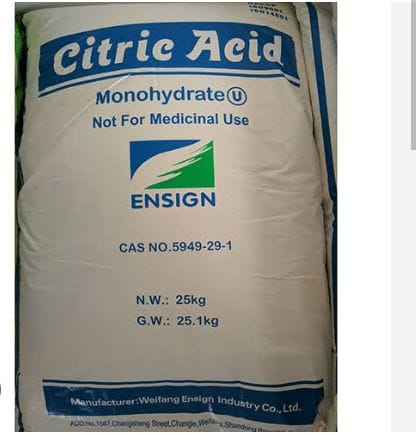
Citric Acid Supplier in Nairobi, Kenya, Uganda & Tanzania
Are you looking for a reliable citric acid supplier in Nairobi, Kenya, for food processing, beverage production, detergent manufacturing, cosmetics or industrial applications? Olinc Chemical Suppliers serves businesses looking for chemical supply solutions for their production and operational needs.
Citric acid is a versatile organic acid widely used as an acidity regulator, pH adjuster, flavour enhancer and cleaning ingredient. It is found naturally in citrus fruits and is also commercially manufactured for use across food, beverage, pharmaceutical, personal-care and industrial sectors.
Whether you are a food manufacturer, beverage producer, detergent manufacturer, cleaning-product formulator or industrial buyer, choosing the correct citric acid form and grade is essential for achieving the required results.
Olinc Chemical Suppliers welcomes enquiries from businesses in Nairobi and across Kenya, as well as buyers in Uganda and Tanzania. Contact our team to confirm current availability, grade, packaging, specifications and pricing for your intended application.
What Is Citric Acid?
Citric acid is a weak organic acid with the chemical formula C₆H₈O₇. It is naturally present in lemons, oranges, limes and other citrus fruits, but commercial citric acid is commonly produced through controlled fermentation processes.
It is widely used because it can lower pH, regulate acidity, contribute a sour taste to foods and beverages, and help bind certain metal ions. In cleaning applications, it can help dissolve mineral deposits such as limescale.
Citric acid is commonly identified as E330 or INS 330 when used as a food additive in accordance with applicable food regulations.
Citric acid product information
| Property | Details |
|---|---|
| Product name | Citric Acid |
| Chemical name | 2-hydroxypropane-1,2,3-tricarboxylic acid |
| Chemical formula | C₆H₈O₇ |
| Common name | Sour salt |
| Food additive number | E330 / INS 330 |
| Anhydrous CAS number | 77-92-9 |
| Monohydrate CAS number | 5949-29-1 |
| Appearance | Usually white or colourless crystalline powder or granules |
| Taste | Sour |
| Solubility | Soluble in water; solubility depends on temperature and form |
| Chemical type | Weak organic acid |
| Common applications | Food processing, beverages, detergents, cleaning products and manufacturing |
Important: Citric acid is not the same as ascorbic acid (vitamin C). Although both are organic acids used in food applications, they have different chemical properties and functions.
Types of Citric Acid Available
One of the most important things buyers should understand is the difference between citric acid anhydrous and citric acid monohydrate.

Citric Acid Anhydrous
Citric acid anhydrous contains no water of crystallisation in its chemical formula. It has the formula C₆H₈O₇ and a molar mass of approximately 192.12 g/mol.
It is used in food processing, beverages, pharmaceutical formulations and industrial applications where the anhydrous form is specified.

Citric Acid Monohydrate
Citric acid monohydrate contains one molecule of water of crystallisation per citric acid molecule. Its formula is C₆H₈O₇·H₂O, and its molar mass is approximately 210.14 g/mol.
It is widely used in food, beverage, cleaning and other formulations where this form meets the required specification.
What is the difference between anhydrous and monohydrate citric acid?
Both forms provide citric acid, but they differ in their water content and molecular mass. Consequently, equal weights do not contain exactly the same amount of citric acid on a molar basis.
| Feature | Anhydrous | Monohydrate |
|---|---|---|
| Chemical formula | C₆H₈O₇ | C₆H₈O₇·H₂O |
| Water of crystallisation | None | One molecule |
| Molar mass | Approximately 192.12 g/mol | Approximately 210.14 g/mol |
| Common applications | Food, beverages and industrial formulations | Food, beverages and industrial formulations |
| Selection | Where anhydrous is specified | Where monohydrate is specified |
Neither form is automatically better for every application. Choose according to your formulation, required concentration, product specification and manufacturing process. If substituting one form for the other, adjust the formulation appropriately.
Main Uses of Citric Acid
Citric acid is used in many industries because it performs several functions, including acidity regulation, pH adjustment, flavour enhancement and mineral deposit removal.
Food processing and manufacturing
Citric acid is widely used in food manufacturing as an acidity regulator and flavouring ingredient.
Applications include:
-
Processed foods and packaged products
-
Sauces, dressings and condiments
-
Jams, jellies and fruit preparations
-
Sweets, confectionery and sour candies
-
Canned fruits and vegetables
-
Selected dairy and processed food formulations
-
Food products requiring controlled acidity
Citric acid can help create a consistent sour taste and adjust the acidity of a formulation. Its effect on preservation depends on the complete recipe, pH, processing method and storage conditions.
Manufacturers should select a food-grade product that complies with the applicable food safety and regulatory requirements.
Beverage manufacturing
Beverage producers use citric acid to regulate acidity and achieve a balanced flavour profile.
It may be used in:
-
Soft drinks and carbonated beverages
-
Fruit-flavoured drinks
-
Juice-based beverages
-
Powdered drink mixes
-
Energy and sports drink formulations
-
Syrups and beverage concentrates
The amount required depends on the beverage recipe, target pH, desired sourness and other ingredients. Formulators should conduct appropriate testing to maintain consistency between production batches.
Detergent and cleaning product manufacturing
Citric acid is an important ingredient in certain cleaning formulations because it can help dissolve mineral deposits and bind metal ions.
Common applications include:
-
Descaling products
-
Bathroom and sanitary cleaning formulations
-
Selected kitchen cleaning products
-
Hard-water deposit removers
-
Household cleaning products
-
Industrial cleaning formulations
It can help remove limescale and mineral deposits from compatible surfaces. However, acidic cleaners may damage marble, limestone, cement-based surfaces and certain metals. Always check material compatibility before use.
Soap and cosmetics manufacturing
Citric acid can be used in selected personal-care and cosmetic formulations to adjust pH or perform other formulation-specific functions.
Potential applications include:
-
Selected shampoos and hair-care products
-
Liquid soaps and body washes
-
Skin-care formulations
-
Bath and personal-care products
-
Cosmetic formulations requiring pH adjustment
Its use must be carefully controlled because the suitable pH depends on the finished product and its ingredients. Adding citric acid directly to soap or cosmetic formulations without testing can change product performance or stability.
Pharmaceutical applications
Citric acid is used in certain pharmaceutical formulations as an acidity regulator, buffering ingredient or component of effervescent products.
The appropriate grade must meet the relevant pharmaceutical quality requirements. Industrial-grade or general-purpose citric acid should not be assumed suitable for pharmaceutical manufacturing.
Water treatment and industrial processing
Citric acid may be used in selected industrial water treatment, equipment cleaning and processing operations.
Examples include:
-
Removing certain mineral deposits from compatible equipment
-
Cleaning selected industrial surfaces and components
-
Controlling acidity in specific process solutions
-
Binding metal ions in suitable formulations
-
Selected textile and manufacturing processes
Its suitability depends on the equipment material, water chemistry, contaminants and cleaning procedure. For specialised applications, confirm compatibility with the equipment manufacturer or process engineer.
Food-Grade vs Industrial-Grade Citric Acid
When purchasing citric acid, it is important to identify the intended application before selecting the grade.
Food-grade citric acid
Food-grade citric acid is intended for food and beverage applications when it meets the relevant purity specifications and applicable regulations.
It may be used in food manufacturing, beverages, confectionery, sauces and other suitable food products.
Buyers should verify the product’s documentation, applicable food additive requirements and supplier handling arrangements.
Industrial-grade citric acid
Industrial-grade citric acid is intended for suitable non-food applications, such as cleaning products, descaling formulations and selected manufacturing processes.
The required purity and impurity limits depend on the application. Industrial grade should not be substituted for food-grade citric acid in food production.
Which grade should you choose?
-
Food and beverages: Specify food grade and the relevant compliance requirements.
-
Cleaning products: Select a grade that meets the formulation and performance specifications.
-
Cosmetics and personal care: Confirm the purity, documentation and suitability required for the finished product.
-
Pharmaceuticals: Require the relevant pharmaceutical specification and documentation.
-
Industrial processing: Choose according to the process requirements and technical data sheet.
When requesting a quotation from Olinc Chemical Suppliers, mention your intended application so the appropriate grade can be confirmed.
Physical and Chemical Properties
Understanding the properties of citric acid helps manufacturers and other buyers determine how it may perform in their applications.
-
Appearance: Typically white or colourless crystals or crystalline powder.
-
Odour: Generally odourless.
-
Acidity: A weak organic acid with three ionisable carboxylic acid groups.
-
Water solubility: Readily soluble in water; the exact solubility depends on temperature and product form.
-
Flavour: Sour, which makes it useful in suitable food and beverage formulations.
-
Chelating ability: Can bind certain metal ions, supporting its use in selected cleaning and formulation applications.
-
pH effect: Lowers pH when added in appropriate quantities to a solution, depending on the solution’s buffering capacity.
-
Forms: Commonly supplied as anhydrous or monohydrate.
Exact assay, moisture content, particle size and other numerical specifications should be confirmed from the supplier’s technical data sheet or certificate of analysis.
Packaging and Bulk Supply
Citric acid is commonly supplied in sealed industrial packaging. 25 kg bags are a common commercial packaging format, but the actual sizes and availability should be confirmed before ordering.
Olinc Chemical Suppliers welcomes enquiries from buyers seeking citric acid for regular production, wholesale distribution or bulk industrial requirements.
When enquiring, please specify:
-
Required form: anhydrous or monohydrate
-
Required grade: food, industrial or another specified grade
-
Quantity required in kilograms or bags
-
Preferred packaging
-
Delivery location
-
Any required technical documentation
For large orders, it is useful to confirm the required delivery schedule and whether the packaging is suitable for your storage conditions.
Storage and Safe Handling
Citric acid is widely used in commercial and industrial settings, but appropriate storage and handling remain important.
Storage recommendations
-
Keep the product in a cool, dry and well-ventilated area.
-
Keep bags tightly closed when not in use.
-
Protect the product from moisture and contamination.
-
Store in clean, properly labelled packaging.
-
Follow the manufacturer’s recommendations and the product’s safety data sheet.
-
For food-grade products, maintain suitable storage hygiene and prevent cross-contamination.
Handling precautions
Citric acid dust may irritate the eyes, skin and respiratory tract. Prolonged or repeated exposure can increase irritation.
Recommended precautions include:
-
Wear appropriate protective gloves and safety goggles.
-
Avoid breathing dust during handling and mixing.
-
Use suitable ventilation and dust-control practices.
-
Wash hands after handling.
-
Follow the product’s SDS and workplace safety procedures.
If contact with the eyes occurs, rinse cautiously with clean water and follow the product’s first-aid guidance. Seek medical attention if symptoms persist or are severe.
Citric Acid Supplier in Nairobi, Kenya, Uganda and Tanzania
Olinc Chemical Suppliers serves customers looking for industrial and commercial chemicals in Nairobi, Kenya, and welcomes enquiries from buyers across the wider East African market.
If your business is based in Nairobi, Mombasa, Kisumu or another part of Kenya, contact us to enquire about citric acid availability and supply arrangements.
Buyers in Uganda and Tanzania can also enquire about product specifications, pricing, bulk orders and possible delivery arrangements. Cross-border transport, delivery timelines and availability should be confirmed for each order.
Whether you are sourcing citric acid for food processing, beverage production, cleaning products or industrial use, providing your requirements upfront helps us respond to your enquiry more effectively.
Frequently Asked Questions About Citric Acid
What is citric acid used for?
Citric acid is used in food processing, beverage manufacturing, confectionery, cleaning products, descaling, cosmetics, selected pharmaceutical formulations and industrial processing. Its function depends on the application and grade.
What is another name for citric acid?
Citric acid is also known by its chemical name, 2-hydroxypropane-1,2,3-tricarboxylic acid. In food applications, it is commonly identified as E330 or INS 330. It should not be confused with ascorbic acid, also known as vitamin C.
What is the difference between citric acid anhydrous and monohydrate?
Anhydrous citric acid contains no water of crystallisation, while monohydrate contains one molecule of water of crystallisation per molecule of citric acid. Their molecular masses differ, so formulations may need adjustment when switching between the two forms.
Is citric acid food grade?
Citric acid is available in food-grade forms, but not every product sold as citric acid is automatically suitable for food manufacturing. Confirm the grade, specifications and applicable compliance documentation before use in food or beverages.
Can citric acid be used in detergent manufacturing?
Yes. It is used in certain cleaning formulations for pH adjustment, mineral deposit removal and metal-ion binding. The formulation must be compatible with the intended surface and cleaning conditions.
Can citric acid remove limescale?
Citric acid can help dissolve many mineral deposits, including limescale, on compatible surfaces. Test the cleaning method first and avoid acid-sensitive materials such as marble and limestone.
Is citric acid the same as baking soda?
No. Citric acid is an acid, while baking soda is sodium bicarbonate, an alkaline compound. They react when mixed in water, releasing carbon dioxide gas. They have different properties and are not interchangeable.
How is citric acid packaged?
Citric acid is commonly supplied in sealed bags, with 25 kg being a common commercial format. Actual packaging sizes and availability depend on the supplier and should be confirmed before ordering.
What is the price of citric acid in Kenya?
The price varies according to grade, form, quantity, packaging and delivery requirements. Contact Olinc Chemical Suppliers for a current quotation.
Can I buy citric acid in Uganda or Tanzania?
You can contact Olinc Chemical Suppliers to enquire about supply for Uganda and Tanzania. Product availability, transport, delivery schedules and any cross-border requirements must be confirmed for your order.
How do I order citric acid from Olinc Chemical Suppliers?
Share your required grade, form, quantity and delivery location with our team. We can then confirm current availability, specifications, packaging options and pricing for your enquiry.
Why Choose Olinc Chemical Suppliers?
Olinc Chemical Suppliers helps businesses source chemicals for commercial and industrial applications. We understand that buyers need more than a product name: they need the right grade, appropriate packaging, clear specifications and a quotation that matches their requirements.
When enquiring about citric acid, our team can help you clarify:
-
The required form: anhydrous or monohydrate
-
The intended application and grade
-
Available packaging and order quantities
-
Product specifications and documentation
-
Current pricing and possible delivery arrangements
Our aim is to make chemical sourcing straightforward for businesses in Nairobi and across Kenya, with enquiries from Uganda and Tanzania also welcome.
Request a Citric Acid Quotation
Looking for a citric acid supplier in Nairobi, Kenya? Contact Olinc Chemical Suppliers for current prices, packaging options, specifications and bulk supply enquiries.
Contact Olinc Chemical Suppliers
Location
Avon Business Center, Enterprise Road, Nairobi, Kenya
Phone / WhatsApp
0793062849
sales@olincinchemicals.com
Website
www.olincinchemicalsl.com



Reviews
There are no reviews yet.