
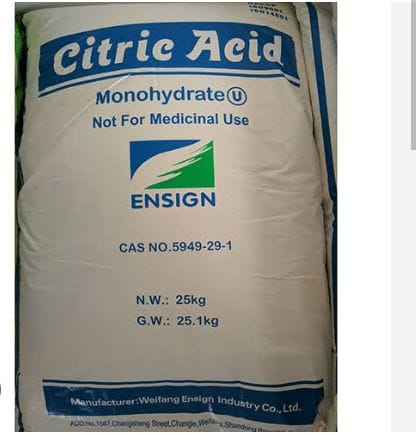
Citric Acid Supplier in Nairobi, Kenya
Are you looking for a reliable citric acid supplier in Nairobi, Kenya, for food processing, beverage manufacturing, detergent production, water treatment or other industrial applications? Olinc Chemical Suppliers welcomes enquiries from businesses looking for citric acid for their manufacturing and commercial requirements.
Citric acid is a versatile organic acid widely used to regulate acidity, enhance sour taste in food products, support product stability and help control mineral deposits in selected cleaning formulations. It occurs naturally in citrus fruits, including lemons and oranges, but commercially supplied citric acid is manufactured for consistent quality and large-scale industrial use.
Because of its versatility, citric acid is an important raw material for food and beverage producers, cleaning product manufacturers, cosmetics formulators, pharmaceutical manufacturers and various industrial businesses.
At Olinc Chemical Suppliers, we understand that buyers need clear information before making a purchase. This page explains what citric acid is, how it is used, the difference between its available forms, important specifications, storage requirements and factors affecting its price.
Whether you are sourcing citric acid for a production facility in Nairobi, another part of Kenya, or a business in Uganda or Tanzania, contact Olinc Chemical Suppliers to enquire about availability, grades, packaging and current quotations.
What Is Citric Acid?
Citric acid is a weak organic acid with the chemical formula C₆H₈O₇. It is commonly supplied as a white crystalline powder or colourless crystals with a characteristic sour taste.
It is widely recognised as food additive E330 or INS 330 when used as a food additive. International food additive references identify its functions as including acidity regulation, antioxidant support, colour retention and sequestration of certain metal ions. Its permitted uses depend on the food category and applicable regulations.
Citric acid is useful because it can adjust pH, contribute acidity to formulations and bind certain metal ions. These properties make it valuable in both food and non-food applications.
For example, beverage manufacturers may use citric acid to create a balanced sour taste, while cleaning product manufacturers may use it in formulations designed to remove selected mineral deposits and limescale.
Although citric acid is often associated with lemons, commercial citric acid should be purchased according to the required grade and specification, rather than simply by its name or appearance.
Citric Acid Product Identification
| Property | Description |
|---|---|
| Product name | Citric Acid |
| Chemical formula | C₆H₈O₇ |
| Chemical type | Organic acid |
| CAS number — anhydrous | 77-92-9 |
| CAS number — monohydrate | 5949-29-1 |
| Food additive number | E330 / INS 330 |
| Appearance | White crystalline powder or crystals |
| Taste | Sour |
| Water solubility | Soluble in water |
| Common forms | Anhydrous and monohydrate |
| Common functions | Acidity regulation, chelation and descaling in suitable applications |
| Packaging | Confirm current available pack sizes with Olinc Chemical Suppliers |
The CAS numbers for the two common forms differ, so buyers should check the product documentation to ensure that the supplied form matches their manufacturing requirements.
Other Names for Citric Acid
Customers may search for citric acid using different names. The following terms can help identify the product:
-
Citric acid
-
Citric acid powder
-
Food-grade citric acid
-
Industrial citric acid
-
Anhydrous citric acid
-
Citric acid monohydrate
-
2-hydroxypropane-1,2,3-tricarboxylic acid
-
Sour salt, a common informal name in some markets
These terms do not all describe identical specifications. In particular, anhydrous citric acid and citric acid monohydrate differ in their water content and should be selected according to the formulation or process.
Main Uses of Citric Acid
Citric acid is used across several industries because it can regulate acidity, contribute flavour, bind selected metal ions and help dissolve certain mineral deposits.
Food Processing and Manufacturing
Food-grade citric acid is used in suitable food products to adjust acidity, provide a sour taste and support product quality.
Applications may include:
-
Sweets and confectionery
-
Jams, jellies and fruit preparations
-
Sauces, dressings and condiments
-
Processed foods
-
Selected canned and packaged foods
-
Baking and other food formulations
Its role varies by recipe and product category. Food manufacturers should confirm the applicable permitted uses and usage levels before incorporating citric acid into commercial products.
Beverage Manufacturing
Citric acid is commonly used in suitable beverage formulations to create or balance acidity and improve flavour consistency.
Applications may include:
-
Soft drinks
-
Fruit-flavoured drinks
-
Juice drinks and concentrates
-
Drink powders
-
Syrups
-
Sports and other formulated beverages
The quantity required depends on the recipe, desired acidity, other ingredients and processing conditions. Citric acid is not a substitute for a validated preservation process where microbial safety is required.
Detergent and Cleaning Product Manufacturing
Citric acid is used in selected household and industrial cleaning formulations.
Depending on the formulation, it may help:
-
Adjust the pH of cleaning products.
-
Remove or loosen certain mineral deposits.
-
Reduce the effects of hard-water minerals.
-
Bind selected metal ions.
-
Support the performance of other ingredients.
It may be incorporated into some descaling products, bathroom cleaners, dishwashing formulations and specialised cleaning preparations.
Formulators should assess material compatibility, particularly when using acidic products on metals, natural stone, cement-based surfaces or sensitive finishes.
Limescale and Mineral Deposit Removal
Citric acid can help dissolve certain deposits containing calcium and other minerals. This makes it useful in selected descaling and cleaning products.
Potential applications include cleaning compatible equipment, selected appliances and surfaces affected by mineral build-up.
However, it is not suitable for every surface or piece of equipment. Always check the manufacturer’s instructions, test compatibility and follow the product’s safety guidance before using an acidic cleaner.
Cosmetics and Personal Care Products
Citric acid may be used in selected personal care formulations, including shampoos, liquid soaps, creams and lotions.
Its possible functions include:
-
Adjusting product pH.
-
Helping maintain the desired acidity.
-
Supporting formulation stability.
-
Binding certain metal ions in compatible systems.
Cosmetic formulators must use material suitable for the intended application and validate the finished product’s stability, compatibility and safety.
Pharmaceutical Manufacturing
Citric acid has uses in selected pharmaceutical formulations, depending on the product design and required quality standards.
It may help adjust acidity or contribute to buffering systems when used with suitable ingredients. Pharmaceutical buyers should specify the applicable pharmaceutical or compendial requirements and obtain supporting documentation.
Food-grade or general industrial material should not automatically be assumed suitable for pharmaceutical production.
Water Treatment and Industrial Processes
Citric acid may be used in selected industrial processes where acidity adjustment, mineral control or removal of certain deposits is required.
Possible applications include specialised equipment cleaning, process cleaning and selected water-system maintenance procedures.
The correct treatment chemical depends on water chemistry, equipment materials, the type of deposit and the treatment objective. Citric acid should not be treated as a universal water disinfectant or a replacement for a properly designed water treatment programme.
Textile and Other Manufacturing Applications
Citric acid may have roles in selected textile processing, formulation and manufacturing operations where acidity adjustment or metal-ion control is required.
Its suitability depends on the process conditions, material compatibility and the quality specifications of the final product.
Industrial customers should provide their intended application when requesting a quotation so they can identify the most appropriate product specification.
Benefits of Citric Acid
Citric acid offers several practical benefits in applications where its chemical properties are appropriate.
Effective acidity control: It helps manufacturers adjust pH and achieve the desired acidity in suitable formulations.
Flavour enhancement: In food and beverage products, it contributes a sour taste and helps balance flavour.
Chelating properties: It can bind certain metal ions, which may help manage metal-related effects in selected formulations.
Descaling capability: It can help dissolve certain mineral deposits in compatible cleaning applications.
Versatile use: It serves a range of food, cleaning, cosmetic and industrial applications when the appropriate grade is selected.
Water solubility: Its solubility makes it convenient for many water-based production processes.
The actual benefit depends on the grade, concentration, formulation, process conditions and intended use.
Types of Citric Acid: Anhydrous vs Monohydrate
One of the most important decisions when buying citric acid is selecting the correct physical form.

1. Anhydrous Citric Acid
Anhydrous citric acid contains no water of crystallisation in its chemical form. It is used in applications where its specific moisture characteristics and formulation behaviour are required.
Buyers should confirm its specification and suitability for their process, particularly when moisture content affects the finished product.

2. Citric Acid Monohydrate
Citric acid monohydrate contains one molecule of water of crystallisation per molecule of citric acid. It is widely used in suitable food and other formulations.
The presence of water of crystallisation affects its mass-based composition, so manufacturers should use the correct formulation calculations for the selected form.
Which one should you buy? Choose the form specified by your recipe, process or technical requirements. If you are unsure, share your application with Olinc Chemical Suppliers before ordering.
Citric Acid Grades: Food Grade and Industrial Grade
Different applications require different levels of quality assurance and documentation.
Food Grade Citric Acid
Food-grade citric acid is intended for food and beverage applications when it meets the applicable food additive specifications.
Buyers should confirm that the material meets the relevant standards and request appropriate quality documentation. Its use must comply with the regulations for the particular food product and market.
Pharmaceutical or Special-Specification Grade
Some applications require citric acid that complies with a specific pharmacopoeial standard or customer specification.
The buyer should identify the required standard before purchasing and verify the supplier’s documentation. General food-grade material is not automatically equivalent to pharmaceutical-grade material.
Industrial Grade Citric Acid
Industrial-grade citric acid is used in compatible non-food processes, such as certain cleaning, descaling and manufacturing applications.
It should not be used for food, pharmaceutical or other regulated applications unless it has been specifically qualified for that purpose.
Availability note: These are common buyer categories, not a confirmation that every grade is currently stocked by Olinc Chemical Suppliers. Please enquire about the available grade and documentation.
Citric Acid Specifications and Quality Requirements
When buying citric acid in bulk, it is important to check the product specifications instead of relying only on its appearance or product name.
Key quality parameters may include:
-
Assay or purity: Confirms the citric acid content against the applicable specification.
-
Appearance: Checks that the product meets the specified physical appearance requirements.
-
Moisture content: Especially important when selecting between anhydrous and monohydrate forms.
-
Acidity and pH: Relevant to the intended formulation and quality-control requirements.
-
Impurity limits: May include chloride, sulphate, oxalate, heavy metals or other parameters specified for the grade.
-
Particle size: May matter for dissolving, mixing and production requirements.
-
Documentation: Technical data sheet (TDS), safety data sheet (SDS) and certificate of analysis (CoA), where applicable.
Exact numerical limits depend on the grade and specification. Buyers should request the documentation for the actual product being supplied rather than assume that all citric acid products have identical specifications.
Citric Acid Packaging and Storage
Packaging options
Citric acid is commonly supplied in sealed bags or other suitable moisture-resistant packaging. The actual packaging available depends on the supplier, product grade and order quantity.
When contacting Olinc Chemical Suppliers, specify the quantity you require and whether the product is intended for food, cleaning or industrial manufacturing. We can confirm the available packaging options and current quotation details.
How to store citric acid
For good product quality and storage stability:
-
Store in a cool, dry and well-ventilated area.
-
Keep the packaging tightly closed when not in use.
-
Protect the product from moisture and contamination.
-
Store in a clean, clearly labelled area.
-
Keep food-grade material separate from chemicals that could contaminate it.
-
Follow the manufacturer’s storage recommendations and the current SDS.
Citric acid should be handled using clean, dry equipment when contamination or moisture could affect the final formulation.
Safety and Handling Precautions
Citric acid is widely used in food and industrial applications, but concentrated material and airborne dust can still present handling risks. Dust may irritate the eyes, respiratory tract or skin.
Recommended precautions include:
-
Avoid creating or breathing dust.
-
Wear suitable eye protection and protective gloves.
-
Use appropriate ventilation when handling large quantities.
-
Wash hands after handling.
-
Avoid contact with the eyes.
-
Follow the product SDS for spill response, first aid and disposal.
-
Assess compatibility before using citric acid in cleaning or descaling applications.
Do not mix citric acid with bleach or sodium hypochlorite. Acidifying hypochlorite solutions can release hazardous chlorine gas. Cleaning chemicals should only be combined when the product instructions explicitly confirm compatibility.
Buying Citric Acid in Nairobi, Kenya
Olinc Chemical Suppliers welcomes enquiries from food processors, beverage manufacturers, cleaning product producers, distributors and industrial buyers looking for citric acid in Nairobi, Kenya.
When requesting a quotation, please provide:
-
The type of citric acid required: anhydrous or monohydrate, if specified.
-
The grade required.
-
The quantity needed.
-
Any technical specifications or documentation requirements.
-
Your delivery location.
-
Your preferred packaging, if applicable.
Providing these details helps us assess your requirements and confirm the most suitable available product.
Citric Acid Supply Enquiries for Uganda and Tanzania
Businesses in Uganda and Tanzania can also contact Olinc Chemical Suppliers to enquire about citric acid supply arrangements.
We welcome enquiries from commercial buyers in locations such as Kampala, Jinja, Entebbe, Dar es Salaam, Arusha and Mwanza, as well as other destinations in the region.
For cross-border enquiries, include your destination and required quantity. Transport costs, customs procedures, import requirements and product documentation should be confirmed before an order is finalised.
Why Buy Citric Acid from Olinc Chemical Suppliers?
Olinc Chemical Suppliers serves customers seeking industrial and specialty chemicals in Nairobi, Kenya.
When enquiring about citric acid, our team can assist you with:
-
Checking current product availability.
-
Requesting a quotation for your required quantity.
-
Confirming available grades and physical forms.
-
Enquiring about packaging options.
-
Identifying relevant technical documentation.
-
Discussing collection and delivery arrangements.
Our goal is to help you identify the product specification that fits your application and make an informed purchasing decision.
Frequently Asked Questions About Citric Acid
What is citric acid used for?
Citric acid is used for acidity regulation in foods and beverages, flavour adjustment, selected cleaning and descaling products, cosmetics, pharmaceutical formulations and various industrial processes.
What is the chemical formula of citric acid?
The chemical formula is C₆H₈O₇.
What is the CAS number for citric acid?
The CAS number is 77-92-9 for anhydrous citric acid and 5949-29-1 for citric acid monohydrate
Is citric acid the same as E330?
E330 is the food additive number commonly used to identify citric acid. Its permitted applications and conditions of use depend on the applicable food regulations.
Is citric acid the same as lemon salt?
Citric acid is sometimes informally called lemon salt or sour salt. However, buyers should check the ingredient label and product specification to ensure that the material is actually citric acid.
What is the difference between anhydrous citric acid and monohydrate?
Anhydrous citric acid does not contain water of crystallisation in its chemical form, whereas citric acid monohydrate contains one molecule of water of crystallisation. The correct form depends on the intended application and formulation requirements.
Is citric acid suitable for food manufacturing?
Yes, when the material meets the applicable food-grade requirements and is used in accordance with the regulations governing the particular food product. Industrial-grade citric acid should not automatically be used in food.
Can citric acid be used in detergent manufacturing?
Citric acid can be used in selected detergent and cleaning formulations for pH adjustment, mineral-ion control and other formulation purposes. Compatibility and performance should be tested for the intended product.
Can citric acid remove limescale?
It can help dissolve certain calcium-containing mineral deposits. Its suitability depends on the deposit, surface material and cleaning conditions. Always check material compatibility before use.
Is citric acid available in powder form?
Commercial citric acid is commonly supplied as a white crystalline powder or crystals. The exact particle characteristics depend on the product specification.
How much does citric acid cost in Kenya?
Pricing depends on grade, physical form, quantity, packaging, availability and delivery location. Contact Olinc Chemical Suppliers for a current quotation.
Where can I buy citric acid in Nairobi?
You can contact Olinc Chemical Suppliers at Enterprise Road, Avon Business Center, Nairobi, Kenya, to enquire about availability, specifications, pricing and packaging.
Can I enquire about bulk supply to Uganda and Tanzania?
Yes. Customers can enquire about supply arrangements for Uganda and Tanzania. Availability, transport costs and cross-border requirements should be confirmed for each order.
What information should I provide when ordering citric acid?
Provide the required grade, physical form, quantity, application, destination and any technical specifications. This makes it easier to assess whether the available product meets your needs.
Request a Citric Acid Quotation from Olinc Chemical Suppliers
Are you looking for a dependable source of citric acid for food processing, beverage production, cleaning products or industrial manufacturing?
Contact Olinc Chemical Suppliers to enquire about current availability, pricing, grades, packaging and bulk orders.
-
Business name: Olinc Chemical Suppliers
-
Location: Enterprise Road, Avon Business Center, Nairobi, Kenya
-
Email: sales@olincinchemicals.com
-
Phone/WhatsApp: 0793062849
-
Website: www.olincinchemicalsl.com
Whether you need citric acid for a small production run or a larger commercial order, share your requirements with our team for a quotation.
Olinc Chemical Suppliers — serving citric acid supply enquiries across Nairobi, Kenya, Uganda and Tanzania.


Reviews
There are no reviews yet.