
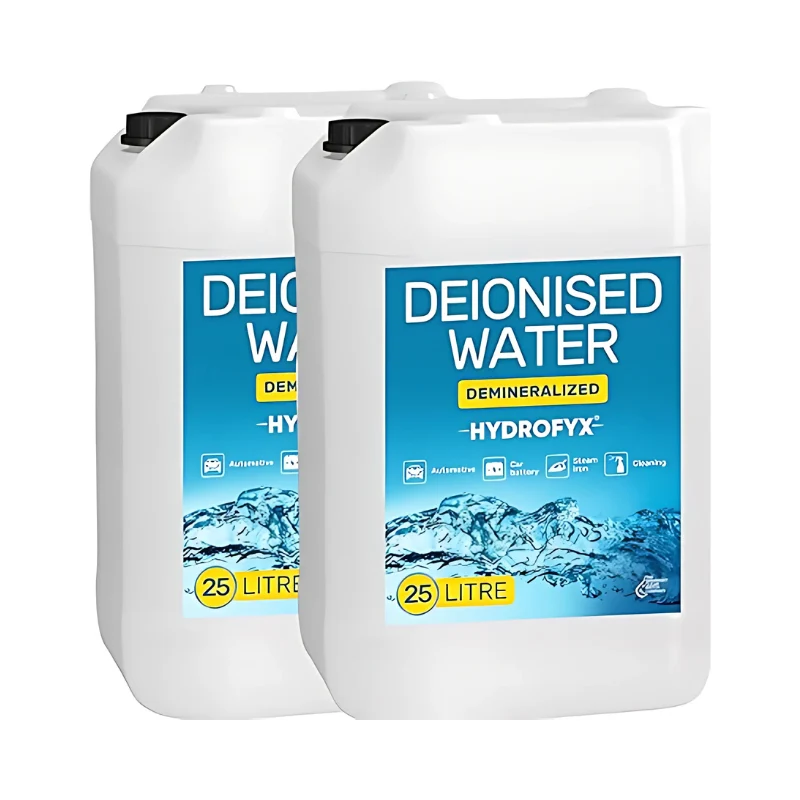
Deionised Water Supplier in Kenya | Olinc Chemical Suppliers
What Is Deionised Water?
Deionised Water (DI Water) is purified water from which dissolved mineral ions and electrically charged impurities have been removed through a specialised purification process known as deionisation or ion exchange.
Ordinary water naturally contains dissolved minerals and salts such as calcium, magnesium, sodium, chloride, sulphates and other ionic substances. Although these minerals are naturally present in drinking and industrial water, they can cause problems in applications that require water with low mineral content.
Deionised water is produced by passing water through specialised ion-exchange resins that remove positively and negatively charged ions. The result is water with significantly reduced dissolved ionic impurities and electrical conductivity.
Unlike ordinary tap water, which contains varying concentrations of dissolved minerals, DI water is particularly useful in laboratories, battery maintenance, manufacturing, cosmetics, industrial processes and equipment requiring low-mineral water.
At Olinc Chemical Suppliers, we cater to customers looking for Deionised Water in Nairobi, Kenya, with enquiries and supply arrangements for businesses across Uganda and Tanzania.
Whether you need DI water for laboratory work, industrial applications, battery maintenance, chemical preparation or manufacturing, understanding the correct water specification is essential before purchasing.
Other Names for Deionised Water
Customers may encounter several names when searching for this product. Understanding these terms makes it easier to identify the correct water type.
-
Deionised Water
-
Deionized Water (American spelling)
-
DI Water
-
Demineralised Water
-
Demineralized Water
-
Demin Water
-
De-ionised Water
-
Ion-Free Water (informal description)
-
Low-Ionic Water
-
Deionised Process Water
Important distinction: Distilled water, reverse osmosis water and deionised water are related purified-water products, but they are not identical. Their production methods and impurity profiles differ.
Battery water, laboratory water and pharmaceutical-grade purified water should also not automatically be treated as interchangeable. Always select water according to the required application and specification.
Chemical Properties and Characteristics of Deionised Water
Deionised water has distinctive properties that make it useful in applications where dissolved mineral ions must be minimised.
|
Property |
Description |
|---|---|
|
Chemical formula |
H₂O |
|
Appearance |
Clear, colourless liquid |
|
Odour |
Odourless |
|
Taste |
Not intended for drinking unless separately certified |
|
Dissolved ionic content |
Significantly reduced |
|
Electrical conductivity |
Low compared with ordinary tap water |
|
Mineral content |
Greatly reduced |
|
Calcium and magnesium |
Greatly reduced |
|
Physical state |
Liquid |
|
pH |
Variable; often influenced by absorbed carbon dioxide |
|
Main characteristic |
Low concentration of dissolved ions |
What makes DI water different from ordinary water?
Ordinary tap water contains dissolved minerals and salts. These substances can contribute to scaling, unwanted chemical reactions, electrical conductivity and contamination in sensitive processes.
Deionised water has significantly fewer dissolved ions, making it more suitable for applications where mineral deposits or ionic contamination must be controlled.
Note: Deionisation removes ions but does not necessarily remove bacteria, viruses, dissolved organic compounds, particles or all other contaminants. DI water is not automatically sterile or pharmaceutical-grade water.
Main Uses and Applications of Deionised Water
Deionised water is used across several industries because it minimises the introduction of dissolved mineral ions into products, equipment and manufacturing processes.
Laboratory Applications
Its applications include:
-
Preparation of chemical solutions and reagents.
-
Dilution of laboratory chemicals.
-
Rinsing glassware and laboratory equipment.
-
Analytical and chemical testing.
-
Preparation of samples for selected laboratory procedures.
-
General laboratory cleaning and washing.
For sensitive analytical procedures, the required water purity may be higher than ordinary DI water. Laboratories should check conductivity, resistivity, organic content and microbiological specifications where relevant.
Battery Maintenance and Manufacturing
Applications include:
-
Topping up serviceable flooded lead-acid batteries.
-
Battery manufacturing processes.
-
Battery electrolyte preparation by qualified manufacturers.
-
Industrial battery maintenance.
Minerals such as calcium, magnesium and iron can negatively affect battery performance. Using appropriately specified low-mineral water helps reduce the risk of introducing these contaminants.
Important: Use only water meeting the battery manufacturer’s requirements. Never open or top up sealed, AGM or gel batteries unless the manufacturer specifically provides for it. DI water is not battery acid and should never be confused with battery electrolyte.
Cosmetic and Personal-Care Manufacturing
It is used in formulations such as:
-
Liquid soaps.
-
Shampoos.
-
Hair conditioners.
-
Body lotions.
-
Face creams.
-
Body washes.
-
Hand washes.
-
Cleaning and beauty formulations.
Using low-mineral water helps reduce unwanted interactions between dissolved minerals and other formulation ingredients.
For example, minerals in ordinary water can affect the performance of certain surfactants, emulsifiers and preservatives.
However, DI water does not act as a preservative. Cosmetic manufacturers must use an appropriate preservation system and maintain microbiological quality.
Pharmaceutical Manufacturing
Potential applications include:
-
Preparation of certain non-sterile formulations.
-
Equipment cleaning and rinsing.
-
Selected manufacturing processes.
-
Preparation of intermediate solutions.
Important: Ordinary deionised water is not automatically pharmaceutical purified water, Water for Injection (WFI) or sterile water. Pharmaceutical manufacturers must use water that meets the applicable pharmacopoeial and regulatory requirements for the intended use.
Industrial Manufacturing and Processing
Deionised water is used in selected processes involving:
-
Chemical manufacturing.
-
Industrial formulation and blending.
-
Equipment rinsing.
-
Process-water preparation.
-
Industrial cleaning.
-
Manufacturing of specialty products.
It is particularly useful where ordinary water could introduce minerals that affect product quality.
Steam Boilers and Industrial Heating Systems
Its low mineral content helps reduce the introduction of hardness salts that contribute to scale formation.
Potential benefits include:
-
Reduced mineral deposits.
-
Lower risk of hardness-related scaling.
-
Better control of feedwater chemistry.
-
Support for efficient heat transfer.
-
Reduced maintenance associated with mineral deposits.
However, DI water is not automatically suitable for direct boiler feeding. Proper deaeration, pH adjustment, oxygen control and other chemical treatment may still be required according to boiler operating conditions.
Automotive and Vehicle Applications
-
Preparation of compatible engine coolant mixtures.
-
Certain battery maintenance applications.
-
Selected vehicle cleaning and technical processes.
-
Equipment rinsing.
For coolant preparation, always follow the vehicle or coolant manufacturer’s instructions. Some coolants are supplied ready-mixed and should not be diluted.
Electronics and Electrical Manufacturing
The electronics industry requires water with controlled contamination levels because mineral residues can affect sensitive components.
DI water is used in selected processes such as:
-
Rinsing electronic components.
-
Cleaning selected circuit boards.
-
Manufacturing processes requiring low ionic contamination.
-
Equipment cleaning.
-
Preparation of selected industrial cleaning solutions.
For highly sensitive electronics applications, additional purification and strict quality control may be necessary.
Textile and Garment Manufacturing
Applications include:
-
Preparation of selected dye solutions.
-
Textile chemical formulation.
-
Equipment rinsing.
-
Specialised fabric processing.
It helps reduce mineral-related interference and supports consistency in processes requiring controlled water quality.
Paints, Coatings and Chemical Formulations
Manufacturers of water-based paints, coatings and specialty chemical products may use DI water to minimise unwanted mineral contamination.
It can be used in:
-
Water-based paint manufacturing.
-
Selected coating formulations.
-
Chemical dilution.
-
Specialty cleaning products.
-
Industrial chemical blending.
The appropriate water specification depends on the formulation and the manufacturer’s quality requirements.
Why Is Deionised Water Important in Manufacturing?
For manufacturers, the quality of water used in production can influence the performance, appearance and consistency of finished products.
Here are some of the main reasons businesses choose DI water.
Reduces mineral contamination
DI water contains significantly fewer dissolved mineral ions than ordinary tap water, helping prevent unwanted mineral introduction into products.
Helps prevent mineral deposits
It reduces the introduction of calcium and magnesium ions that contribute to scale formation in equipment and water systems.
Supports consistent product quality
Using water with controlled ionic content can help manufacturers maintain more consistent production results.
Supports sensitive chemical formulations
Some chemicals react with dissolved minerals. Low-ion water helps reduce these unwanted interactions.
Reduces unwanted residue
When appropriately specified and handled, DI water helps minimise mineral deposits left behind after rinsing and cleaning.
Improves process control
Manufacturers can work with a more controlled water input, making it easier to manage certain production specifications.
Difference Between Deionised, Distilled, Demineralised and Reverse Osmosis Water
This is one of the most important questions customers ask when purchasing purified water.
Although these products are often used for similar purposes, their purification methods are different.
1. Deionised Water (DI Water)
2. Distilled Water
3. Demineralised Water
4. Reverse Osmosis Water (RO Water)
|
Water type |
Main purification method |
|---|---|
|
Deionised water |
Ion exchange |
|
Distilled water |
Evaporation and condensation |
|
Demineralised water |
Mineral removal through different processes |
|
RO water |
Membrane filtration |
Which one should you choose?
-
Choose DI water when your process requires reduced dissolved ionic content.
-
Choose distilled water when your application specifies water produced through distillation.
-
Choose RO water when your application requires membrane-treated water.
-
Choose pharmaceutical or laboratory-grade purified water when your process requires a defined purity standard.
Remember that no single purification method guarantees removal of every type of contaminant.
Quality Grades and Specifications of Deionised Water
Not all deionised water has the same purity level. The correct grade depends on the intended application.
When purchasing DI water, it is important to know the required conductivity, resistivity and other quality parameters.
Important quality parameters
|
Parameter |
What it tells you |
|---|---|
|
Electrical conductivity |
Indicates the presence of dissolved ions |
|
Resistivity |
Indicates the electrical resistance of the water |
|
Total Dissolved Solids (TDS) |
Estimates the concentration of dissolved substances |
|
pH |
Indicates acidity or alkalinity |
|
Total Organic Carbon (TOC) |
Measures organic carbon contamination |
|
Microbiological quality |
Indicates microbial contamination |
|
Appearance |
Should be clear and free from visible particles |
Understanding conductivity and resistivity
Electrical conductivity is one of the most important indicators of DI water quality.
-
Lower conductivity generally indicates fewer dissolved ions.
-
Higher resistivity generally indicates fewer dissolved ions.
At 25°C, ultrapure water has a theoretical resistivity of approximately 18.2 MΩ·cm. This is a specialised high-purity benchmark, not a specification that should automatically be assumed for every commercial DI water product.
For ordinary industrial or battery applications, different specifications may be appropriate.
Olinc purchasing recommendation: Customers should specify their intended use when requesting DI water so that the appropriate quality and grade can be confirmed.
Packaging and Supply Options
Deionised water is generally supplied in clean, sealed containers suitable for transporting and storing purified water.


-
1-litre containers for small requirements.
-
5-litre containers.
-
10-litre containers.
-
20-litre jerrycans.
-
25-litre containers.
-
200-litre drums.
-
1,000-litre IBC tanks for bulk requirements.
Packaging availability depends on stock and the supplier’s arrangements.
Bulk supply
For businesses that consume large quantities of deionised water, bulk supply may be more economical and convenient.
Bulk customers can enquire about:
-
Regular supply requirements.
-
Large-volume orders.
-
Suitable storage containers.
-
Delivery arrangements.
-
Required water quality specifications.
Contact Olinc Chemical Suppliers to confirm the available packaging and quantities.
Storage and Handling of Deionised Water
Proper storage is essential because DI water can absorb contaminants from the surrounding environment and storage containers.
Unlike ordinary water, highly purified water can quickly pick up dissolved substances from unsuitable materials.
Recommended storage practices include:
-
Store in clean, tightly sealed containers.
-
Use suitable containers made from compatible materials such as appropriate HDPE or other approved plastics.
-
Keep away from dust, dirt and direct contamination.
-
Avoid storing in rusty metal containers.
-
Do not mix with ordinary tap water.
-
Keep containers away from chemicals and other contaminants.
-
Avoid unnecessary exposure to air.
-
Follow the supplier’s recommended storage conditions.
-
Use clean dispensing equipment.
Does Deionised Water Expire?
Deionised water does not have a conventional expiry date in the same way as many chemical products. However, its purity can deteriorate during storage due to contamination from containers, air, handling and microorganisms.
For this reason, buyers should follow the supplier’s recommended shelf life and storage conditions, particularly where conductivity or microbiological quality is important.
Safety and Precautions When Using Deionised Water
Deionised water is generally a low-hazard material, but its suitability depends on the intended application.
Important precautions include:
-
Use clean containers and dispensing equipment.
-
Avoid contamination during handling.
-
Do not assume DI water is sterile or suitable for drinking.
-
Follow the manufacturer’s specifications for battery, laboratory and industrial applications.
-
Use appropriate protective equipment when handling chemicals mixed with DI water.
-
Never confuse deionised water with battery acid or chemical electrolyte.
Important: DI water should not automatically be marketed as drinking water. Mineral removal alone does not establish microbiological safety or drinking-water compliance.
Why Buy Deionised Water from Olinc Chemical Suppliers?
When sourcing water for industrial, laboratory or manufacturing applications, reliability and consistent quality are important.
Olinc Chemical Suppliers provides chemical and industrial raw-material sourcing solutions for businesses across Kenya and the wider East African market.
Why contact Olinc for your deionised water requirements?
-
Convenient Nairobi location: We are located at Avon Business Center, Enterprise Road, Nairobi.
-
Industrial supply enquiries: We cater to customers requiring purified water for different industrial processes.
-
Different quantity requirements: Enquire about small-volume and bulk supply options.
-
Application guidance: Tell us how you intend to use the water so we can help establish the appropriate specification.
-
Regional market reach: We welcome enquiries from Kenya, Uganda and Tanzania.
-
Quotation support: Contact us for current prices, available packaging and supply arrangements.
Whether you operate a laboratory, battery maintenance business, cosmetic manufacturing facility, chemical production plant or industrial processing company, Olinc Chemical Suppliers can assist with your deionised water enquiries.
Frequently Asked Questions About Deionised Water
These questions address some of the most common concerns customers have when purchasing DI water.
What is deionised water used for?
Deionised water is used in laboratories, battery maintenance, cosmetic manufacturing, pharmaceutical processing, industrial cleaning, electronics manufacturing, chemical formulation and selected boiler-water systems.
Is deionised water the same as distilled water?
No. Deionised water is generally produced through ion exchange, while distilled water is produced through evaporation and condensation. Both reduce impurities, but their purity profiles can differ.
Is deionised water the same as demineralised water?
The terms are frequently used interchangeably in commercial markets. Both describe water with reduced dissolved mineral content, although the actual purification process and quality specifications may differ.
Can deionised water be used in car batteries?
It can be used in serviceable flooded lead-acid batteries when it meets the battery manufacturer’s water specifications. It should not be added to sealed or maintenance-free batteries.
Can DI water be used in laboratories?
Yes. It is commonly used for preparing solutions, diluting chemicals and rinsing laboratory equipment. Highly sensitive testing may require a higher specified water grade.
Can deionised water be used in liquid soap manufacturing?
Yes. It is suitable for many liquid soap and detergent formulations because it reduces the introduction of dissolved minerals that may interfere with surfactants and other ingredients.
Is deionised water suitable for making cosmetics?
It can be used as the water phase in many cosmetic formulations. However, manufacturers must ensure that the water meets the appropriate chemical and microbiological specifications.
Can deionised water be used in boilers?
Yes, where the boiler design and feedwater specifications permit it. Additional water treatment, including oxygen removal and chemical conditioning, may be necessary.
Does deionised water contain minerals?
It contains significantly reduced concentrations of dissolved mineral ions compared with ordinary water. The actual residual mineral content depends on the purification process and product specification.
Is deionised water safe to drink?
It is not automatically certified as drinking water. Deionisation does not guarantee the removal of microorganisms or all non-ionic contaminants. Only drink water that meets applicable drinking-water standards.
What is the conductivity of deionised water?
It varies according to the grade and purification process. Highly purified water can have very low conductivity, while ordinary industrial DI water may have higher conductivity. Always request the actual measured value.
What is the difference between DI water and RO water?
DI water is typically produced through ion exchange, while RO water uses membrane technology. DI water is particularly effective at reducing dissolved ions, whereas RO can remove a broader range of dissolved substances and particles.
Can deionised water be used for mixing chemicals?
Yes. It is commonly used for preparing chemical solutions and industrial formulations where low ionic contamination is required. The suitability depends on the chemicals and final product specifications.
Does deionised water leave mineral deposits?
It generally leaves fewer mineral deposits than ordinary tap water because it contains significantly fewer dissolved mineral ions. However, contamination during use or storage can introduce residues.
Where can I buy deionised water in Nairobi, Kenya?
You can contact Olinc Chemical Suppliers, located at Avon Business Center, Enterprise Road, Nairobi, for pricing, availability and packaging enquiries.
Can I purchase deionised water in bulk?
Yes. Customers requiring larger quantities can contact Olinc to enquire about bulk supply, available packaging and delivery arrangements.
Does Olinc supply deionised water to Uganda and Tanzania?
Olinc welcomes enquiries from customers in Uganda and Tanzania. Contact the sales team to confirm supply and delivery arrangements for your location.
Order Deionised Water from Olinc Chemical Suppliers
Are you searching for a dependable Deionised Water supplier in Nairobi, Kenya?
Olinc Chemical Suppliers welcomes enquiries from laboratories, manufacturers, battery maintenance businesses, cosmetic producers, industrial companies and wholesalers looking for deionised water.
Whether you need DI water for laboratory testing, chemical formulation, battery maintenance, industrial processing or manufacturing, contact us to discuss your requirements.
Request a quotation today!
Olinc Chemical Suppliers
Enterprise Road, Avon Business Center, Nairobi, Kenya
0793062849
sales@olincinchemicals.com
www.olincinchemicalsl.com

Reviews
There are no reviews yet.