
EDTA Disodium and Tetrasodium Supplier in Nairobi, Kenya, Uganda and Tanzania | Olinc Chemical Suppliers
Welcome to Olinc Chemical Suppliers, your chemical supply partner in Nairobi, Kenya. We serve businesses and manufacturers looking for industrial and speciality chemicals, including EDTA Disodium and EDTA Tetrasodium for detergent production, water treatment, cosmetics, personal care products, industrial cleaning and chemical manufacturing.
EDTA is a widely used chelating agent that binds metal ions such as calcium, magnesium, iron, copper and manganese. By controlling these metal ions, it helps prevent unwanted deposits, improves formulation stability and supports the performance of many industrial and household products.
If you are searching for an EDTA supplier in Nairobi, Kenya, or looking to buy EDTA Disodium or Tetrasodium in Uganda and Tanzania, Olinc Chemical Suppliers welcomes your enquiry.
We can help you establish the product form, grade, specifications, packaging and quantity required for your application. Contact us for current availability and a quotation.
What Is EDTA?
EDTA stands for Ethylenediaminetetraacetic Acid. It is an organic chemical compound and a powerful chelating agent. Its main function is to bind metal ions and form stable complexes with them.
EDTA is available in different chemical forms, including:
- EDTA Acid.
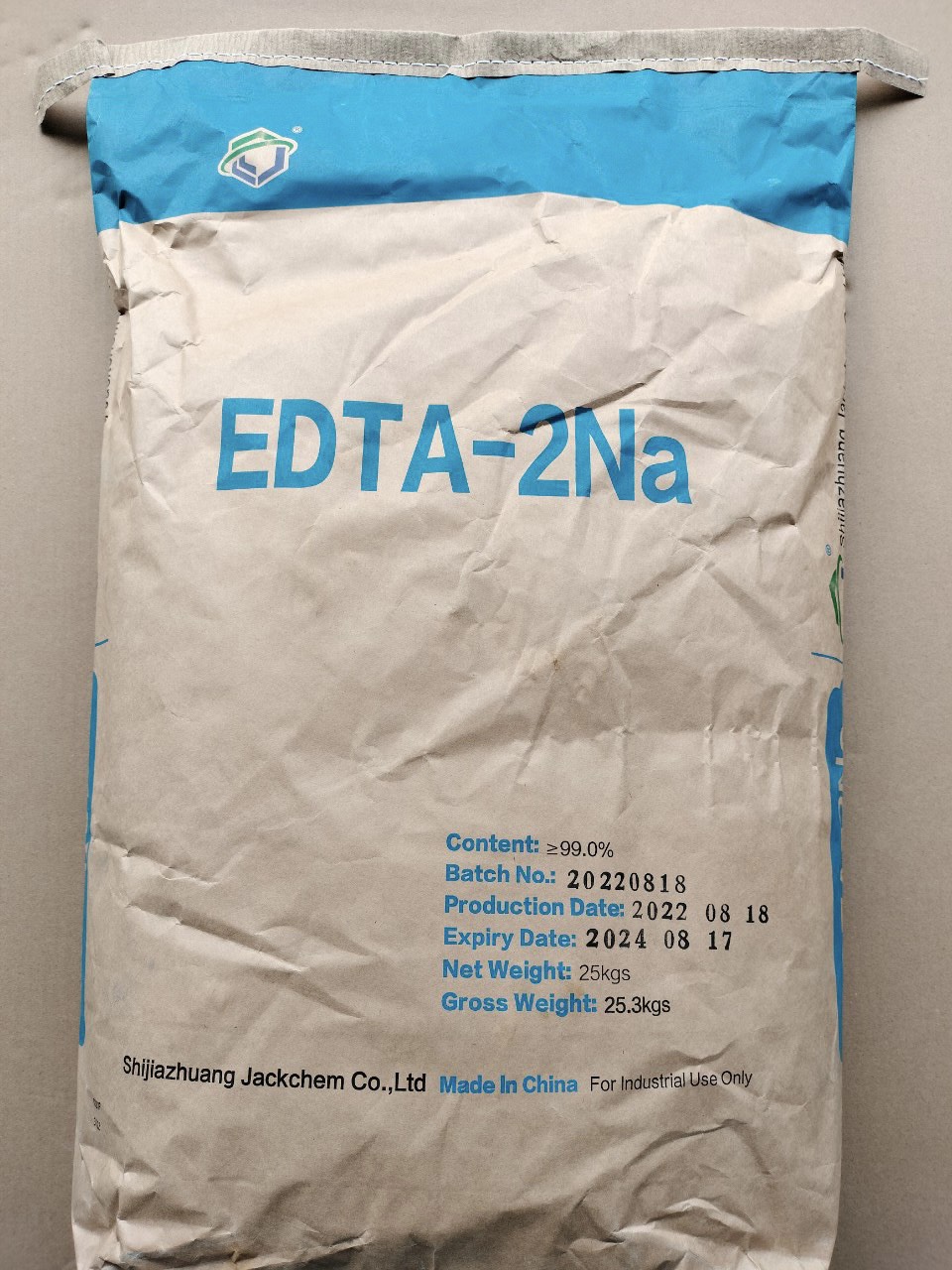
- EDTA Disodium (EDTA-2Na).
- EDTA Tetrasodium (EDTA-4Na).
- Other specialised EDTA salts, such as calcium disodium EDTA.
For industrial and formulation applications, EDTA Disodium and EDTA Tetrasodium are two commonly used forms.
Although they perform a similar chelating function, they are not identical. They differ in sodium content, solution pH, solubility characteristics and suitability for different formulations.
EDTA Disodium (EDTA-2Na)
EDTA Disodium is the disodium salt of ethylenediaminetetraacetic acid. It is commonly used as a chelating agent in personal care products, cosmetics, detergents, cleaning formulations and selected industrial processes.
It binds metal ions that could otherwise interfere with product performance, stability or appearance.
Chemical identification
| Property | Description |
|---|---|
| Product name | EDTA Disodium |
| Chemical name | Disodium ethylenediaminetetraacetate |
| Common names | Disodium EDTA, EDTA-2Na, EDTA 2 Sodium |
| Common commercial form | Disodium EDTA dihydrate |
| Formula (dihydrate) | C₁₀H₁₄N₂Na₂O₈·2H₂O |
| CAS number (dihydrate) | 6381-92-6 |
| Molecular weight (dihydrate) | Approximately 372.24 g/mol |
| Appearance | Usually white crystalline powder or crystals |
| Main function | Chelating and sequestering agent |
The anhydrous form has a different molecular weight and may be identified using a different CAS number. Always check the exact grade and hydration state on the supplier’s specification.
Main uses of EDTA Disodium
Cosmetics and personal care manufacturing
EDTA Disodium is used in cosmetic and personal care formulations to bind trace metal ions that may affect the stability, colour, fragrance or performance of a finished product.
Common formulation applications include:
- Shampoos.
- Hair conditioners.
- Liquid soaps.
- Body washes.
- Facial cleansers.
- Creams and lotions.
- Skin-care products.
- Selected cosmetic and hygiene formulations.
By controlling metal ions, EDTA can help reduce metal-related formulation changes and support product stability.
Detergent manufacturing
EDTA Disodium is used in selected detergent formulations to bind metal ions present in water and raw materials.
Hard water contains calcium and magnesium ions that can interfere with cleaning performance. Chelating agents help control these ions and reduce their unwanted effects.
Applications include selected liquid detergents, cleaning products and specialised detergent formulations.
Industrial cleaning
Some industrial cleaning formulations contain EDTA Disodium to control metal ions and assist in cleaning processes where mineral deposits or metal contamination are a concern.
It may be used in selected cleaning products for manufacturing facilities, equipment and industrial surfaces, depending on formulation compatibility.
Water treatment
EDTA Disodium can bind certain dissolved metal ions in water. It is used in selected water-treatment and industrial process applications where metal-ion control is required.
Its suitability depends on the treatment objective. It should not be assumed to remove all metals from water or replace conventional treatment processes.
Textile processing
EDTA Disodium can be used in textile-processing formulations to bind metal ions that may interfere with dyeing, bleaching and other wet-processing operations.
Controlling these ions can help reduce unwanted reactions and improve process consistency.
Laboratory applications
Laboratories use EDTA Disodium in selected analytical procedures and chemical preparations involving metal-ion complexation.
The required grade and purity depend on the analytical method.
EDTA Tetrasodium (EDTA-4Na)
EDTA Tetrasodium is the fully neutralised tetrasodium salt of ethylenediaminetetraacetic acid. It is a water-soluble chelating agent commonly used in alkaline detergent formulations, industrial cleaning, water treatment and chemical manufacturing.
It binds metal ions such as calcium, magnesium, iron and copper, helping prevent unwanted reactions, precipitation and deposits.
Chemical identification
| Property | Description |
|---|---|
| Product name | EDTA Tetrasodium |
| Chemical name | Tetrasodium ethylenediaminetetraacetate |
| Common names | Tetrasodium EDTA, EDTA-4Na, EDTA 4 Sodium |
| Anhydrous formula | C₁₀H₁₂N₂Na₄O₈ |
| Common anhydrous CAS number | 64-02-8 |
| Common hydrated form | Tetrasodium EDTA tetrahydrate |
| Tetrahydrate formula | C₁₀H₁₂N₂Na₄O₈·4H₂O |
| Tetrahydrate CAS number | 13254-36-4 |
| Appearance | Usually white crystalline powder |
| Main function | Chelating and sequestering agent |
The exact formula, molecular weight and CAS number depend on whether the supplied product is anhydrous or hydrated. Buyers should confirm this information against the manufacturer’s Technical Data Sheet.
Main uses of EDTA Tetrasodium
Liquid detergent manufacturing
EDTA Tetrasodium is used in detergent formulations to bind metal ions that can interfere with cleaning performance.
It is particularly relevant to alkaline cleaning systems, where its solubility and alkaline characteristics can be useful.
Applications include:
- Liquid laundry detergents.
- Industrial detergents.
- Dishwashing formulations.
- Heavy-duty cleaning products.
- Selected household cleaning products.
Soap manufacturing
EDTA Tetrasodium can be incorporated into selected soap and cleaning formulations to help control metal ions from water and raw materials.
This can help reduce the effects of hard-water minerals and unwanted metal-related deposits.
Industrial and institutional cleaning
Industrial cleaning products may contain EDTA Tetrasodium to improve formulation performance by controlling metal ions.
Potential applications include:
- Factory cleaning formulations.
- Heavy-duty surface cleaners.
- Equipment cleaning products.
- Industrial degreasers where the formulation is compatible.
- Institutional and commercial cleaning products.
Water treatment
EDTA Tetrasodium is used in selected water-treatment and process-water applications to bind dissolved metal ions.
It can help control metal-ion interference in certain industrial systems. The treatment objective and environmental discharge requirements should be considered because EDTA-metal complexes can remain soluble and may complicate downstream metal removal.
Textile and dyeing industry
EDTA Tetrasodium can be used in textile processing to control metal ions that may affect dyeing and other chemical treatment stages.
It is relevant to selected textile formulations involving bleaching, dyeing and wet processing.
Paper and pulp processing
EDTA-based chelating agents are used in selected paper and pulp operations to control metal ions that may interfere with process chemicals and affect product quality.
Chemical manufacturing
EDTA Tetrasodium is used as a chelating ingredient in industrial formulations where metal-ion control is important.
Its suitability depends on the required pH, process conditions and chemical compatibility.
What Is the Difference Between EDTA Disodium and EDTA Tetrasodium?
This is one of the most important things buyers should understand before placing an order.
Both products bind metal ions, but they differ in their degree of sodium neutralisation and their behaviour in solution.
| Feature | EDTA Disodium | EDTA Tetrasodium |
|---|---|---|
| Common abbreviation | EDTA-2Na | EDTA-4Na |
| Sodium ions | Two | Four |
| Main function | Chelating agent | Chelating agent |
| Typical solution behaviour | Less alkaline | More alkaline |
| Water solubility | Soluble; depends on form and conditions | Generally highly water-soluble |
| Common applications | Cosmetics, personal care, selected detergents and industrial uses | Detergents, alkaline cleaners, water treatment and industrial formulations |
| Formulation suitability | Often selected for mildly acidic to near-neutral systems | Often selected for alkaline systems |
| Selection factor | Final formulation pH and required chelating performance | Final formulation pH, solubility and required chelating performance |
Which one should you buy?
Choose EDTA Disodium when your formulation requires a chelating agent suited to a mildly acidic, near-neutral or otherwise compatible formulation system. It is commonly used in cosmetics and personal care products.
Choose EDTA Tetrasodium when you need a chelating agent for an alkaline detergent, soap or industrial cleaning formulation where its higher alkalinity and water solubility are useful.
For water treatment and industrial applications, the best option depends on the water chemistry, metal ions involved, pH and treatment process.
Do not substitute one form for the other without checking the formulation and adjusting the process where necessary.
How Does EDTA Work?
EDTA works through a process known as chelation.
Its molecular structure has several binding sites that can attach to a metal ion. When EDTA encounters a suitable metal ion, it forms a stable complex that helps keep the metal controlled in the solution.
Common metal ions that EDTA can bind include:
- Calcium (Ca²⁺).
- Magnesium (Mg²⁺).
- Iron (Fe²⁺ and Fe³⁺).
- Copper (Cu²⁺).
- Zinc (Zn²⁺).
- Manganese (Mn²⁺).
This is useful because uncontrolled metal ions can cause problems in manufacturing and product formulations.
For example, calcium and magnesium contribute to water hardness. Iron and copper can participate in unwanted reactions that affect colour, stability and product performance.
By binding these ions, EDTA helps reduce their interference with the intended process.
Benefits of Using EDTA in Industrial and Manufacturing Processes
The main benefits depend on the formulation, but may include:
- Metal-ion control: Binds selected metal ions that may interfere with manufacturing processes.
- Reduced mineral interference: Helps control calcium and magnesium in suitable cleaning and formulation systems.
- Improved formulation stability: Helps limit certain metal-catalysed changes in compatible products.
- Cleaning performance support: Helps cleaning formulations work more consistently in the presence of metal ions.
- Process consistency: Supports control of metal-related reactions during textile, paper and chemical processing.
- Formulation flexibility: Available in different salt forms to suit different pH and solubility requirements.
EDTA does not replace every other ingredient in a detergent, cosmetic or water-treatment formulation. It performs a specific chelating function and should be selected as part of the complete formulation.
Technical Specifications Buyers Should Check
When buying EDTA Disodium or Tetrasodium, do not rely on the product name alone. Different manufacturers and grades may have different specifications.
Important parameters include:
| Specification | Why it matters |
|---|---|
| Assay or purity | Indicates the content of the specified EDTA salt |
| Hydration state | Distinguishes anhydrous material from hydrated forms |
| Chelating value | Indicates metal-binding capacity under the specified test method |
| pH | Helps establish suitability for the intended formulation |
| Water solubility | Important for preparing solutions and liquid formulations |
| Appearance | Helps identify the expected physical form |
| Moisture content | Relevant to product quality and storage |
| Chloride content | May matter in sensitive industrial formulations |
| Sulphate content | May be restricted in certain applications |
| Iron and heavy-metal impurities | Important where low contamination is required |
| NTA content | May be relevant to particular product specifications |
| Batch identification | Supports traceability and quality control |
Typical specification considerations
Commercial EDTA grades may be sold with assay values around 99% or other manufacturer-defined specifications. Tetrasodium grades may also be supplied with a specified pH range and chelating value.
These are examples of commercial specification parameters, not guaranteed Olinc stock values.
If your production process requires a specific purity, pH, chelating value or impurity limit, request the actual manufacturer’s Technical Data Sheet (TDS) and Certificate of Analysis (COA) before ordering.
EDTA Packaging and Supply Quantities
EDTA Disodium and Tetrasodium are commonly supplied as solid powders or crystalline products in moisture-protective packaging.
Commercial packaging may include:
- 25 kg bags.
- Other quantities depending on the supplier and product grade.
Some manufacturers also supply liquid EDTA formulations, including concentrated tetrasodium EDTA solutions for industrial applications.
Packaging, concentration and availability vary by product and manufacturer. A liquid EDTA solution should not be treated as equivalent to a solid product on a kilogram-for-kilogram basis because its active concentration differs.
For bulk orders, contact Olinc Chemical Suppliers with your required EDTA type, quantity and delivery location.
Storage and Handling of EDTA Disodium and Tetrasodium
Correct storage helps maintain product quality and prevents contamination.
Recommended general precautions include:
- Store in a cool, dry and well-ventilated place.
- Keep containers tightly closed when not in use.
- Protect the product from moisture.
- Store in its original, clearly labelled packaging.
- Avoid contamination with incompatible materials.
- Use clean and dry handling equipment.
- Follow the manufacturer’s recommended storage conditions.
Safety precautions
- Wear suitable gloves and safety goggles when handling the product.
- Avoid generating or inhaling dust.
- Avoid direct contact with eyes and prolonged skin contact.
- Use appropriate ventilation during handling.
- Consult the product Safety Data Sheet before use.
- Follow workplace chemical-handling and disposal procedures.
The hazard classification may differ between EDTA forms and individual product grades. Always use the SDS supplied for the exact product being purchased.
Industries That Use EDTA Disodium and Tetrasodium
EDTA salts are used in many industries because of their ability to bind metal ions.
Common sectors include:
- Detergent and soap manufacturing.
- Cosmetics and personal care production.
- Water treatment and industrial process-water management.
- Textile manufacturing and dyeing.
- Paper and pulp processing.
- Industrial cleaning.
- Chemical manufacturing.
- Selected agricultural formulations.
- Laboratory and research applications.
- Selected metal-finishing and electroplating processes.
The required grade, purity and documentation will depend on the industry and final product.
Why Buy EDTA from Olinc Chemical Suppliers?
Olinc Chemical Suppliers serves customers looking for industrial and speciality chemicals in Nairobi, Kenya and the wider East African region.
When enquiring about EDTA Disodium or Tetrasodium, tell us your intended application and required quantity. This helps establish which product form and specification you need.
Contact Olinc for enquiries about:
- EDTA Disodium (EDTA-2Na).
- EDTA Tetrasodium (EDTA-4Na).
- Product specifications and grade information.
- Packaging and quantity options.
- Current prices and availability.
- Bulk-order quotations.
- Technical documentation, where available.
Our aim is to make it easier for manufacturers, cleaning-product producers, water-treatment businesses and other industrial customers to source the chemical products they require.
EDTA Supplier in Nairobi, Kenya, Uganda and Tanzania
If you are searching for an EDTA supplier in East Africa, Olinc Chemical Suppliers welcomes enquiries from customers in:
Nairobi and other parts of Kenya: For detergent manufacturing, cosmetics, industrial cleaning, water treatment and chemical-processing requirements.
Uganda: For businesses and manufacturers looking for EDTA Disodium and Tetrasodium for industrial and formulation applications.
Tanzania: For customers requiring EDTA chelating agents for cleaning products, water treatment and manufacturing.
Whether you are looking for EDTA Disodium in Nairobi, Tetrasodium EDTA in Kenya, or an EDTA supplier serving Uganda and Tanzania, contact our team to confirm product availability and delivery arrangements.
Frequently Asked Questions About EDTA Disodium and Tetrasodium
What is EDTA used for?
EDTA is used as a chelating agent to bind metal ions such as calcium, magnesium, iron and copper. It is used in detergents, cosmetics, personal care products, water treatment, industrial cleaning, textile processing and chemical manufacturing.
What is the difference between EDTA Disodium and Tetrasodium?
EDTA Disodium contains two sodium ions, while EDTA Tetrasodium contains four. Tetrasodium EDTA is generally more alkaline and highly water-soluble, making it useful in alkaline detergents and cleaning formulations. Disodium EDTA is commonly used in cosmetics and personal care formulations. The final formulation pH and technical requirements should guide selection.
What is the chemical formula of EDTA Disodium?
The common dihydrate form has the formula C₁₀H₁₄N₂Na₂O₈·2H₂O. The exact formula depends on the hydration state.
What is the chemical formula of EDTA Tetrasodium?
The anhydrous form has the formula C₁₀H₁₂N₂Na₄O₈. The commonly encountered tetrahydrate includes four water molecules in its formula.
What is the CAS number of EDTA Disodium?
A common commercial form, Disodium EDTA Dihydrate, has CAS number 6381-92-6.
What is the CAS number of EDTA Tetrasodium?
The anhydrous form is commonly identified by CAS number 64-02-8. The tetrahydrate form is commonly identified by CAS number 13254-36-4.
Can EDTA be used in liquid soap manufacturing?
Yes. EDTA salts are used in selected liquid soap and detergent formulations to bind metal ions that may interfere with product performance. The suitable salt form depends on the formulation’s pH and processing requirements.
Which EDTA is suitable for detergent manufacturing?
Both can be used in selected detergent formulations. Tetrasodium EDTA is commonly selected for alkaline detergent systems, while Disodium EDTA may be suitable for other formulation types. Always test compatibility with the complete formulation.
Is EDTA used in shampoo and cosmetics?
Yes. EDTA salts are used in many personal care formulations, including shampoos, conditioners, creams, lotions and cleansers. They help bind metal ions that may affect formulation stability and appearance.
Can EDTA be used in water treatment?
Yes. EDTA can bind certain dissolved metal ions and is used in selected industrial water-treatment applications. However, it does not necessarily remove those metals from the water; the resulting soluble metal-EDTA complexes may require additional treatment.
Does EDTA remove water hardness?
EDTA can bind calcium and magnesium ions responsible for water hardness. It can therefore help control their effects in certain processes and formulations. Whether this is appropriate for a particular water-treatment system depends on the treatment objective.
Is EDTA Disodium the same as EDTA Acid?
No. EDTA Acid is the acid form, while EDTA Disodium is a sodium salt. Their solubility and pH behaviour differ, so they should not automatically be substituted for one another.
Is EDTA Tetrasodium soluble in water?
Tetrasodium EDTA is generally highly soluble in water. The exact solubility depends on the grade, hydration state and solution conditions.
What packaging sizes are available?
Commercial suppliers may offer small packs and industrial packaging such as 25 kg bags. Contact Olinc Chemical Suppliers to confirm the packaging currently available for the required product.
How much does EDTA cost in Kenya?
The price depends on whether you need Disodium or Tetrasodium EDTA, the grade, purity, hydration state, packaging, order quantity and availability. Contact Olinc for a current quotation.
Can I order EDTA in bulk?
Yes, bulk requirements can be discussed with Olinc Chemical Suppliers. Provide the product type, quantity and delivery location so that availability and quotation arrangements can be confirmed.
Do you supply EDTA outside Nairobi?
Olinc Chemical Suppliers welcomes enquiries from customers in other parts of Kenya, Uganda and Tanzania. Contact us to discuss delivery arrangements and the quantity required.
What documents should I request when buying EDTA?
Depending on your application, you may need a Technical Data Sheet (TDS), Safety Data Sheet (SDS) and batch Certificate of Analysis (COA). These documents help confirm the product’s identity, specifications, safety information and quality.
Order EDTA Disodium or Tetrasodium from Olinc Chemical Suppliers
Are you looking for EDTA Disodium or EDTA Tetrasodium for detergent manufacturing, cosmetics, industrial cleaning, water treatment or another industrial application?
Contact Olinc Chemical Suppliers for product availability, specifications, packaging options and a quotation.
Business: Olinc Chemical Suppliers
Location: Avon Business Center, Enterprise Road, Nairobi, Kenya
Phone / WhatsApp: 0793062849
Alternative contact: 0743657810
Email: sales@olincinchemicals.com
Order or request a quotation on WhatsApp: https://wa.me/254793062849


Reviews
There are no reviews yet.