
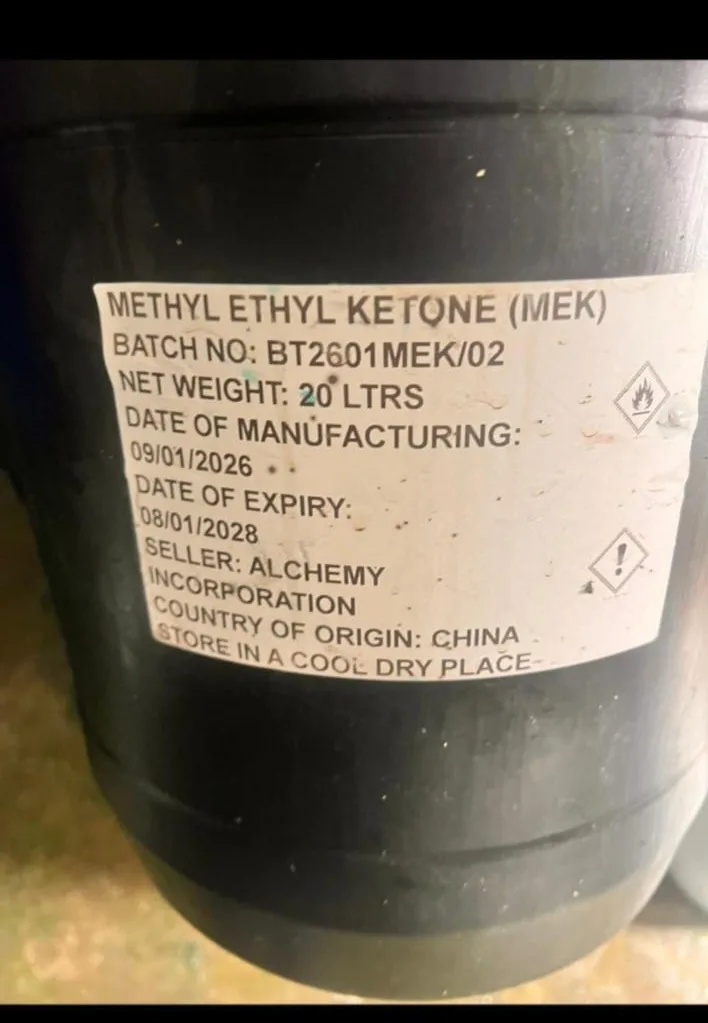
Methyl Ethyl Ketone (MEK) Supplier in Kenya | Industrial MEK Solvent – Olinc Chemical Suppliers
Welcome to Olinc Chemical Suppliers, your Nairobi-based contact for industrial chemical enquiries in Kenya.
Are you looking for Methyl Ethyl Ketone (MEK) for paint and coating production, printing inks, adhesive manufacturing, industrial cleaning or other solvent-based applications? MEK is a powerful, fast-evaporating industrial solvent valued for its ability to dissolve a wide range of natural and synthetic resins.
Methyl Ethyl Ketone is widely used in manufacturing processes that require effective solvency, relatively low solution viscosity and controlled solvent evaporation. It is particularly important in the production of printing inks, lacquers, surface coatings, adhesives, varnishes and selected chemical formulations.
Also known as 2-Butanone, Butan-2-one or Ethyl Methyl Ketone, MEK is a clear, colourless liquid belonging to the ketone family of organic solvents. It has a characteristic sweet, acetone-like odour and evaporates relatively quickly under normal conditions.
At Olinc Chemical Suppliers, we welcome enquiries from manufacturers, printing and packaging businesses, paint and coating companies, adhesive producers, industrial workshops and other businesses seeking MEK in Nairobi and across Kenya.
What Is Methyl Ethyl Ketone (MEK)?
Methyl Ethyl Ketone is an organic solvent belonging to the ketone chemical family. It is a relatively volatile liquid with strong solvent properties and is used in applications where materials such as resins, polymers, oils and other compatible organic substances need to be dissolved or carried in a formulation.
MEK is particularly valued because it combines:
- Strong solvency for many natural and synthetic resins.
- Fast evaporation compared with several commonly used industrial solvents.
- Relatively low viscosity.
- Compatibility with many organic solvents.
- Use in solvent-based coatings, adhesives and printing inks.
- Suitability for selected cleaning and manufacturing processes.
Unlike petroleum solvent mixtures such as White Spirit, MEK is a defined chemical compound with a specific molecular formula and CAS number.
Chemical Identification and Technical Information
| Property | Description |
|---|---|
| Product name | Methyl Ethyl Ketone |
| Common abbreviation | MEK |
| IUPAC name | Butan-2-one |
| Alternative name | 2-Butanone |
| Chemical family | Ketones |
| Chemical formula | C₄H₈O |
| Structural formula | CH₃COCH₂CH₃ |
| Molecular weight | 72.11 g/mol |
| CAS number | 78-93-3 |
| EC number | 201-159-0 |
| Physical appearance | Clear, colourless liquid |
| Odour | Characteristic sweet, acetone-like odour |
| Water solubility | Partially miscible with water |
| Main function | Industrial solvent |
Other Names for Methyl Ethyl Ketone
MEK is sold and identified under several names in chemical catalogues, technical documents and industrial purchasing systems.
Common alternative names include:
- Methyl Ethyl Ketone
- MEK
- 2-Butanone
- Butan-2-one
- Ethyl Methyl Ketone
- Methyl Acetone
- MEK Solvent
- Butanone
- Methyl Ethyl Ketone Solvent
When requesting MEK, customers should use the CAS number 78-93-3 to help avoid confusion with other chemicals.
Important distinction: MEK should not be confused with Methyl Ethyl Ketone Peroxide (MEKP). MEK is a solvent, whereas MEKP is an organic peroxide used as a curing or initiating agent in certain unsaturated polyester resin systems. They are different chemicals with different hazards and applications.
Physical and Chemical Properties of MEK
MEK’s physical properties make it suitable for a wide range of industrial solvent applications.
Appearance
MEK is normally a clear, colourless liquid. Its appearance and purity can be assessed against the supplier’s product specification.
Odour
It has a characteristic sweet, sharp odour often compared with acetone. Odour should not be used as a reliable measure of exposure or product purity.
Boiling Point
MEK has a boiling point of approximately 79.6–80°C at normal atmospheric pressure.
Its relatively low boiling point contributes to its rapid evaporation and makes it useful in solvent-based processes that require the solvent to leave the applied material within a controlled period.
Density
Its density is approximately 0.805 g/cm³ at 20°C, although the exact value depends on the product specification and measurement conditions.
Flash Point
MEK has a very low flash point, commonly reported around -6°C in closed-cup testing.
This means it can produce ignitable vapour at ordinary ambient temperatures. Strict ignition control is essential during storage, transfer and use.
Evaporation Rate
MEK is a fast-evaporating solvent. Its evaporation behaviour can influence coating drying, adhesive application, ink performance and cleaning processes.
The evaporation rate should be considered alongside other solvents in a formulation because it affects working time, drying characteristics and final film properties.
Water Solubility
MEK is partially miscible with water and is compatible with many organic solvents. Its water interaction differs from that of fully water-miscible solvents such as acetone.
Solvent Strength
MEK has good solvency for many natural and synthetic resins, including selected acrylic, polyurethane, polyester, cellulose and rubber-based materials. Actual compatibility depends on the precise resin and formulation.
Typical Reference Properties
| Property | Typical reference value |
|---|---|
| Appearance | Clear, colourless liquid |
| Molecular weight | 72.11 g/mol |
| Boiling point | Approximately 79.6°C |
| Melting point | Approximately -86°C |
| Density at 20°C | Approximately 0.805 g/cm³ |
| Flash point | Approximately -6°C, closed cup |
| Vapour density (air = 1) | Approximately 2.5 |
| Autoignition temperature | Approximately 404°C |
| Explosive limits in air | Approximately 1.8–11.5% by volume |
| Water solubility | Partial |
These are indicative reference values, not a guaranteed Olinc product specification. Values can vary slightly by test method and source. Buyers should confirm the actual grade using its current Technical Data Sheet and Safety Data Sheet.
Main Uses and Industrial Applications of Methyl Ethyl Ketone
MEK is used in several manufacturing sectors because of its solvent power, volatility and compatibility with a broad range of organic materials.
Paint and Coatings Manufacturing
One of MEK’s important applications is in the manufacture of paints and industrial coatings.
It can be used as a solvent in selected formulations involving:
- Industrial surface coatings.
- Acrylic coatings.
- Polyurethane coating systems where approved.
- Polyester resin-based coatings.
- Cellulose lacquers.
- Protective coatings.
- Selected high-solids coating formulations.
- Specialised solvent-based paint systems.
MEK helps dissolve compatible resins and adjust the solvent balance of a formulation. Its evaporation characteristics also influence drying behaviour and the formation of the final coating.
Paint manufacturers must assess resin compatibility, application conditions, film quality and the requirements of the finished product before selecting MEK.
Printing Ink Manufacturing
MEK is an important solvent in selected printing ink formulations, particularly where rapid solvent evaporation and good resin solvency are required.
It may be used in:
- Gravure printing inks.
- Flexographic printing inks.
- Packaging inks.
- Selected industrial printing inks.
- Ink formulations for compatible plastic films.
- Selected printing varnishes and coatings.
Printing ink manufacturers consider factors such as resin compatibility, substrate type, printing speed, drying equipment, solvent retention and final print quality.
MEK may help dissolve ink resins and influence the drying behaviour of the ink during printing.
Adhesive Manufacturing
MEK is used in selected solvent-based adhesive formulations because it can dissolve compatible polymers and resins.
Potential applications include:
- Contact adhesives.
- Rubber-based adhesives.
- Polychloroprene adhesive systems.
- Selected vinyl adhesives.
- Industrial bonding formulations.
- Certain specialty adhesive products.
Its solvent properties can help produce adhesive solutions with suitable viscosity and application characteristics.
Not all adhesives are formulated with MEK. Water-based, hot-melt, reactive and other adhesive systems may require completely different raw materials.
Lacquers and Varnishes
MEK is used in selected lacquer and varnish formulations where a fast-evaporating solvent with good resin solvency is required.
Applications may include:
- Cellulose lacquers.
- Selected industrial varnishes.
- Protective surface finishes.
- Certain wood and furniture coatings.
- Specialised resin-based finishing products.
The correct solvent combination is important because it affects drying time, gloss, film formation and surface appearance.
Plastics and Polymer Manufacturing
MEK is used in selected polymer-processing and manufacturing operations as a solvent or cleaning agent.
Potential applications include:
- Dissolving compatible polymeric materials.
- Cleaning selected manufacturing equipment.
- Preparing compatible polymer solutions.
- Supporting selected coating and bonding processes.
- Cleaning surfaces before certain manufacturing operations.
Material compatibility must be checked because MEK can attack or damage some plastics, elastomers and surface finishes.
Rubber and Rubber Adhesive Manufacturing
MEK is used in selected rubber-processing and adhesive applications.
It may be used in:
- Rubber-based adhesive formulations.
- Selected rubber cement systems.
- Solvent-based rubber compounds.
- Cleaning certain compatible equipment.
- Selected bonding and coating processes.
Its ability to dissolve certain rubber-related materials makes it relevant to specialist manufacturers. The suitability of MEK depends on the rubber type and formulation.
Industrial Cleaning and Degreasing
MEK is a solvent for selected industrial cleaning operations. It can dissolve compatible organic residues, resins, adhesives, oils and certain coatings.
Applications may include:
- Cleaning selected production equipment.
- Removing compatible adhesive residues.
- Cleaning selected metal components.
- Removing certain resin deposits.
- Cleaning printing and coating equipment.
- Selected industrial maintenance operations.
MEK is a strong solvent and may damage painted surfaces, plastics, rubber seals and other sensitive materials. Compatibility testing and appropriate workplace controls are essential.
Paint and Coating Removal Formulations
MEK may be incorporated into selected paint and coating removal formulations because of its ability to dissolve certain organic coating materials.
The performance depends on the type of coating, substrate, formulation and exposure conditions.
It should not be assumed to remove every type of paint or coating effectively.
Chemical Manufacturing and Processing
MEK also has applications as a process solvent and in selected chemical manufacturing operations.
Its uses can include:
- Solvent for chemical processing.
- Extraction operations.
- Selected pharmaceutical manufacturing processes.
- Processing of compatible resins and organic compounds.
- Selected industrial formulation work.
Specific suitability depends on purity, regulatory requirements and process design.
Oil and Wax Processing
MEK is used in certain specialised extraction and dewaxing operations, including processes involving oils and waxes.
These are industrial process applications that require appropriate equipment and controlled operating conditions.
Industries That Use MEK
| Industry | Application |
|---|---|
| Paint manufacturing | Solvent for compatible paint and coating resins |
| Printing and packaging | Solvent in selected printing inks and varnishes |
| Adhesive manufacturing | Solvent for compatible rubber and polymer adhesive systems |
| Plastics manufacturing | Selected polymer processing and cleaning |
| Rubber manufacturing | Rubber cement and selected rubber-based formulations |
| Furniture manufacturing | Selected lacquers, coatings and finishing products |
| Industrial maintenance | Cleaning compatible equipment and removing residues |
| Chemical manufacturing | Process solvent and extraction applications |
| Coatings manufacturing | Solvent for compatible industrial resin systems |
| Packaging production | Selected ink and coating processes |
Which Companies Use MEK?
For Olinc’s sales prospecting, printing ink manufacturers, paint and coating producers, adhesive manufacturers and rubber-product manufacturers are particularly relevant.
There are two useful groups of companies to consider:
Companies with publicly documented MEK product applications
The following international chemical manufacturers publish MEK product information and identify its industrial applications:
Sasol Chemicals
Sasol produces MEK and identifies its applications in surface coatings and other solvent-based formulations. Its published product information identifies MEK as a high-efficiency solvent for coating applications.
ExxonMobil Chemical
ExxonMobil identifies MEK applications involving coating resins, adhesive resins, printing inks and paint-stripping formulations. It also identifies its relevance to polychloroprene adhesive systems and gravure printing inks.
Shell Chemicals
Shell publishes technical information for MEK and describes its use in printing inks, lacquers and other coatings involving natural and synthetic resins.
These are chemical manufacturers that publish MEK product and application information. This does not mean every factory or local subsidiary necessarily uses MEK in its own manufacturing operations.
Potential Kenyan customers for Olinc Chemical Suppliers
The following Nairobi-based businesses operate in sectors where MEK may be relevant. They are worthwhile prospects for supplier introductions, but their current MEK consumption and purchasing arrangements have not been independently confirmed.
Printing ink and packaging manufacturers
- Inkson Industrial Co. Ltd – printing inks, can coatings and press chemicals.
- Ideal Inks & Coatings Ltd – printing inks and coatings for packaging and converting businesses.
- Inks Experts Ltd – printing ink manufacturing and supply.
- KENNAT INKS & Chemical Plant Ltd – printing inks and related chemical supplies.
- Inks (K) Ltd – printing inks and varnishes.
- General Printers 2021 Ltd – flexible packaging and printing.
Paint and coatings manufacturers
- Crown Paints Kenya PLC.
- Kansai Plascon.
- Glory Paints / Nasib Industrial Products Ltd.
- Galaxy Paints & Coatings Ltd.
- Novel Paints Ltd.
- United Paints Ltd.
- Ideal Manufacturing Co. Ltd.
Adhesive and rubber-product manufacturers
- Dunlex Adhesives Limited.
- Rubber Products Limited.
- H.B. Fuller Kenya Limited.
These companies are potential leads based on their manufacturing activities and the industrial applications of MEK. Do not assume that they currently use MEK: some may use alternative solvents, water-based formulations or proprietary blends.
When approaching them, ask to speak with procurement, production or technical personnel and establish:
- Whether they use MEK or another ketone solvent.
- Their required purity and grade.
- Their monthly or quarterly consumption.
- Their preferred packaging.
- Whether they require a TDS, SDS or COA.
- Whether they have an approved supplier process.
Grades of Methyl Ethyl Ketone
MEK may be supplied under different quality specifications depending on its intended application.
Industrial Grade MEK
Industrial-grade MEK is used in general manufacturing and industrial solvent applications.
Potential uses include compatible cleaning, coatings, adhesives, printing inks and other industrial formulations.
Technical Grade MEK
Technical-grade MEK is supplied for applications where the customer requires defined technical properties and an agreed specification.
The purity and impurity limits should be checked against the supplier’s documentation.
High-Purity MEK
Higher-purity MEK is used in applications where tighter limits on water, acidity, non-volatile matter and other impurities may be necessary.
Some commercial products specify purity around 99.5% or higher, but this should not be assumed for every grade.
Laboratory or Analytical Grade
Laboratory and analytical grades are intended for laboratory work and specific analytical requirements.
They should not automatically be substituted for industrial grades or assumed to be suitable for every regulated manufacturing process.
Purchasing note: Grade names are not always standardised across suppliers. The actual numerical specification and COA are more important than the grade label alone.
MEK Compared with Other Common Industrial Solvents
Customers may ask whether MEK can be replaced with acetone, ethyl acetate, toluene or another solvent.
| Solvent | Key difference |
|---|---|
| MEK | Ketone solvent with strong resin solvency and fast evaporation |
| Acetone | Generally faster evaporating and fully miscible with water |
| Ethyl Acetate | Ester solvent commonly used in coatings, inks and adhesives |
| Toluene | Aromatic hydrocarbon solvent with different solvency and evaporation characteristics |
| Xylene | Aromatic solvent with a higher boiling range and slower evaporation than MEK |
| White Spirit | Petroleum hydrocarbon mixture, generally much slower evaporating than MEK |
These solvents are not automatically interchangeable. A formulation change requires compatibility testing and consideration of drying time, resin solubility, safety, emissions and final product performance.
Packaging and Supply Considerations
MEK is commonly handled and transported in compatible, tightly sealed containers designed for flammable solvents.
Depending on the supplier and commercial arrangement, common industrial packaging formats may include:
- 5-litre containers.
- 20-litre or 25-litre containers.
- 200-litre or approximately 210-litre drums.
- IBCs or bulk supply for suitable industrial operations.
These are common market formats, not a confirmation of Olinc’s current stock or available packaging. Confirm the required pack size and supply arrangement when requesting a quotation.
When purchasing larger quantities, customers should consider:
- Compatibility of the packaging material.
- Container integrity and approved closures.
- Safe unloading and transfer arrangements.
- Storage capacity and fire protection.
- Product traceability and batch documentation.
Storage Requirements for MEK
MEK is highly flammable and requires careful storage.
Recommended storage precautions include:
- Keep containers tightly closed when not in use.
- Store in a cool, well-ventilated area.
- Keep away from direct sunlight and excessive heat.
- Keep away from flames, sparks and hot surfaces.
- Use suitable electrical equipment in areas where flammable vapours may be present.
- Store away from strong oxidising agents and other incompatible substances.
- Use suitable flammable-liquid storage arrangements.
- Prevent spills from reaching drains and waterways.
- Keep containers properly labelled.
- Restrict access to trained and authorised personnel.
MEK vapour is heavier than air and may travel along the ground to an ignition source. Storage and use areas must be designed to prevent vapour accumulation.
Safety Precautions When Handling Methyl Ethyl Ketone
MEK is a highly flammable solvent. It can also cause irritation and harmful effects when exposure is not properly controlled.
Fire and Explosion Hazard
MEK has a very low flash point. Its vapours can ignite at ordinary ambient temperatures.
Avoid:
- Smoking near the product.
- Open flames.
- Welding and cutting operations nearby.
- Sparks from electrical equipment.
- Static discharge during transfer.
- Hot surfaces and other ignition sources.
Use appropriate ventilation, suitable electrical equipment and properly designed flammable-liquid handling systems. Containers and transfer equipment should be bonded and grounded where required by the approved procedure.
Inhalation Exposure
Inhaling MEK vapour may cause:
- Headache.
- Dizziness.
- Nausea.
- Drowsiness.
- Throat and respiratory irritation.
- Central nervous system effects at sufficiently high exposure levels.
Use in a properly ventilated industrial area. Where exposure assessment indicates a need, suitable respiratory protection should be selected and used under a workplace respiratory-protection programme.
Skin Contact
Repeated or prolonged contact may remove natural skin oils and cause dryness or irritation.
Use suitable chemical-resistant gloves and protective clothing. Glove material should be selected using the manufacturer’s chemical-resistance information.
Eye Contact
MEK can cause eye irritation.
Wear suitable chemical splash goggles where splashing may occur. If eye contact happens, rinse cautiously with clean water and seek medical advice in accordance with the SDS.
Accidental Ingestion
Do not swallow MEK. If ingestion occurs, obtain urgent medical advice and follow the emergency instructions in the SDS. Do not induce vomiting unless instructed by medical professionals.
Environmental Protection
MEK should not be released into drains, rivers, soil or other water sources.
Collect spills using appropriate procedures and suitable equipment. Contaminated absorbents and waste solvent should be handled through authorised waste-management arrangements.
Quality Documentation to Request When Purchasing MEK
Industrial customers should request relevant product documentation before using MEK in a manufacturing process.
Important documents include:
1. Technical Data Sheet (TDS)
This provides information about the product’s technical properties, intended applications and typical specifications.
2. Safety Data Sheet (SDS)
This provides hazard classification, handling precautions, PPE requirements, storage instructions, first aid and emergency procedures.
3. Certificate of Analysis (COA)
Where available, a COA provides batch-specific test results, such as purity, water content, acidity, density and other specification parameters.
4. Product Identification
Confirm:
- Product name.
- CAS number: 78-93-3.
- Grade.
- Purity.
- Manufacturer or supplier.
- Batch number.
- Packaging details.
Frequently Asked Questions About MEK
What is Methyl Ethyl Ketone used for?
MEK is mainly used as an industrial solvent in paints, coatings, printing inks, adhesives, lacquers, varnishes, rubber-based formulations and selected industrial cleaning operations.
What is the chemical formula of MEK?
The chemical formula is C₄H₈O. Its structural formula is CH₃COCH₂CH₃.
What is the CAS number of MEK?
The CAS number is 78-93-3.
Is MEK the same as 2-Butanone?
Yes. Methyl Ethyl Ketone, 2-Butanone and Butan-2-one are names for the same chemical compound.
Is MEK the same as acetone?
No. Both are ketone solvents, but they have different chemical structures and physical properties. MEK generally has a higher boiling point and evaporates more slowly than acetone.
Is MEK a strong solvent?
Yes. MEK has good solvency for many natural and synthetic resins, making it useful in coatings, inks, adhesives and other industrial formulations.
Is MEK used in printing ink manufacturing?
Yes. It is used in selected printing ink formulations, including certain gravure and flexographic ink systems, depending on the ink formulation and printing process.
Can MEK be used in adhesive manufacturing?
Yes. It can be used as a solvent in selected rubber-based, polychloroprene and other compatible adhesive formulations.
Is MEK used in paint manufacturing?
Yes. MEK is used in selected solvent-based paints, lacquers and industrial coating formulations, particularly those involving compatible resin systems.
Is MEK soluble in water?
MEK is partially miscible with water. It is also compatible with many organic solvents.
Is MEK flammable?
Yes. MEK is highly flammable and has a very low flash point. It must be stored and handled away from ignition sources.
What is the difference between MEK and MEKP?
MEK is Methyl Ethyl Ketone, a solvent. MEKP is Methyl Ethyl Ketone Peroxide, an organic peroxide used as a curing agent in certain resin systems. They are different products and must never be confused.
What is the difference between MEK and White Spirit?
MEK is a defined ketone compound that evaporates relatively quickly and has strong solvency for many resins. White Spirit is a mixture of petroleum hydrocarbons and is commonly used for compatible oil-based paints and cleaning. Their applications and technical properties differ.
What packaging is available for MEK?
Common industrial packaging includes smaller containers, 20–25-litre containers, drums and IBCs, depending on the supplier. Confirm available packaging when requesting a quotation.
What should I provide when requesting a MEK quotation?
Provide your required quantity, preferred packaging, intended application and any required purity or technical specification. If you are a manufacturer, include your TDS or specification requirements where available.
Enquire About Methyl Ethyl Ketone (MEK) in Nairobi, Kenya
If your business requires Methyl Ethyl Ketone for printing inks, paints, coatings, adhesives, lacquers, rubber-related applications or selected industrial cleaning processes, contact Olinc Chemical Suppliers with your requirements.
We welcome enquiries from manufacturers, industrial businesses, workshops, printing companies and commercial buyers in Nairobi and across Kenya. Customers from Uganda, Tanzania and the wider East African market may also enquire about their product requirements.
To help us respond to your enquiry, provide:
- Required quantity.
- Intended application.
- Preferred packaging.
- Required grade or purity.
- Any technical documentation requirements.
Olinc Chemical Suppliers
Location: Enterprise Road, Avon Business Center, Nairobi, Kenya
Phone / WhatsApp: 0793062849
Alternative phone: 0743657810
Email: sales@olincinchemicals.com
Website: www.olincchemicalsl.com
Contact Olinc Chemical Suppliers for Methyl Ethyl Ketone (MEK) product and supply enquiries in Kenya.


Reviews
There are no reviews yet.