
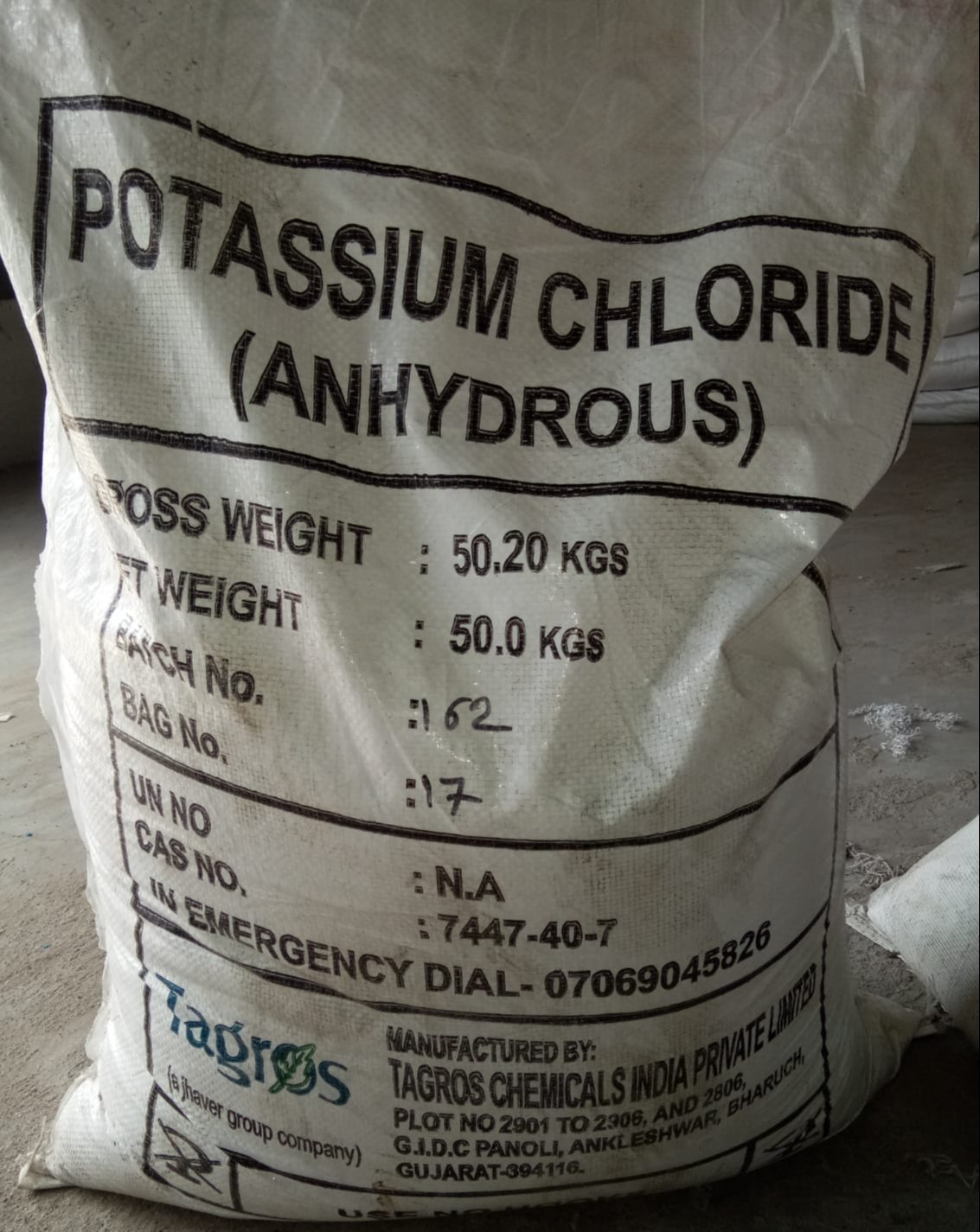
Potassium Chloride Supplier in Kenya | Olinc Chemical Suppliers
Potassium Chloride (KCl) is an inorganic chemical salt widely used in agriculture, food processing, pharmaceuticals, water treatment, chemical manufacturing and various industrial applications. It is valued as a source of potassium, an essential plant nutrient and an important mineral used in several manufacturing processes.
Also known as Muriate of Potash (MOP), Potassium Muriate and Sylvite, Potassium Chloride is commonly supplied as white or colourless crystals or granules. It is available in different grades, including agricultural, industrial, food and pharmaceutical grades, depending on the intended application.
Olinc Chemical Suppliers welcomes enquiries for Potassium Chloride in Nairobi, Kenya, Uganda and Tanzania. Whether you need it for fertiliser production, food processing, laboratory work, water treatment or industrial manufacturing, contact us to enquire about available grades, packaging, pricing and bulk supply.
What is Potassium Chloride?
Potassium Chloride is an inorganic compound made up of potassium and chloride ions. Its chemical formula is KCl. It occurs naturally as the mineral sylvite and is commercially produced mainly through the mining and processing of potassium-rich mineral deposits and brines.
It is an important commercial chemical because it supplies potassium, which is essential for plant growth, and is also used in food, pharmaceutical and industrial processes.
In agriculture, Potassium Chloride is one of the most widely used potassium fertiliser materials. In food manufacturing, suitably certified food-grade Potassium Chloride can be used as a salt substitute or mineral ingredient. In industrial applications, it may be used in chemical processing, drilling fluids and water-treatment processes.
Why is Potassium Chloride important?
-
Provides potassium for agricultural fertiliser formulations.
-
Supplies potassium and chloride ions in various industrial processes.
-
Can be used as a sodium chloride alternative in selected food formulations.
-
Serves as a raw material in chemical manufacturing.
-
Has applications in pharmaceutical and laboratory processes when the appropriate grade is selected.
-
Is highly soluble in water, making it useful in many aqueous formulations.
Other names for Potassium Chloride
Potassium Chloride is known by several names in agriculture, chemical supply, food processing and industrial manufacturing. Buyers may use these different terms when searching for the product.
Common names and related search terms include:
-
Potassium Chloride
-
Potassium Chloride KCl
-
KCl
-
Potassium Chloride Salt
-
Potassium Salt
-
Potassium Muriate
-
Muriate of Potash
-
MOP
-
Muriate of Potash Fertiliser
-
Potash Chloride
-
Chloride of Potassium
-
Sylvite (the naturally occurring mineral form)
-
Sylvine (an alternative mineral name)
-
Food Grade Potassium Chloride
-
Industrial Grade Potassium Chloride
-
Pharmaceutical Grade Potassium Chloride
-
Agricultural Grade Potassium Chloride
-
Potassium Chloride Crystals
-
Potassium Chloride Granules
-
Potassium Chloride Powder
Important clarification: Muriate of Potash (MOP) is a common agricultural name for potassium chloride fertiliser. Sylvite is the naturally occurring mineral form of KCl. These names are closely related, but a buyer should still confirm the actual product grade, purity and intended application before purchasing.
Chemical identity and product information
| Property | Details |
|---|---|
| Product name | Potassium Chloride |
| Chemical formula | KCl |
| Common abbreviation | KCl |
| CAS number | 7447-40-7 |
| Molecular weight | 74.55 g/mol |
| Chemical type | Inorganic ionic salt |
| Appearance | White or colourless crystalline solid |
| Odour | Odourless |
| Solubility | Soluble in water |
| Taste | Salty (do not taste industrial chemicals) |
| Common agricultural name | Muriate of Potash (MOP) |
| Main elements | Potassium and chlorine |
| Main applications | Agriculture, food, pharmaceuticals and industry |
Potassium Chloride is generally stable under normal storage conditions. Its exact purity, particle size, moisture content and impurity profile depend on the grade and manufacturer.
Main uses and applications of Potassium Chloride
Potassium Chloride has a wide range of applications. The correct grade should always be selected according to the intended use.
Agriculture and fertiliser manufacturing
One of the largest uses of Potassium Chloride is in agriculture, where it is commonly used as a potassium fertiliser known as Muriate of Potash (MOP).
Potassium is one of the three primary nutrients required by plants, alongside nitrogen and phosphorus. It supports several important plant functions, including water regulation, enzyme activation, photosynthesis and nutrient movement.
Potassium Chloride is used in:
-
Compound fertiliser manufacturing.
-
NPK fertiliser production.
-
Direct soil application as a potassium fertiliser.
-
Agricultural nutrient blends.
-
Fertiliser formulations for commercial crop production.
Why do farmers use Potassium Chloride?
Potassium supports:
-
Stronger plant development.
-
Better water-use regulation.
-
Improved crop quality.
-
Enzyme activity and metabolic processes.
-
Plant tolerance to certain environmental stresses.
-
Development of fruits, grains and other harvested crops.
Potassium Chloride fertiliser is commonly labelled 0-0-60 or close to 60% potash equivalent (K₂O), depending on the commercial grade. This is not 60% elemental potassium: it is a fertiliser-label convention expressing potassium content as potassium oxide equivalent.
Important agricultural consideration: Potassium Chloride also supplies chloride. Some chloride-sensitive crops may require another potassium source, such as potassium sulphate, depending on soil conditions and crop requirements.
Food processing and food manufacturing
Food-grade Potassium Chloride is used in selected food-processing applications. It can provide potassium and a salty taste, making it useful in certain formulations where manufacturers want to reduce sodium chloride.
Applications may include:
-
Reduced-sodium food products.
-
Salt replacement blends.
-
Seasoning formulations.
-
Selected processed foods.
-
Certain food processing applications.
-
Mineral and electrolyte formulations.
Potassium Chloride as a salt substitute
Food-grade KCl can replace part of the sodium chloride in selected food products. This helps manufacturers reduce sodium content while retaining some salty taste.
However, Potassium Chloride does not taste exactly like ordinary table salt. Depending on the food and concentration, it may produce a bitter or metallic aftertaste. Manufacturers often blend it with sodium chloride and other ingredients to improve taste.
Only use a grade specifically certified for food applications and compliant with the relevant food regulations.
Pharmaceutical manufacturing
Pharmaceutical-grade Potassium Chloride is used in the manufacture of certain medicines and electrolyte preparations.
Potential applications include:
-
Potassium supplementation products.
-
Oral electrolyte preparations.
-
Pharmaceutical formulations.
-
Certain intravenous electrolyte products.
-
Laboratory preparation of pharmaceutical solutions.
Potassium is an essential electrolyte involved in normal muscle function, nerve signalling and fluid balance.
Important: Pharmaceutical applications require strict purity, quality and regulatory controls. Industrial or agricultural Potassium Chloride must never be substituted for pharmaceutical-grade material. Potassium supplementation and intravenous preparations require appropriate medical and pharmaceutical oversight.
Water treatment
Potassium Chloride is used in selected water-treatment processes, especially in systems involving ion exchange.
Applications include:
-
Regeneration of certain ion-exchange resins.
-
Potassium-based water softening systems.
-
Preparation of potassium chloride solutions.
-
Selected industrial water-treatment processes.
In certain water-softening systems, potassium chloride can be used as an alternative regenerant to sodium chloride, provided the system and resin manufacturer approve its use.
Oil and gas drilling
Potassium Chloride is used in selected drilling-fluid formulations, particularly water-based drilling fluids.
It can help:
-
Inhibit swelling of certain clay minerals.
-
Stabilise water-sensitive shale formations.
-
Control interactions between drilling fluids and formation materials.
-
Improve drilling-fluid performance in suitable geological conditions.
Its use depends on the drilling programme, formation characteristics and required fluid properties.
Chemical manufacturing
Potassium Chloride is used as a raw material and potassium source in various chemical processes.
Applications may include:
-
Production of potassium-based chemical compounds.
-
Preparation of laboratory reagents.
-
Chemical processing.
-
Manufacture of selected potassium salts.
-
Industrial process solutions.
It may be used in processes involving the preparation of potassium hydroxide and other potassium compounds, depending on the production technology.
Laboratory and research applications
Laboratory-grade Potassium Chloride is used in research, analysis and preparation of chemical solutions.
Applications include:
-
Preparation of standard laboratory solutions.
-
Chemical analysis.
-
Electrochemistry experiments.
-
Calibration of certain conductivity instruments.
-
Preparation of reference solutions.
-
Educational laboratory experiments.
For laboratory work, the required purity and specification should match the analytical procedure.
Animal feed and livestock nutrition
Potassium Chloride may be used in appropriately formulated animal-feed products as a source of potassium and chloride.
Potential applications include:
-
Livestock mineral mixtures.
-
Selected feed supplements.
-
Animal nutrition formulations.
-
Specialised electrolyte products for livestock.
Feed-grade material must meet applicable feed safety and quality requirements. It should not be confused with fertiliser or industrial grades.
Benefits and functions of Potassium Chloride
The benefits of Potassium Chloride depend on the industry and grade in which it is used.
| Benefit or function | Importance |
|---|---|
| Potassium supply | Provides an essential nutrient for plant growth and selected food and industrial applications |
| Fertiliser production | Supplies potassium for NPK and other agricultural fertilisers |
| High water solubility | Makes it suitable for preparing aqueous solutions |
| Sodium reduction | Can replace part of sodium chloride in certain food formulations |
| Chemical raw material | Supplies potassium ions for various manufacturing processes |
| Water-treatment applications | Can regenerate compatible ion-exchange systems |
| Drilling-fluid performance | Helps control clay and shale swelling in selected drilling systems |
| Laboratory use | Suitable for preparing solutions and carrying out analytical procedures when the correct grade is used |
Different grades of Potassium Chloride
Potassium Chloride is available in different grades depending on the required purity, particle size, processing standards and intended application.
Choosing the correct grade is important because a product suitable for fertiliser production may not meet the requirements for food or pharmaceutical manufacturing.
Agricultural grade Potassium Chloride
Agricultural-grade Potassium Chloride is mainly used as a potassium fertiliser. It is commonly sold as Muriate of Potash (MOP).
Typical characteristics:
-
Commonly marketed as 0-0-60 or 0-0-62 fertiliser, depending on the product.
-
Available in granular, coarse or standard forms.
-
Used in NPK fertiliser manufacturing.
-
Suitable for agricultural potassium supplementation according to crop and soil requirements.
Industrial grade Potassium Chloride
Industrial-grade KCl is used in selected manufacturing and processing applications.
Typical uses include:
-
Chemical manufacturing.
-
Industrial processing.
-
Drilling-fluid preparation.
-
Selected water-treatment systems.
-
Preparation of industrial chemical solutions.
The purity and impurity limits vary by manufacturer and application.
Food grade Potassium Chloride
Food-grade Potassium Chloride is processed and tested for use in suitable food applications.
Typical applications include:
-
Reduced-sodium foods.
-
Salt replacement blends.
-
Seasonings.
-
Selected processed food formulations.
Buyers should request documentation confirming compliance with the applicable food-grade specifications and regulations.
Pharmaceutical grade Potassium Chloride
Pharmaceutical-grade KCl is manufactured and tested to meet relevant pharmaceutical standards.
Applications include:
-
Pharmaceutical formulations.
-
Electrolyte preparations.
-
Potassium supplementation products.
-
Other approved medicinal applications.
Depending on the intended market, buyers may need compliance with recognised pharmacopoeial standards such as USP or Ph. Eur.
Laboratory or analytical reagent grade
Laboratory-grade Potassium Chloride is used for research, analysis and preparation of laboratory solutions.
Its purity and impurity limits should match the specific analytical method or experiment.
Before ordering: Tell your supplier the intended application. Do not assume that agricultural-grade, industrial-grade, food-grade and pharmaceutical-grade Potassium Chloride are interchangeable.
Potassium Chloride versus other potassium chemicals
Potassium Chloride is often compared with other potassium salts, especially by agricultural buyers and manufacturers.
| Product | Chemical formula | Main applications |
|---|---|---|
| Potassium Chloride | KCl | MOP fertiliser, food processing, drilling fluids and industrial uses |
| Potassium Sulphate | K₂SO₄ | Potassium fertiliser, especially where chloride needs to be limited |
| Potassium Nitrate | KNO₃ | Fertiliser and selected industrial applications |
| Potassium Hydroxide | KOH | Soap manufacturing, chemical processing and pH adjustment |
| Potassium Carbonate | K₂CO₃ | Glass, soap, food and chemical manufacturing |
| Potassium Bicarbonate | KHCO₃ | Food processing, selected agricultural and industrial applications |
What is the difference between Potassium Chloride and Potassium Sulphate?
Both provide potassium, but they also supply different accompanying nutrients.
-
Potassium Chloride supplies potassium and chloride.
-
Potassium Sulphate supplies potassium and sulphur.
Potassium Sulphate is often considered for chloride-sensitive crops, while Potassium Chloride is a widely used and economical potassium fertiliser. The best choice depends on the crop, soil conditions and fertiliser programme.
What is the difference between Potassium Chloride and Potassium Nitrate?
Potassium Chloride supplies potassium and chloride, while Potassium Nitrate supplies potassium and nitrate nitrogen. They have different nutrient compositions and uses in fertiliser formulations.
Is Potassium Chloride the same as table salt?
No. Table salt is Sodium Chloride (NaCl), while Potassium Chloride is KCl. Both are chloride salts, but they contain different metal ions and have different nutritional, chemical and industrial properties.
Technical specifications to check when buying Potassium Chloride
If you are purchasing Potassium Chloride for manufacturing, agriculture or laboratory use, checking its technical specifications helps ensure that the product meets your requirements.
| Specification | What it means |
|---|---|
| Purity | Percentage of Potassium Chloride in the product |
| Potassium content | Amount of potassium present |
| K₂O equivalent | Fertiliser-label expression of potassium content |
| Chloride content | Amount of chloride ions |
| Moisture content | Amount of water in the product |
| Particle size | Determines whether the product is powder, fine crystal or granule |
| Appearance | Usually white or colourless crystalline material |
| Water solubility | Indicates how readily it dissolves |
| Insoluble matter | Indicates the amount of material that does not dissolve |
| Impurity profile | Helps establish suitability for specialised applications |
Understanding the 0-0-60 fertiliser label
Agricultural Potassium Chloride is commonly marketed as 0-0-60.
The three numbers represent the fertiliser’s nitrogen, phosphate and potash content, respectively.
-
0 represents nitrogen.
-
0 represents phosphate (P₂O₅).
-
60 represents potash (K₂O equivalent).
This means that a 0-0-60 fertiliser contains approximately 60% potassium expressed as K₂O equivalent. It does not mean that the product contains 60% elemental potassium.
This distinction is important when calculating fertiliser application rates and comparing potassium sources.
Packaging and supply options for Potassium Chloride
Potassium Chloride is commonly supplied in bags suitable for agricultural, industrial and commercial handling.
Common commercial packaging options include:
-
25 kg bags: Suitable for smaller industrial, commercial and manufacturing requirements.
-
50 kg bags: Commonly used for agricultural and bulk chemical supply.
-
Jumbo bags: Used for larger industrial or agricultural quantities.
-
Bulk supply: May be available for large-volume industrial and fertiliser requirements.
Packaging, net weight and availability depend on the supplier and product grade. Contact Olinc Chemical Suppliers to enquire about the available packaging.
When requesting a quotation, provide:
-
Required quantity in kilograms, bags or tonnes.
-
Intended application (agriculture, food, industrial, laboratory or other).
-
Required grade and purity.
-
Preferred packaging size.
-
Delivery destination.
-
Any required product documentation.
Solubility and handling of Potassium Chloride
Potassium Chloride is soluble in water, making it useful in applications that require potassium and chloride ions in solution.
Its solubility increases with temperature, so warmer water can dissolve more KCl than colder water.
When preparing a solution:
-
Use clean water suitable for the intended application.
-
Add the required quantity gradually while stirring.
-
Allow sufficient time for the crystals to dissolve.
-
Check for undissolved material if a clear solution is required.
-
Follow the concentration requirements of the relevant process.
The required concentration will depend on the intended use, whether agricultural, industrial, laboratory or another application.
Storage and safety precautions
Potassium Chloride is generally a stable inorganic salt, but it should still be handled and stored correctly to maintain product quality.
Storage recommendations
-
Store in a cool, dry and well-ventilated area.
-
Keep bags and containers sealed when not in use.
-
Protect from moisture to prevent caking.
-
Store away from incompatible materials.
-
Keep in clearly labelled packaging.
-
Avoid contamination with dirt, oils and other chemicals.
-
Use clean, dry handling equipment.
-
Follow the manufacturer’s recommended storage conditions.
Handling precautions
-
Avoid generating or breathing excessive dust.
-
Wear suitable protective gloves and safety glasses when handling bulk material.
-
Use appropriate dust control and ventilation.
-
Wash hands after handling.
-
Keep industrial and agricultural chemicals away from food and food-preparation areas.
-
Consult the product SDS before use.
Important health consideration: Potassium is an essential electrolyte, but excessive potassium intake can be dangerous, particularly for people with impaired kidney function or those taking certain medications. Food and pharmaceutical applications require appropriate grade selection, formulation controls and regulatory compliance.
Who buys Potassium Chloride?
Potassium Chloride is purchased by different businesses depending on the required grade and application.
Potential buyers include:
-
Fertiliser manufacturers.
-
Agricultural input distributors.
-
Commercial farmers and agricultural businesses.
-
Food and beverage manufacturers.
-
Pharmaceutical manufacturers.
-
Chemical processing companies.
-
Water-treatment companies.
-
Oil and gas drilling companies.
-
Laboratories and research institutions.
-
Industrial chemical distributors.
If you are a manufacturer or bulk buyer, specifying your application and required grade helps ensure that you receive the correct product.
Frequently asked questions about Potassium Chloride
What is Potassium Chloride used for?
Potassium Chloride is used in agriculture as a potassium fertiliser, in food processing as a salt substitute, in pharmaceutical manufacturing, water treatment, chemical production, drilling fluids and laboratory applications.
What is the chemical formula of Potassium Chloride?
The chemical formula is KCl. It consists of potassium ions (K⁺) and chloride ions (Cl⁻).
What is another name for Potassium Chloride?
Its most common alternative commercial name is Muriate of Potash (MOP), especially in agriculture. It is also known as Potassium Muriate and Potash Chloride.
Is Potassium Chloride the same as Muriate of Potash?
Yes. Muriate of Potash is the common agricultural trade name for potassium chloride fertiliser. It is widely used to supply potassium to crops.
What is the CAS number of Potassium Chloride?
The CAS number for Potassium Chloride is 7447-40-7.
What does 0-0-60 mean on Potassium Chloride fertiliser?
It means the fertiliser contains approximately 0% nitrogen, 0% phosphate and 60% potash expressed as K₂O equivalent. It is a standard fertiliser-label format.
Is Potassium Chloride soluble in water?
Yes. Potassium Chloride dissolves in water and forms a solution containing potassium and chloride ions. Its solubility increases as water temperature rises.
What does Potassium Chloride look like?
It is usually supplied as white or colourless crystals, granules or powder. Agricultural grades may also have different appearances depending on processing and mineral impurities.
Is Potassium Chloride used in NPK fertiliser?
Yes. It is a major source of potassium in many NPK fertiliser formulations. It is often used to provide the potassium component of compound fertilisers.
Can Potassium Chloride be used as a salt substitute?
Yes. Food-grade Potassium Chloride can replace part of Sodium Chloride in selected food products to reduce sodium content. It may have a bitter or metallic aftertaste, so formulations are often adjusted.
What is the difference between Potassium Chloride and Sodium Chloride?
Potassium Chloride contains potassium and chloride ions, while Sodium Chloride contains sodium and chloride ions. They are chemically different salts with different applications and nutritional properties.
What is the difference between Potassium Chloride and Potassium Sulphate?
Potassium Chloride supplies potassium and chloride, while Potassium Sulphate supplies potassium and sulphur. Potassium Sulphate may be preferred for chloride-sensitive crops.
What grades of Potassium Chloride are available?
Commercial grades include agricultural, industrial, food, pharmaceutical and laboratory grades. The correct grade depends on the intended application and required purity.
How is Potassium Chloride packaged?
Common packaging includes 25 kg and 50 kg bags, jumbo bags and bulk supply. The actual options depend on the supplier and product grade.
Can Potassium Chloride be used in water treatment?
Yes. It is used in certain ion-exchange water-treatment systems, including compatible systems that use potassium chloride for resin regeneration.
Is Potassium Chloride suitable for laboratory use?
Yes. Laboratory-grade Potassium Chloride is used to prepare solutions, conduct chemical experiments and perform analytical procedures. The required purity depends on the test or experiment.
Where can I buy Potassium Chloride in Nairobi, Kenya?
You can contact Olinc Chemical Suppliers in Nairobi, Enterprise Road, Avon Business Center, to enquire about Potassium Chloride availability, pricing, grades and packaging options.
Does Olinc Chemical Suppliers serve customers in Uganda and Tanzania?
Olinc welcomes chemical supply enquiries from Kenya, Uganda and Tanzania. Contact us with your required quantity and delivery destination to discuss available supply arrangements.
How can I request a quotation for Potassium Chloride?
Send Olinc Chemical Suppliers your required quantity, intended application, grade and preferred packaging. You can also specify whether you need agricultural, industrial or another grade.
Why buy Potassium Chloride from Olinc Chemical Suppliers?
Olinc Chemical Suppliers is a Nairobi-based supplier of industrial and specialty chemical raw materials serving businesses, manufacturers and commercial customers.
When enquiring about Potassium Chloride, you can contact us for assistance with:
-
Product availability and current pricing.
-
Available grades and specifications.
-
Packaging options for different quantities.
-
Small and bulk quantity enquiries.
-
Product documentation where available.
-
Supply enquiries within Kenya, Uganda and Tanzania.
Whether you are purchasing Potassium Chloride for fertiliser manufacturing, industrial processing, food production or another application, Olinc welcomes your enquiry.
Order Potassium Chloride from Olinc Chemical Suppliers
Muriate of Potash – agricultural and industrial chemical applications
Olinc Chemical Suppliers
Nairobi, Enterprise Road, Avon Business Center
Phone / WhatsApp: 0793062849
Email: sales@olincinchemicals.com
Website: www.olincinchemicalsl.com
Enquire on WhatsApp


Reviews
There are no reviews yet.