
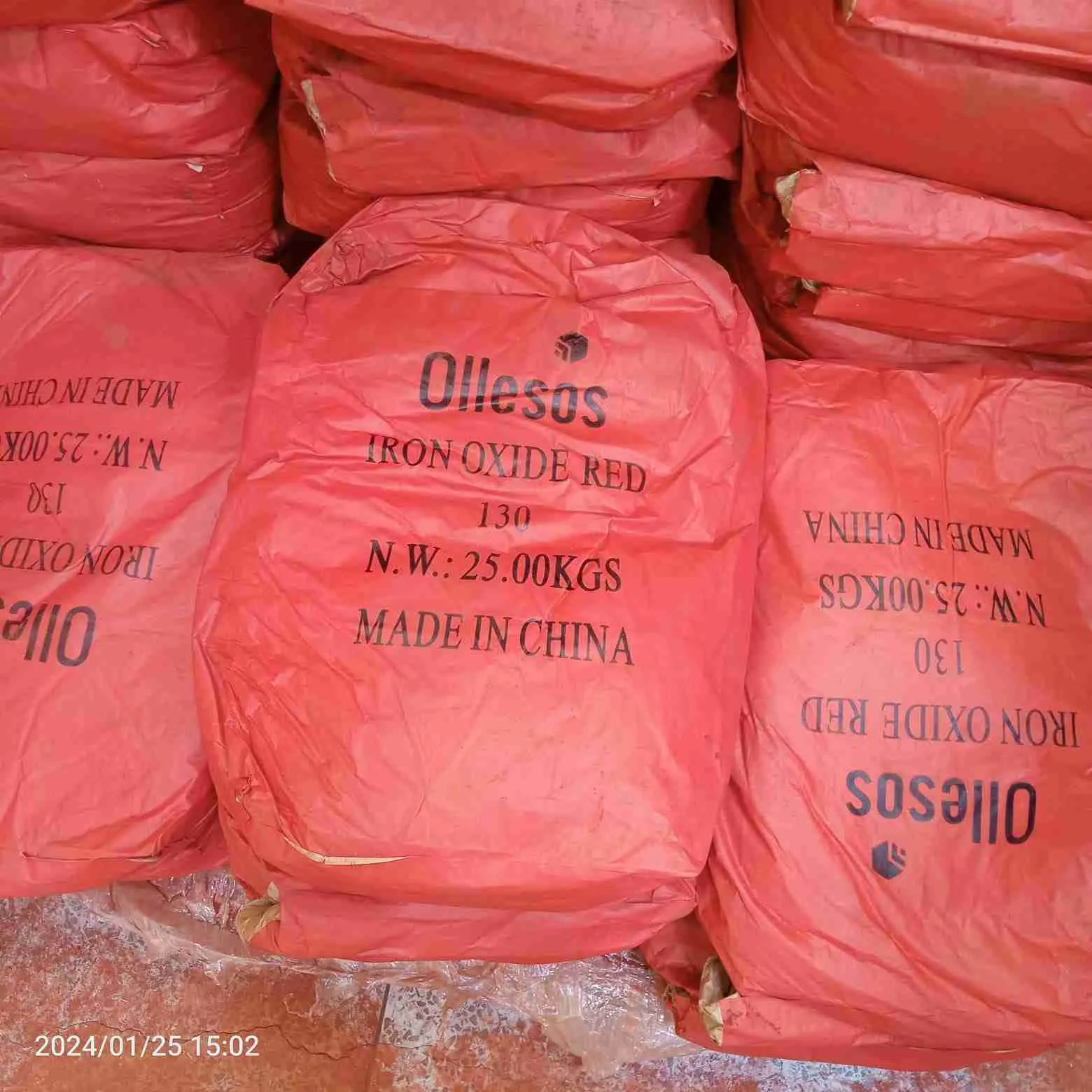
Red Iron Oxide Supplier in Kenya | Olinc Chemical Suppliers
Red Iron Oxide is an inorganic red pigment widely used in paints, coatings, construction materials, concrete products, plastics, rubber, ceramics and other industrial applications. It is valued for its strong red colour, excellent opacity, chemical stability, lightfastness and resistance to weathering.
Also known as Iron Oxide Red, Ferric Oxide, Iron(III) Oxide, Red Ferric Oxide and Pigment Red 101, this pigment is commonly based on ferric oxide, with the chemical formula Fe₂O₃.
Red Iron Oxide is particularly popular in the construction industry, where it is used to colour concrete blocks, paving blocks, interlocking cabro, roof tiles, cement products and decorative building materials. It is also used by paint manufacturers to produce red, brownish-red and other earth-toned coatings.
For manufacturers and businesses looking for a reliable Red Iron Oxide supplier in Nairobi, Olinc Chemical Suppliers welcomes enquiries from across Kenya, Uganda and Tanzania. Contact us to enquire about available grades, colour shades, specifications, packaging and bulk-order pricing.
Other Names and Synonyms of Red Iron Oxide
Red Iron Oxide is sold under different chemical, technical and commercial names. Knowing these names helps buyers identify the product when comparing supplier quotations or searching for the correct pigment.
Common chemical and alternative names:
-
Red Iron Oxide
-
Iron Oxide Red
-
Iron(III) Oxide
-
Ferric Oxide
-
Ferric Oxide Red
-
Red Ferric Oxide
-
Iron Sesquioxide
-
Diiron Trioxide
-
Iron(III) Oxide Red
-
Iron Oxide Pigment
-
Synthetic Iron Oxide Red
-
Synthetic Red Iron Oxide
-
Natural Red Iron Oxide
-
Red Iron Oxide Pigment
-
Anhydrous Ferric Oxide
-
Hematite
-
Haematite
-
Mineral Red
-
Rouge
-
Venetian Red
-
Indian Red
-
Spanish Red
-
Mars Red
-
Pigment Red 101
-
C.I. Pigment Red 101
-
CI 77491
-
Colour Index 77491
-
Fe₂O₃
-
CAS 1309-37-1
Commercial and pigment references buyers may encounter:
-
Bayferrox Red
-
Bayferrox 130
-
Bayferrox 110
-
Bayferrox 120
-
Bayferrox 180
-
Bayferrox 190
-
Bayferrox 4130
-
Bayferrox 4140
-
Lanxess Iron Oxide Red
-
Cathay Iron Oxide Red
-
Huntsman Iron Oxide Pigments
-
Heubach Iron Oxide Red
-
Yipin Iron Oxide Red
-
Tata Pigments Red Oxide
These commercial names and grade numbers identify particular manufacturers or product specifications. They are not all interchangeable, and colour shades may vary between grades.
Important purchasing note: Some names, such as Venetian Red, Indian Red and Mars Red, can refer to historical pigments or mixtures with different compositions. If you require pure synthetic Iron Oxide Red, confirm that the product is based on Fe₂O₃ and request its technical documentation.
Chemical Identification and Basic Specifications
| Property | Details |
|---|---|
| Product name | Red Iron Oxide |
| Chemical name | Iron(III) Oxide |
| Chemical formula | Fe₂O₃ |
| CAS number | 1309-37-1 |
| EC number | 215-168-2 |
| Molecular weight | 159.69 g/mol |
| Colour Index | Pigment Red 101 |
| Colour Index number | CI 77491 |
| Appearance | Fine red powder |
| Chemical classification | Inorganic iron oxide pigment |
| Solubility in water | Insoluble |
| Density of pure material | Approximately 5.0 g/cm³ |
| Main function | Red colouring pigment |
Commercial synthetic pigment grades may contain small amounts of moisture, surface treatment or other permitted constituents, so their measured specifications can differ from the theoretical properties of pure Fe₂O₃.
PubMed Central (PMC)+2
Types and Grades of Red Iron Oxide
Red Iron Oxide is available in different grades depending on the manufacturing process, particle size, colour shade and intended application.
Synthetic Red Iron Oxide
Synthetic Red Iron Oxide is manufactured under controlled conditions to achieve consistent colour, purity and pigment performance.
It is widely used in:
-
Paints and coatings.
-
Concrete and cement products.
-
Interlocking paving blocks.
-
Roof tiles.
-
Plastics and masterbatch.
-
Printing inks.
-
Rubber products.
-
Ceramics.
Advantages:
-
Consistent colour shade.
-
Good tinting strength.
-
High opacity.
-
Good lightfastness.
-
Good resistance to weathering.
-
Controlled particle-size characteristics.
-
Suitable for large-scale industrial manufacturing.
Synthetic pigment grades are often preferred when consistent colour between production batches is important.
Natural Red Iron Oxide
Natural Red Iron Oxide is obtained from naturally occurring iron-rich mineral deposits, particularly hematite-containing materials.
Its colour may range from earthy red to reddish-brown depending on the mineral composition and processing.
Common applications:
-
Traditional paints and coatings.
-
Decorative finishes.
-
Cement colouring.
-
Construction materials.
-
Ceramics.
-
Mineral pigments.
-
Artistic and architectural finishes.
Natural grades may contain other minerals and impurities. Their colour, purity and pigment strength can vary more than those of controlled synthetic grades.
Red Iron Oxide 110
Red Iron Oxide 110 is a common commercial pigment grade. It is generally associated with yellowish-red shades, although the precise colour depends on the manufacturer and product specification.
It may be used in:
-
Paints.
-
Coatings.
-
Concrete products.
-
Cement colouring.
-
Construction materials.
-
Plastics.
Red Iron Oxide 120
Red Iron Oxide 120 is another commercial grade used in pigment applications. Its precise shade and performance should be confirmed against the manufacturer’s colour reference and technical data sheet.
Red Iron Oxide 130
Red Iron Oxide 130 is a widely encountered synthetic pigment grade, commonly associated with bright red shades.
Applications include:
-
Paint manufacturing.
-
Industrial coatings.
-
Concrete colouring.
-
Cement products.
-
Roof tiles.
-
Plastic products.
-
Rubber.
-
Printing inks.
Red Iron Oxide 190
Red Iron Oxide 190 is commonly associated with darker red shades than some other commercial grades. The exact shade should be confirmed using the supplier’s colour chart or sample.
It can be used in:
-
Construction pigments.
-
Cement products.
-
Paints and coatings.
-
Concrete blocks.
-
Decorative surfaces.
Micronized Red Iron Oxide
Micronized Red Iron Oxide is processed to achieve finer particle characteristics that can improve dispersion and processing in suitable formulations.
It is particularly useful in:
-
Liquid paints.
-
Industrial coatings.
-
Printing inks.
-
Plastics.
-
Masterbatch manufacturing.
-
Fine pigment dispersions.
Important: Grade numbers such as 110, 120, 130 and 190 are commercial designations, not universal colour standards. A Red 130 from one manufacturer may not match another manufacturer’s Red 130 exactly. Always compare the colour shade, tinting strength, particle size and TDS before substituting grades.
Industrial Applications of Red Iron Oxide
Concrete and Cement Manufacturing
One of the most important uses of Red Iron Oxide is colouring concrete and cement-based construction products.
It is widely used by manufacturers of:
-
Interlocking cabro paving blocks.
-
Concrete paving stones.
-
Concrete floor tiles.
-
Cement blocks.
-
Decorative concrete.
-
Roof tiles.
-
Precast concrete products.
-
Concrete slabs.
-
Kerbstones.
-
Cement-based architectural finishes.
-
Coloured mortar and stucco.
Why manufacturers use Red Iron Oxide in concrete:
-
Produces attractive red and earthy colour shades.
-
Offers good colour stability under sunlight.
-
Has good resistance to the alkaline conditions of cementitious materials when a suitable pigment grade is used.
-
Provides consistent colouring when properly dispersed and dosed.
-
Can be incorporated into integral-colour concrete formulations.
For cabro and paving-block manufacturers, the pigment helps produce decorative products in different red shades for landscaping, walkways, parking areas and outdoor spaces.
Important for concrete manufacturers: Select a pigment grade specifically suitable for cementitious systems. Check its alkali resistance, water solubility, colour consistency and compatibility with the concrete mix. ASTM C979/C979M is a relevant specification for pigments used in integrally coloured concrete.
Paints and Coatings Manufacturing
Red Iron Oxide is widely used as a colouring pigment in paint and coating production.
Applications include:
-
Red oxide metal primers.
-
Anti-corrosive coatings.
-
Industrial protective paints.
-
Decorative paints.
-
Wood coatings.
-
Metal coatings.
-
Masonry paints.
-
Floor coatings.
-
Protective structural steel coatings.
-
General-purpose industrial coatings.
Benefits in paint formulations:
-
Provides red and reddish-brown colour.
-
Offers good opacity and hiding power.
-
Has strong tinting properties.
-
Provides good resistance to light exposure.
-
Helps produce durable colour finishes.
-
Can be blended with other pigments to achieve different shades.
Red Iron Oxide is particularly common in red oxide primers used on metal surfaces. However, the corrosion-protection performance of a primer depends on the complete formulation, including the binder, other pigments, additives, film thickness and surface preparation. The pigment alone does not make a coating anti-corrosive.
Interlocking Blocks and Cabro Manufacturing
Red Iron Oxide is an important raw material for manufacturers of coloured cabro and interlocking blocks.
It is used to produce:
-
Red cabro.
-
Coloured paving blocks.
-
Decorative walkways.
-
Driveway paving stones.
-
Landscaping blocks.
-
Commercial paving products.
-
Coloured concrete kerbs.
The pigment is added during the concrete mixing process to colour the concrete throughout rather than simply coating the surface.
This is useful for manufacturers who want consistent coloured paving products.
Roof Tiles and Roofing Materials
Red Iron Oxide is used in the manufacture of coloured concrete roof tiles and other roofing products.
It helps manufacturers achieve:
-
Red roof tiles.
-
Terracotta-like shades.
-
Reddish-brown roofing finishes.
-
Decorative cement roofing products.
Its good lightfastness makes suitable grades useful for products exposed to outdoor weather conditions.
Ceramics and Tiles Manufacturing
Red Iron Oxide is used in ceramics as a colouring agent.
Applications include:
-
Ceramic tiles.
-
Decorative pottery.
-
Terracotta products.
-
Ceramic glazes.
-
Bricks.
-
Roofing ceramics.
-
Decorative ceramic materials.
The final colour depends on the pigment composition, firing temperature, kiln atmosphere, glaze chemistry and other raw materials.
Plastics and Masterbatch Manufacturing
Red Iron Oxide is used as an inorganic pigment in selected plastic formulations.
Applications include:
-
Plastic pipes.
-
Plastic containers.
-
Plastic sheets.
-
Plastic moulded products.
-
Plastic furniture.
-
PVC products.
-
Polyethylene products.
-
Polypropylene products.
-
Plastic masterbatch.
Benefits:
-
Provides red pigmentation.
-
Offers good colour stability.
-
Provides useful opacity.
-
Has good heat stability in suitable grades.
-
Can be used in selected outdoor plastic products.
For plastic manufacturing, the pigment’s particle size, dispersibility, heat stability and compatibility with the polymer should be checked.
Rubber Manufacturing
Red Iron Oxide is used in selected rubber formulations to provide red or reddish-brown colour.
Applications may include:
-
Rubber flooring.
-
Rubber mats.
-
Moulded rubber products.
-
Coloured rubber sheets.
-
Rubber components.
-
Industrial rubber products.
The correct grade should be selected based on the rubber compound, processing conditions and required final colour.
Printing Ink Manufacturing
Red Iron Oxide can be used in printing inks where an inorganic red pigment with suitable opacity and colour stability is required.
Applications include:
-
Industrial printing inks.
-
Packaging inks.
-
Decorative printing.
-
Selected screen-printing systems.
-
Specialty printing formulations.
Micronized grades may be preferred where finer dispersion is important.
Asphalt and Road Construction
Red Iron Oxide can be used to colour selected asphalt and bituminous construction materials.
Applications include:
-
Coloured asphalt.
-
Decorative road surfaces.
-
Cycle paths.
-
Pedestrian pathways.
-
Coloured parking areas.
-
Landscaping surfaces.
The selected pigment must be suitable for the temperature and chemical environment of the asphalt production process.
Decorative and Architectural Finishes
Red Iron Oxide is used in architectural products where earthy red and terracotta shades are desired.
Applications include:
-
Decorative wall coatings.
-
Textured wall finishes.
-
Cement-based decorative surfaces.
-
Coloured plaster.
-
Architectural concrete.
-
Decorative paving products.
Other Industrial Applications
Depending on the grade and regulatory requirements, Red Iron Oxide may also be used in:
-
Leather colouring.
-
Paper pigmentation.
-
Artist pigments.
-
Mineral-based colouring systems.
-
Certain specialty industrial products.
Key Benefits of Red Iron Oxide
Red Iron Oxide is popular among manufacturers because of its combination of colour performance and durability.
-
Strong red colour: Produces attractive red, reddish-brown and earthy shades.
-
Good opacity: Helps cover underlying surfaces in paint and coating formulations.
-
High tinting strength: Provides effective colouring at suitable pigment concentrations.
-
Excellent lightfastness: Suitable grades maintain their colour under normal light exposure.
-
Good weather resistance: Useful for outdoor paints and construction products.
-
Alkali resistance: Appropriate grades perform well in cement-based applications.
-
Chemical stability: Suitable for many industrial formulations.
-
Versatility: Used in paints, concrete, ceramics, plastics, rubber and other products.
-
Heat stability: Suitable grades can withstand the processing temperatures of selected industrial applications.
-
Colour consistency: Controlled synthetic grades can provide reliable batch-to-batch performance.
These benefits depend on the grade, formulation and manufacturing conditions.
Technical Specifications to Check Before Buying
When buying Red Iron Oxide, manufacturers should consider more than the colour and price. Technical specifications determine how the pigment performs in the final product.
| Specification | Why it matters |
|---|---|
| Fe₂O₃ content | Indicates the iron oxide content |
| Colour shade | Determines the final red appearance |
| Tinting strength | Measures pigment colouring power |
| Particle size | Affects colour, opacity and dispersion |
| Oil absorption | Important for paint and coating formulation |
| pH value | Helps assess suitability for different formulations |
| Moisture content | Important for storage and accurate dosing |
| Water-soluble salts | Important for concrete and coating performance |
| Sieve residue | Indicates coarse particles and fineness |
| Bulk density | Useful for handling and formulation calculations |
| Specific gravity | Important for volume and pigment calculations |
| Heat stability | Important for plastics and other heat-processed products |
| Dispersibility | Determines how easily the pigment distributes in a formulation |
Typical Specifications of Commercial Synthetic Red Iron Oxide
The following are illustrative values found in commercial pigment technical data sheets, not guaranteed specifications for every grade.
| Parameter | Example commercial range |
|---|---|
| Fe₂O₃ content | Approximately 94–96% or higher, depending on grade |
| pH | Approximately 3–7 |
| Oil absorption | Approximately 15–25 g/100 g |
| Moisture / volatile matter | Often 1% maximum |
| Tinting strength | Approximately 95–105% of standard |
| Water-soluble matter | Often 0.3–1.0% maximum |
| Sieve residue | Grade and test method dependent |
| Specific gravity | Approximately 5.0 g/cm³ |
Actual figures vary by manufacturer, grade and test method. Always request the TDS and batch COA for the product being purchased.
How Much Red Iron Oxide Should You Use?
The required quantity depends on the product being manufactured, desired colour intensity, pigment strength and formulation.
For concrete and cement products
The dosage is normally calculated as a percentage of the cement weight, not the total weight of sand, aggregate and water.
For illustration, if a manufacturer uses 100 kg of cement:
| Illustrative pigment dosage | Red Iron Oxide required |
|---|---|
| 1% | 1 kg |
| 2% | 2 kg |
| 3% | 3 kg |
| 4% | 4 kg |
| 5% | 5 kg |
These are examples for formulation trials, not universal recommendations. The required dosage should be established through testing for the desired shade and product performance.
ASTM C979/C979M-24 provides requirements for pigments used in integrally coloured concrete and sets a maximum prescribed pigment dosage of 10% of cement mass, subject to its provisions.
For paint manufacturing
The amount depends on:
-
Desired colour intensity.
-
Required opacity.
-
Type of paint.
-
Other pigments and fillers.
-
Binder system.
-
Pigment particle size and tinting strength.
For plastics and masterbatch
The dosage depends on:
-
Polymer type.
-
Pigment concentration.
-
Desired final shade.
-
Processing temperature.
-
Dispersion quality.
-
Product thickness.
Recommendation: Always conduct small-scale formulation trials before full production. This helps prevent colour variations and unnecessary raw-material costs.
Packaging Options for Red Iron Oxide
Red Iron Oxide is generally supplied as a dry powder in sealed bags designed to protect it from moisture and contamination.
Common industrial packaging includes:
-
25 kg bags.
-
50 kg bags.
-
1,000 kg jumbo bags.
-
Other bulk packaging depending on the manufacturer.
For smaller manufacturers, standard bags are often convenient for storage and handling. Larger construction-material and paint manufacturers may prefer bulk packaging.
Contact Olinc Chemical Suppliers to enquire about current packaging options, available quantities and bulk-order arrangements.
Storage and Handling of Red Iron Oxide
Proper storage helps preserve pigment quality, prevent contamination and maintain consistent performance.
Storage recommendations:
-
Store in a cool, dry and well-ventilated area.
-
Keep bags tightly sealed when not in use.
-
Protect the pigment from moisture.
-
Store on pallets or raised surfaces.
-
Avoid direct contact with water.
-
Keep away from dirt and other contaminating materials.
-
Avoid damaging bags during handling.
-
Follow the manufacturer’s recommended storage conditions.
Handling precautions:
-
Avoid breathing airborne pigment dust.
-
Use suitable protective gloves.
-
Wear safety goggles.
-
Use appropriate respiratory protection where dust exposure may occur.
-
Provide adequate ventilation or dust extraction.
-
Wash hands after handling.
-
Follow the product-specific Safety Data Sheet (SDS).
Although many commercial synthetic iron oxide pigments are not classified as hazardous under certain chemical classification systems, airborne dust should still be controlled during industrial handling. Follow the SDS for the actual product supplied.
Red Iron Oxide Compared with Other Pigments
Manufacturers sometimes compare Red Iron Oxide with other colouring agents and mineral pigments.
| Product | Main characteristics | Common applications |
|---|---|---|
| Red Iron Oxide | Inorganic red pigment with good lightfastness and weather resistance | Paints, concrete, cement and plastics |
| Yellow Iron Oxide | Yellow inorganic pigment | Paints, concrete and construction products |
| Black Iron Oxide | Black inorganic pigment | Concrete, coatings and plastics |
| Brown Iron Oxide | Brown pigment, often based on iron oxide mixtures | Construction and decorative coatings |
| Titanium Dioxide | Strong white pigment with high opacity | Paints, plastics and coatings |
| Chromium Oxide Green | Stable green inorganic pigment | Paints, ceramics and construction |
| Organic Red Pigments | Often provide bright, intense colours | Inks, paints and plastics |
| Calcium Carbonate | White mineral filler and extender | Paints, plastics and construction |
Red Iron Oxide vs Natural Red Ochre
Red Iron Oxide is commonly supplied as a controlled synthetic pigment, while red ochre is a natural earth pigment containing iron oxides and other mineral components.
Synthetic Red Iron Oxide generally offers more consistent colour and pigment strength.
Red Iron Oxide vs Red Oxide Primer
These products are related but not the same.
-
Red Iron Oxide is the raw pigment.
-
Red Oxide Primer is a formulated paint containing a binder, pigment and other additives.
Paint manufacturers use Red Iron Oxide as one of the raw materials when producing suitable red oxide primers.
How to Choose the Right Red Iron Oxide Supplier
Before purchasing, consider the following:
-
Confirm the application: Are you manufacturing cabro, concrete blocks, paint, roof tiles, plastics or rubber?
-
Check the grade: Determine whether you need Red 110, 120, 130, 190 or another specified grade.
-
Confirm the shade: Request a colour sample or colour reference.
-
Review the specifications: Check Fe₂O₃ content, tinting strength, particle size, moisture and pH.
-
Request documentation: Ask for the TDS, COA and SDS.
-
Check packaging: Confirm whether the available bags match your production requirements.
-
Compare prices correctly: Compare products with similar grades and specifications.
-
Consider consistency: For repeat production, try to maintain the same manufacturer and grade.
For manufacturers producing cabro, paving blocks and cement products, colour consistency between batches is particularly important.
Why Buy Red Iron Oxide from Olinc Chemical Suppliers?
Olinc Chemical Suppliers serves manufacturers, contractors, distributors and businesses looking for industrial chemicals and raw materials in Nairobi and the wider East African region.
When enquiring about Red Iron Oxide from Olinc, you can:
-
Request current pricing for your required quantity.
-
Enquire about available grades and colour shades.
-
Confirm packaging options.
-
Discuss the suitability of the pigment for your application.
-
Request available product specifications.
-
Enquire about small or bulk-order requirements.
-
Discuss supply arrangements in Kenya, Uganda and Tanzania.
Whether you manufacture cabro, concrete blocks, roof tiles, paints, coatings, plastics or other coloured industrial products, we welcome your enquiry.
Contact Olinc Chemical Suppliers
-
Business: Olinc Chemical Suppliers
-
Location: Nairobi, Enterprise Road, Avon Business Center
-
Phone / WhatsApp: 0793062849
-
Email: sales@olincinchemicals.com
-
Website: www.olincinchemicalsl.com
Frequently Asked Questions About Red Iron Oxide
What is Red Iron Oxide used for?
Red Iron Oxide is used as a red colouring pigment in paints, coatings, concrete, cement products, interlocking blocks, roof tiles, ceramics, plastics, rubber and printing inks.
What is another name for Red Iron Oxide?
It is also known as Iron Oxide Red, Ferric Oxide, Iron(III) Oxide, Red Ferric Oxide, Iron Sesquioxide, Hematite and Pigment Red 101.
What is the chemical formula of Red Iron Oxide?
Its chemical formula is Fe₂O₃.
What is the CAS number for Red Iron Oxide?
The CAS number is 1309-37-1.
Is Red Iron Oxide suitable for cabro manufacturing?
Yes. Suitable pigment-grade Red Iron Oxide is widely used to colour concrete interlocking blocks and paving stones. Select a grade designed for cementitious applications.
Can Red Iron Oxide be used in cement?
Yes. It is used in cement-based products such as concrete blocks, coloured mortar, roof tiles, paving stones and decorative concrete.
Does Red Iron Oxide fade in sunlight?
Synthetic Red Iron Oxide generally has excellent lightfastness. Suitable grades are widely used in outdoor construction products and coatings because of their colour stability.
Is Red Iron Oxide water-soluble?
No. Red Iron Oxide is insoluble in water. It is dispersed throughout a formulation rather than dissolved.
What is the difference between Red Iron Oxide 110 and 130?
They are commercial pigment grades that may differ in shade, particle characteristics and other performance specifications. Their exact colour differences depend on the manufacturer. Request a colour chart or sample before choosing.
Is Red Iron Oxide used in paint manufacturing?
Yes. It is used in decorative and industrial paints, protective coatings, red oxide primers and other coating formulations.
Can Red Iron Oxide be mixed with other pigments?
Yes. It can be blended with suitable pigments such as Yellow Iron Oxide, Black Iron Oxide and Titanium Dioxide to produce different colours and shades.
How much Red Iron Oxide is needed for making cabro?
The quantity depends on the cement content, pigment grade and desired colour intensity. Manufacturers should conduct small-scale trials to establish the correct dosage for their concrete mix.
What packaging is available for Red Iron Oxide?
Common industrial packaging includes 25 kg bags, 50 kg bags and jumbo bags. Actual availability depends on the supplier and manufacturer.
Is synthetic Red Iron Oxide better than natural Red Iron Oxide?
Synthetic Red Iron Oxide generally offers more consistent colour, purity and tinting strength. Natural grades may be suitable for applications where an earthy appearance and natural mineral pigment are desired.
Where can I buy Red Iron Oxide in Nairobi, Kenya?
You can contact Olinc Chemical Suppliers at Enterprise Road, Avon Business Center, Nairobi, to enquire about pricing, available grades, specifications and bulk supply.
Does Olinc Chemical Suppliers serve customers in Uganda and Tanzania?
Olinc welcomes enquiries from businesses in Kenya, Uganda and Tanzania. Contact us with your required quantity and delivery location to discuss supply arrangements.



Reviews
There are no reviews yet.