
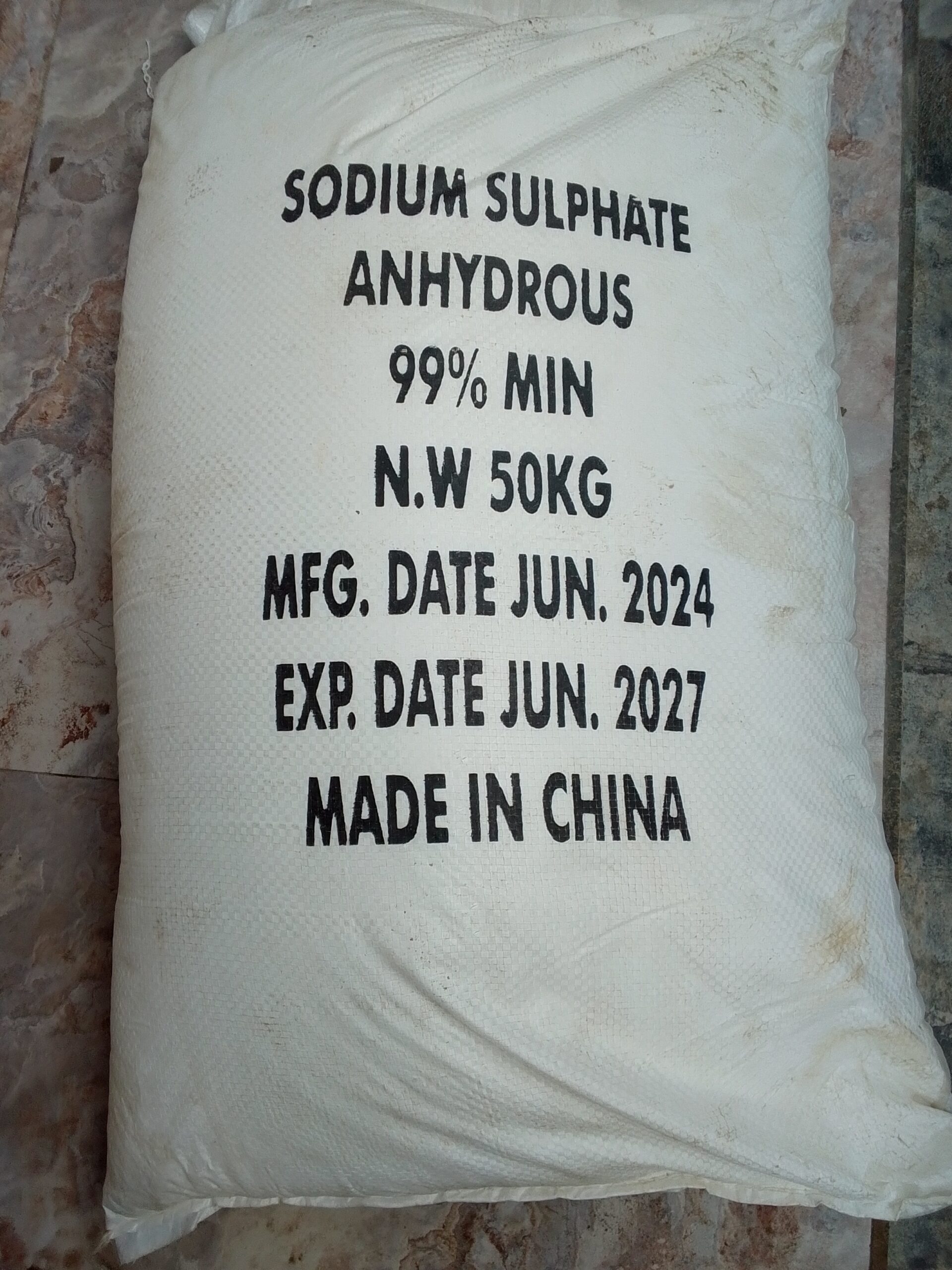
Sodium Sulphate Anhydrous Supplier in Nairobi, Kenya, Tanzania and Uganda
Sodium Sulphate Anhydrous is an important industrial chemical used in detergent manufacturing, glass production, textile processing, paper and pulp manufacturing, and various chemical industries. Also known as anhydrous sodium sulfate, thenardite or Glauber’s salt (anhydrous form), it is valued for its role as a filler in powdered detergents and as a raw material in several manufacturing processes.
Olinc Chemical Suppliers provides a point of contact for businesses looking to source industrial chemicals in Nairobi, Kenya, and across the wider East African market. This page explains the product, its properties, applications, grades, specifications, packaging, storage, safety and the information buyers should confirm before ordering.
What Is Sodium Sulphate Anhydrous?
Sodium Sulphate Anhydrous is an inorganic sodium salt with the chemical formula Na₂SO₄. It is commonly supplied as a white crystalline powder, fine crystals or granules. The word anhydrous means that the product does not contain water of crystallisation as part of its chemical structure.
It is widely used in industrial manufacturing because it is chemically stable under normal storage conditions, dissolves readily in water and is compatible with a range of manufacturing processes.
In detergent production, it is especially valued as a filler or bulking agent. In glass manufacturing, it can help remove bubbles and impurities from molten glass. It is also used in textile dyeing, pulp and paper processing, and as a drying agent in laboratories.
Thermo Fisher Scientific+2
Chemical identification
| Property | Details |
|---|---|
| Product name | Sodium Sulphate Anhydrous |
| Alternative spelling | Sodium Sulfate Anhydrous |
| Chemical formula | Na₂SO₄ |
| CAS number | 7757-82-6 |
| Molecular weight | 142.04 g/mol |
| Common names | Anhydrous sodium sulfate, salt cake, thenardite |
| Chemical family | Inorganic sodium salt |
| Appearance | White crystalline powder, crystals or granules |
| Odour | Odourless |
| Water solubility | Soluble in water |
| Nature | Generally neutral to mildly alkaline depending on grade and solution conditions |
Other names buyers may use: Sodium Sulphate, Sodium Sulfate, Anhydrous Sodium Sulphate, Disodium Sulphate, Salt Cake and Thenardite. Thenardite is also the name of the naturally occurring mineral form of anhydrous sodium sulphate.
Understanding the Difference Between Anhydrous Sodium Sulphate and Glauber’s Salt
This is an important distinction when ordering.
Sodium Sulphate Anhydrous
-
Formula: Na₂SO₄
-
No water of crystallisation
-
Molecular weight: 142.04 g/mol
-
Commonly used in detergent, glass and textile industries.
Sodium Sulphate Decahydrate
-
Formula: Na₂SO₄·10H₂O
-
Contains ten water molecules per formula unit
-
Molecular weight: approximately 322.20 g/mol
-
Also known as Glauber’s salt.
Although these products are related, they are not identical. Anhydrous sodium sulphate contains a higher proportion of sodium sulphate by weight because it does not contain the ten waters of crystallisation found in the decahydrate.
If your production process specifies Sodium Sulphate Anhydrous, do not automatically substitute Glauber’s salt. Confirm the exact product with your production or quality-control team.
Key Properties and Characteristics
Sodium sulphate anhydrous has several characteristics that make it useful in industrial applications:
-
White crystalline appearance: Suitable for applications where a white, solid chemical ingredient is required.
-
Water solubility: Dissolves in water, making it useful in aqueous industrial processes.
-
Chemical stability: Suitable for storage and use under normal recommended conditions.
-
Odourless nature: Does not have a strong characteristic smell.
-
Industrial versatility: Used in detergent, glass, textile, paper and chemical manufacturing.
-
Moisture sensitivity: Can absorb moisture and gradually convert to hydrated sodium sulphate if exposed to humid conditions.
Its moisture sensitivity makes proper packaging and dry storage important, especially when the product is intended for processes that require controlled moisture content.
Industrial Applications and Uses of Sodium Sulphate Anhydrous
Detergent and Soap Manufacturing
One of the major industrial uses of sodium sulphate anhydrous is in the production of powdered detergents.
It is commonly used as a filler or bulking agent in laundry detergent formulations. It helps manufacturers adjust the bulk and composition of detergent powder and can support consistent blending and handling.
It is used in the manufacture of:
-
Laundry detergent powder.
-
Household washing powders.
-
Industrial cleaning powders.
-
Commercial and institutional cleaning products.
-
Selected powdered cleaning formulations.
Why detergent manufacturers use it:
-
Helps adjust the bulk of detergent powder.
-
Provides a relatively economical formulation component.
-
Helps achieve the desired product composition.
-
Is compatible with many powdered detergent formulations, subject to formulation design.
The required quantity depends on the detergent recipe and the concentration of active cleaning ingredients. Sodium sulphate is not itself a replacement for surfactants such as SLES or LABSA.
Glass Manufacturing
Sodium sulphate anhydrous is used in glass manufacturing as a refining or fining agent.
During glass production, it can help with the removal of gas bubbles from molten glass, supporting the production of a more uniform glass product when used under controlled furnace conditions.
It is relevant to manufacturers of:
-
Flat glass.
-
Container glass.
-
Bottles and jars.
-
Glass sheets.
-
Selected speciality glass products.
The quantity and suitability depend on the glass formulation, furnace conditions and the manufacturer’s production process.
Textile Dyeing and Processing
Sodium sulphate anhydrous is widely used in textile processing, particularly in certain dyeing operations involving reactive dyes.
It acts as an electrolyte, helping control dye exhaustion from the dye bath and supporting the movement of dye from the solution onto the fabric.
It is used in:
-
Cotton fabric dyeing.
-
Textile processing.
-
Reactive dyeing operations.
-
Selected yarn dyeing processes.
-
Industrial fabric finishing operations.
Why textile manufacturers use it:
-
Supports dye exhaustion in suitable dyeing systems.
-
Helps improve dye uptake under controlled process conditions.
-
Supports consistent dyeing when the correct concentration and process conditions are maintained.
The dosage depends on the dye type, fabric, dye bath ratio, machine and dyeing method. It should follow the dye manufacturer’s instructions and the textile mill’s established process.
Pulp and Paper Manufacturing
Sodium sulphate has an important role in the Kraft pulping process used in paper and pulp manufacturing.
It can be used as a make-up chemical in the chemical recovery cycle, where sodium sulphate is reduced and converted into sodium sulphide as part of the Kraft recovery process.
Applications include:
-
Kraft pulp production.
-
Paper manufacturing.
-
Paperboard production.
-
Industrial pulp processing.
It is especially relevant to mills operating chemical recovery systems that use the Kraft process
Chemical Manufacturing
Sodium sulphate anhydrous is used as a raw material, processing ingredient or formulation component in selected chemical manufacturing operations.
It may be used in:
-
Manufacturing of sodium-based chemical products.
-
Industrial chemical processing.
-
Preparation of selected formulations.
-
Laboratory and production processes requiring sodium sulphate.
Its suitability depends on the purity, impurities and specifications required by the process.
Laboratory Applications
In laboratory chemistry, anhydrous sodium sulphate is commonly used as a drying agent for organic liquids.
It absorbs small amounts of residual water from certain organic solvents and liquid samples during preparation and purification.
It is used in:
-
Organic chemistry laboratories.
-
Chemical analysis.
-
Solvent drying.
-
Sample preparation.
-
Research and development.
For laboratory use, customers should request the appropriate laboratory or reagent grade. Industrial-grade sodium sulphate should not automatically be used where reagent purity is required.
Thermo Fisher Scientific+1
4.7 Other Industrial Applications
Depending on grade and process requirements, sodium sulphate may also be used in:
-
Selected starch manufacturing processes.
-
Certain chemical processing operations.
-
Selected glass and ceramic production processes.
-
Industrial formulations requiring sodium sulphate as an ingredient.
Its role should be confirmed against the intended production specification.
5. Grades of Sodium Sulphate Anhydrous
Not every buyer requires the same purity. Sodium sulphate is supplied in different grades depending on the application and quality requirements.
Industrial or technical grade
Commonly used in detergent manufacturing, textile processing, glass production and other industrial applications. The buyer should check the purity, chloride, iron, moisture and insoluble matter limits.
High-purity or refined grade
Used where tighter limits on impurities and more consistent specifications are required. It may be appropriate for selected chemical manufacturing processes.
Laboratory or reagent grade
Manufactured and tested to specific laboratory standards. These grades have tighter impurity limits and are intended for analytical, research or laboratory applications.
Food or pharmaceutical grade
These are specialised grades requiring appropriate certification and compliance with the relevant standards. Do not assume that ordinary industrial sodium sulphate is suitable for food, pharmaceutical or cosmetic manufacturing.
ACS Publications+2
6. Technical Specifications Buyers Should Check
The following table shows the key parameters that buyers should request when sourcing sodium sulphate anhydrous.
| Parameter | Typical information / purpose |
|---|---|
| Sodium sulphate (Na₂SO₄) assay | Indicates product purity |
| Appearance | White crystals, powder or granules |
| Moisture content | Indicates the amount of water present |
| Chloride content | Important for processes sensitive to chloride |
| Iron content | Important for colour-sensitive applications |
| Water-insoluble matter | Indicates undissolved impurities |
| Calcium and magnesium | Relevant to selected industrial processes |
| pH of solution | Helps assess solution characteristics |
| Particle size | Important for blending, dissolution and handling |
Example of a commercial technical specification
One published industrial product specification gives a sodium sulphate assay of approximately 99.0–99.7%, with limits for chloride, sodium carbonate, iron and water-insoluble matter. Another commercial specification lists grades with minimum purity levels of 98%, 99% and 99.6%. These are examples only; they are not a guarantee of Olinc’s stock specification.
svminerals.com+2
Important: Ask for the current Technical Data Sheet (TDS) and Certificate of Analysis (COA) for the actual batch being supplied. A customer making detergent powder may have different specification requirements from a customer producing glass or carrying out laboratory analysis.
7. How Sodium Sulphate Anhydrous Works in Different Processes
Its function depends on the industry using it.
| Application | How it works |
|---|---|
| Detergent manufacturing | Acts mainly as a filler or bulking component in powdered formulations |
| Textile dyeing | Acts as an electrolyte to support dye exhaustion in suitable dye baths |
| Glass production | Functions as a refining agent to help remove bubbles from molten glass |
| Kraft paper production | Participates in the chemical recovery cycle, contributing to the regeneration of pulping chemicals |
| Laboratory processing | Absorbs residual water from certain organic liquids when used as a drying agent |
This distinction is useful when selecting a grade. A product suitable for detergent production may not meet the purity requirements for laboratory work.
8. Packaging and Available Quantities
Sodium sulphate anhydrous is commonly supplied in solid form, making it suitable for storage, transportation and bulk industrial purchasing.
Common commercial packaging formats include:
-
25 kg bags.
-
50 kg bags.
-
500 kg bulk bags.
-
1,000 kg jumbo bags.
Actual packaging depends on the manufacturer and supplier. The above are common market formats, not a confirmation that every size is currently available from Olinc.
STPP Group+2
For large manufacturing operations, buyers may enquire about bulk quantities by the tonne.
When requesting a quotation, specify:
-
Required quantity in kilograms or tonnes.
-
Preferred bag size.
-
Required purity or grade.
-
Delivery location.
-
Whether a COA or TDS is required.
9. Storage and Handling
Although sodium sulphate anhydrous is generally stable under normal conditions, it should be stored properly to maintain its quality.
Storage recommendations
-
Store in a cool, dry and well-ventilated area.
-
Keep bags tightly closed or properly sealed.
-
Protect the product from rain, water and excessive humidity.
-
Store on pallets rather than directly on a damp floor.
-
Avoid contact with incompatible or contaminating materials.
-
Keep the packaging intact until the product is needed.
-
Follow the storage instructions on the supplier’s SDS and product label.
Because anhydrous sodium sulphate can absorb moisture and form hydrated sodium sulphate, keeping it dry is particularly important when moisture content is part of the customer’s specification.
Thermo Fisher Scientific+2
Safety and precautions
Sodium sulphate is generally considered a relatively low-hazard industrial salt, but dust can irritate the eyes and respiratory tract. Ingestion of substantial quantities may cause gastrointestinal discomfort.
Recommended precautions include:
-
Wear suitable protective gloves.
-
Use safety glasses or goggles.
-
Avoid breathing airborne dust.
-
Use suitable respiratory protection where dust levels require it.
-
Wash hands after handling.
-
Do not eat, drink or smoke in chemical handling areas.
-
Consult the specific product SDS before use.
In case of eye contact, rinse carefully with clean water. Follow the SDS for first aid and seek medical attention if irritation or symptoms persist.
SODIUM SULFATE+1
10. Sodium Sulphate Anhydrous Compared with Similar Chemicals
Customers sometimes confuse sodium sulphate with other sodium-based industrial chemicals. The following comparison helps clarify the differences.
| Chemical | Main difference and application |
|---|---|
| Sodium Sulphate Anhydrous | Na₂SO₄; used in detergents, glass, textiles and paper manufacturing |
| Sodium Sulphate Decahydrate | Na₂SO₄·10H₂O; hydrated form also known as Glauber’s salt |
| Sodium Sulphite | Na₂SO₃; reducing agent used in selected water treatment, pulp and other processes |
| Sodium Bisulphite | NaHSO₃; used as a reducing agent and dechlorinating chemical |
| Sodium Metabisulphite | Na₂S₂O₅; used in water treatment, food processing (appropriate grade only) and industrial applications |
| Sodium Carbonate (Soda Ash) | Na₂CO₃; alkaline chemical used in detergents, glass and other manufacturing |
| Sodium Chloride | NaCl; common salt used in food, chemical and industrial processes |
Do not substitute these chemicals for one another without checking the production requirements. Their chemical properties and functions are different.
11. Who Buys Sodium Sulphate Anhydrous?
Olinc can receive enquiries from different types of industrial and commercial customers, including:
-
Detergent and washing powder manufacturers.
-
Soap and cleaning chemical manufacturers.
-
Textile mills and dyeing companies.
-
Glass and glassware manufacturers.
-
Paper and pulp manufacturing companies.
-
Chemical processing industries.
-
Laboratories and research facilities.
-
Industrial chemical distributors.
-
Manufacturers purchasing raw materials in bulk.
If your business uses sodium sulphate as a raw material or processing ingredient, share your application and specification when requesting a quotation.
12. Why Source Sodium Sulphate Anhydrous from Olinc Chemical Suppliers?
Choosing the right supplier is important, especially when your production depends on consistent chemical quality and reliable supply arrangements.
Olinc Chemical Suppliers serves industrial and commercial chemical buyers from Nairobi, Kenya, and welcomes enquiries from across East Africa.
When contacting Olinc, you can enquire about:
-
Sodium sulphate anhydrous availability.
-
Industrial-grade product requirements.
-
Available packaging and order quantities.
-
Product specifications and documentation.
-
Current prices and bulk quotations.
-
Supply arrangements for your location.
Our aim is to help customers understand their chemical requirements and obtain the product specification appropriate to their intended application.
13. Sodium Sulphate Anhydrous Supplier in Nairobi, Kenya and East Africa
If you are searching for sodium sulphate anhydrous in Nairobi, Kenya, Olinc Chemical Suppliers welcomes your enquiry.
We also welcome enquiries from customers in:
-
Nairobi and other parts of Kenya: For detergent manufacturing, textile processing, glass production and other industrial requirements.
-
Uganda: For manufacturers and businesses sourcing sodium sulphate for industrial applications.
-
Tanzania: For commercial and industrial buyers requiring sodium sulphate anhydrous.
Customers should share their required grade, purity, quantity and destination so that availability and supply arrangements can be confirmed.
14. How to Order Sodium Sulphate Anhydrous from Olinc
To help us understand your needs and provide a suitable quotation, please provide:
-
Product: Sodium Sulphate Anhydrous (Na₂SO₄).
-
Grade: Industrial, high-purity or laboratory grade, depending on your application.
-
Application: Detergent, textile, glass, paper, laboratory or another use.
-
Quantity: For example, 25 kg, 500 kg, 1 tonne or your required quantity.
-
Packaging: Your preferred bag size, if applicable.
-
Delivery location: Nairobi or another destination in Kenya, Uganda or Tanzania.
If you are not sure which grade you need, tell us what you intend to manufacture. We can use that information to guide the product enquiry.
Request a Sodium Sulphate Anhydrous Quotation
Contact Olinc Chemical Suppliers for product availability, current prices, packaging and bulk-order enquiries.
0793062849
0743657810
sales@olincinchemicals.com
Enterprise Road, Avon Business Center, Nairobi, Kenya
Enquire on WhatsApp
15. Frequently Asked Questions About Sodium Sulphate Anhydrous
1. What is sodium sulphate anhydrous used for?
It is used in detergent powder manufacturing, glass production, textile dyeing, Kraft pulp and paper processing, chemical manufacturing and laboratory solvent drying.
2. What is the chemical formula of sodium sulphate anhydrous?
Its chemical formula is Na₂SO₄.
3. What is the CAS number of sodium sulphate anhydrous?
The CAS number is 7757-82-6.
4. What is the molecular weight of sodium sulphate anhydrous?
Its molecular weight is 142.04 g/mol.
5. What is another name for sodium sulphate anhydrous?
It is also called anhydrous sodium sulfate, salt cake or thenardite. Sodium sulfate is the American spelling of sodium sulphate.
6. Is sodium sulphate anhydrous used in detergent manufacturing?
Yes. It is widely used as a filler or bulking agent in powdered laundry detergent formulations.
7. Is sodium sulphate anhydrous the same as Glauber’s salt?
No. Glauber’s salt usually refers to sodium sulphate decahydrate, Na₂SO₄·10H₂O. Anhydrous sodium sulphate does not contain water of crystallisation.
8. Is sodium sulphate soluble in water?
Yes. It is soluble in water. Its solubility varies with temperature.
9. What does anhydrous mean?
Anhydrous means that the compound does not contain water of crystallisation in its chemical formula.
10. What is the difference between sodium sulphate and sodium sulphite?
Sodium sulphate is Na₂SO₄, while sodium sulphite is Na₂SO₃. They have different chemical properties and industrial applications.
11. Is sodium sulphate anhydrous used in textile dyeing?
Yes. It is used as an electrolyte in certain dyeing processes, particularly reactive dyeing of cotton.
12. Is sodium sulphate used in glass manufacturing?
Yes. It is used as a refining or fining agent to assist in removing bubbles from molten glass.
13. What packaging is available for sodium sulphate anhydrous?
Commercial products are commonly supplied in 25 kg and 50 kg bags, as well as larger bulk bags. Actual packaging depends on supplier availability.
14. What is the price of sodium sulphate anhydrous in Kenya?
Pricing depends on grade, purity, manufacturer, packaging, order quantity and delivery location. Contact Olinc Chemical Suppliers for a current quotation.
15. Where can I buy sodium sulphate anhydrous in Nairobi?
You can contact Olinc Chemical Suppliers at Enterprise Road, Avon Business Center, Nairobi, Kenya, to enquire about product availability, specifications and pricing.
16. Can sodium sulphate anhydrous be used in food manufacturing?
Only an appropriately certified grade that meets the relevant food regulations should be considered. Industrial-grade material should not be assumed suitable for food applications.
17. How should sodium sulphate anhydrous be stored?
Store it in sealed packaging in a cool, dry place, away from moisture and contamination.



Reviews
There are no reviews yet.