
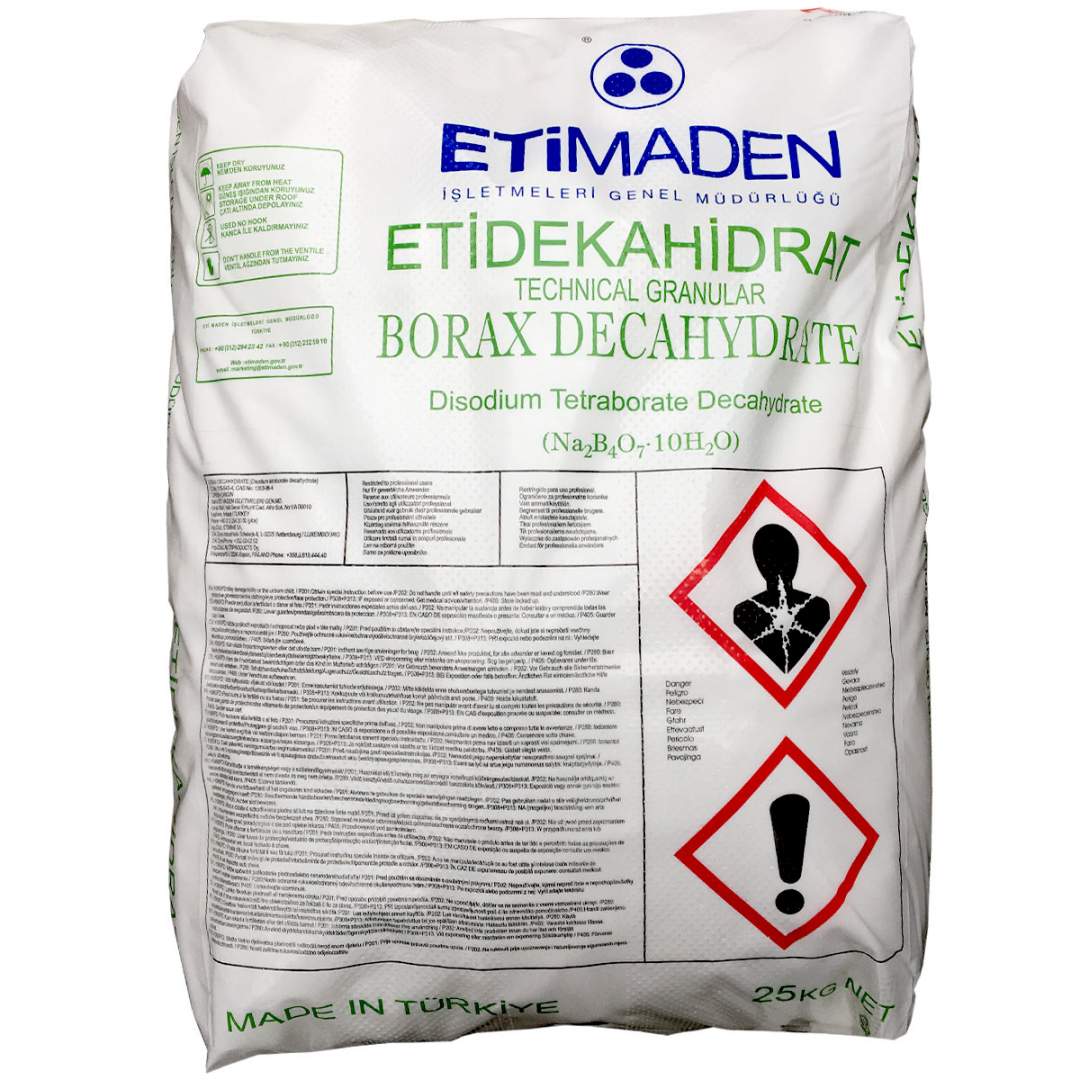
Borax Decahydrate Supplier in Kenya | Olinc Chemical Suppliers
Looking for a reliable Borax Decahydrate supplier in Kenya for your manufacturing, detergent, glass, ceramic or industrial chemical requirements? Olinc Chemical Suppliers welcomes enquiries from businesses looking for borax decahydrate in Nairobi and across Kenya.
Borax decahydrate is a versatile inorganic borate compound valued for its use in detergents, glass manufacturing, ceramics, metallurgy, chemical processing and other industrial applications. It is also known as sodium tetraborate decahydrate and is commonly supplied as a white crystalline powder or granules.
Whether you are a detergent manufacturer, glass producer, ceramic manufacturer, chemical formulator or industrial buyer, choosing the correct borax grade and understanding its properties will help you get the right material for your production process.
This guide covers its chemical identity, properties, grades, applications, industries that use it, packaging, storage, safety and purchasing considerations to help you make an informed buying decision.
What is borax decahydrate?
Borax decahydrate is an inorganic chemical compound made up of sodium, boron, oxygen and water of crystallisation. It is a hydrated form of sodium tetraborate and is widely used as a source of boron in industrial and commercial applications.
It is generally supplied as a white crystalline powder or granules. It dissolves in water and produces an alkaline solution, making it useful in certain detergent formulations, cleaning products and industrial processes.
Borax decahydrate is particularly important in:
-
Detergent and cleaning-product manufacturing.
-
Glass and fibreglass production.
-
Ceramic glazes and enamel manufacturing.
-
Metallurgy, welding and soldering flux formulations.
-
Industrial chemical manufacturing.
-
Selected agricultural and micronutrient formulations.
-
Water-treatment and buffering applications.
Its usefulness comes from its borate content, alkalinity and ability to participate in chemical formulations that require boron-containing ingredients.
For buyers in Kenya: Borax decahydrate is not the same as boric acid, borax pentahydrate or anhydrous sodium tetraborate. These products have different water contents and chemical compositions, so always confirm the exact form required by your production process.
Chemical identity and other names
| Property | Details |
|---|---|
| Common name | Borax Decahydrate |
| Chemical name | Sodium tetraborate decahydrate |
| Other chemical name | Disodium tetraborate decahydrate |
| Chemical formula | Na₂B₄O₇·10H₂O |
| CAS number | 1303-96-4 |
| EC number | 215-540-4 |
| Molecular weight | 381.37 g/mol |
| Chemical family | Inorganic borates |
| Physical form | White crystalline powder, crystals or granules |
| Odour | Odourless |
| Nature | Mildly alkaline salt |
| Main chemical components | Sodium oxide, boric oxide and water of crystallisation |
Multifunctional boric oxide source+3
Other names and synonyms
Your clients may find borax decahydrate listed under several names:
-
Borax
-
Borax decahydrate
-
Sodium tetraborate decahydrate
-
Disodium tetraborate decahydrate
-
Sodium borate decahydrate
-
Disodium borate decahydrate
-
Sodium pyroborate decahydrate
-
Borax 10 mol
-
Tetraborate of sodium decahydrate
-
Sodium borate, hydrated
The name 10 mol borax refers to the ten molecules of water of crystallisation in its chemical formula. When sourcing, the CAS number 1303-96-4 is a useful way to confirm that the requested product is the decahydrate form.
Physical and chemical properties
Understanding the properties of borax decahydrate helps buyers determine its suitability for their production processes.
| Property | Typical description or value |
|---|---|
| Appearance | White crystalline powder or granules |
| Colour | White |
| Odour | Odourless |
| Molecular weight | 381.37 g/mol |
| Specific gravity | Approximately 1.71–1.73 |
| Bulk density | Depends on particle size and grade; approximately 769–882 kg/m³ in published product data |
| Water solubility | Approximately 4.7% by weight at 20°C in a saturated solution |
| pH | Around 9.2–9.3 for certain dilute aqueous solutions; depends on concentration and test conditions |
| Flammability | Non-combustible |
| Chemical behaviour | Mildly alkaline; acts as a buffering and fluxing agent |
| Stability | Stable under normal storage conditions, but sensitive to moisture and temperature fluctuations |
What do these properties mean for buyers?
-
White crystalline appearance: Makes it easy to identify visually and incorporate into many dry formulations.
-
Water solubility: Allows it to be incorporated into water-based formulations, although dissolution is temperature-dependent.
-
Mild alkalinity: Makes it useful in selected detergent and cleaning formulations.
-
Buffering ability: Helps maintain a more controlled pH in suitable chemical systems.
-
Fluxing properties: Makes it useful in selected metalworking, glass and ceramic processes.
-
Water of crystallisation: Means the product contains a defined amount of chemically bound water, which must be considered when calculating formulation quantities.
The exact values vary by grade, manufacturer and test method. For production use, request the supplier’s current Technical Data Sheet (TDS) and batch Certificate of Analysis (COA).
Grades and forms of borax decahydrate
Borax decahydrate is supplied in different grades and particle sizes. The correct choice depends on the application and quality requirements.
Technical or industrial grade
Technical-grade borax decahydrate is intended for industrial manufacturing and processing.
Typical applications include:
-
Industrial detergents and cleaning products.
-
Glass and fibreglass manufacturing.
-
Ceramic glazes and enamels.
-
Metallurgical flux formulations.
-
Industrial fluids and lubricants.
-
Adhesives and selected chemical formulations.
This is generally the grade industrial buyers should investigate first, subject to the process specification.
Detergent grade
This grade is used in suitable detergent and cleaning formulations. Its performance depends on the product’s purity, particle size and formulation requirements.
Typical uses include:
-
Powder laundry detergents.
-
Industrial cleaning compounds.
-
Institutional cleaning products.
-
Selected hard-surface cleaners.
-
Cleaning powders and polishing products.
Granular borax decahydrate
Granular borax consists of larger particles. It may be preferred where buyers need a particular flow characteristic, reduced dust during handling or a specific dissolution rate.
Potential applications include:
-
Bulk industrial processing.
-
Selected detergent blends.
-
Glass and ceramic production.
-
Metallurgical processes.
Powder borax decahydrate
Powder grades have finer particles and may be suitable where rapid dispersion, fine blending or a specified particle size is important.
Potential applications include:
-
Powder detergent manufacturing.
-
Chemical formulation.
-
Selected ceramic and glaze mixtures.
-
Industrial cleaning compounds.
Pharmaceutical and specialised grades
Specialised grades may be produced to meet particular pharmacopoeial or technical standards. These should not be confused with ordinary industrial borax. Any pharmaceutical, cosmetic or personal-care application must meet the relevant product standard and legal requirements.
Which grade should you purchase?
| Your application | What to ask for |
|---|---|
| Powder detergent manufacturing | Suitable detergent or technical powder grade |
| Glass production | Grade with suitable boric oxide, sodium oxide and impurity specifications |
| Ceramics and glazes | Grade compatible with glaze formulation and firing requirements |
| Metalworking flux | Grade approved for the specific flux formulation |
| Industrial cleaning | Grade suitable for the formulation and intended use |
| Laboratory work | Laboratory grade with the required assay and impurity limits |
Do not select a grade on the basis of the word borax alone. Confirm the decahydrate form, CAS number, purity, particle size and relevant impurity limits.
Main industrial and commercial uses of borax decahydrate
Detergent and soap manufacturing
One of the most recognised uses of borax decahydrate is in detergent and cleaning-product manufacturing.
It is used as a multifunctional ingredient in selected formulations because it can contribute alkalinity, buffering, water-softening performance and cleaning support.
Applications include:
-
Powder laundry detergents.
-
Industrial laundry detergents.
-
Institutional cleaning powders.
-
Hard-surface cleaning products.
-
Selected hand-cleaning products.
-
Industrial degreasers and cleaning compounds.
-
Polishes and wax-based cleaning formulations.
How does borax help in detergents?
-
pH buffering: Helps maintain a suitable alkaline environment in a formulation.
-
Water-softening support: Borate chemistry can help manage the effects of certain dissolved minerals in wash water.
-
Cleaning performance: Supports the removal of certain oily and medium-to-heavy soils in suitable formulations.
-
Enzyme stabilisation: Can help stabilise enzymes in some detergent systems.
-
Formulation support: Can help emulsify oils, waxes and paraffins in selected products.
Borax is not a universal replacement for every detergent builder. Its compatibility with surfactants, enzymes, builders and other ingredients should be tested in the finished formulation.
Glass manufacturing
Borax decahydrate is an important source of boric oxide in glass manufacturing. When heated, it releases its water of crystallisation and contributes boron oxide to the glass batch.
It can be used in the manufacture of:
-
Borosilicate glass.
-
Speciality glass.
-
Technical glass.
-
Glass fibres.
-
Selected heat-resistant glass products.
-
Certain glass components used in industrial and scientific equipment.
Why is borax used in glass production?
-
It supplies boric oxide to the glass formulation.
-
It can help modify the melting behaviour of the glass batch.
-
It can influence the viscosity and working characteristics of molten glass.
-
It contributes to the properties of selected speciality glass formulations.
-
It provides sodium and boron together, which can be beneficial in certain glass compositions.
The actual effect depends on the full glass formulation, furnace conditions and the quantities of silica, soda ash, limestone and other raw materials used.
Fibreglass and insulation manufacturing
Borax decahydrate is used in the manufacture of certain glass-fibre products. It provides boric oxide for glass formulations used to produce fibres.
These fibres are used in:
-
Glass wool insulation.
-
Building insulation.
-
Industrial thermal insulation.
-
Fibreglass-reinforced plastics.
-
Automotive composite components.
-
Roofing and construction materials.
-
Industrial reinforcement materials.
Benefits in fibreglass manufacturing
-
Provides boron for glass-fibre formulations.
-
Helps manufacturers control glass composition.
-
Contributes to the thermal and chemical characteristics of selected glass fibres.
-
Supports the manufacture of specialised insulation and reinforcement products.
The suitability and quantity required depend on the manufacturer’s glass recipe.
Ceramic manufacturing and tile production
Borax decahydrate is used in selected ceramic formulations, especially glazes and enamels.
It can function as a source of boron oxide and as a fluxing ingredient. A flux helps ceramic glaze components melt and form a coating at the required firing temperature.
Applications include:
-
Ceramic tiles.
-
Porcelain products.
-
Decorative ceramic products.
-
Ceramic sanitaryware.
-
Ceramic tableware.
-
Glazes and enamel coatings.
-
Selected technical ceramic products.
Advantages in ceramic production
-
Helps control glaze melting behaviour.
-
Can support the formation of smooth glaze surfaces.
-
Contributes to the properties of selected enamel systems.
-
Provides boron oxide for glaze formulations.
-
Can help formulators adjust firing characteristics.
The exact amount depends on the glaze recipe, firing temperature and other ingredients.
Metallurgy, welding and soldering
Borax decahydrate is used in certain metalworking processes as a fluxing material.
A flux is a substance that helps manage surface oxides and other unwanted materials during selected metalworking operations.
Applications include:
-
Welding flux formulations.
-
Brazing fluxes.
-
Soldering fluxes.
-
Metal refining.
-
Selected scrap-metal recovery processes.
-
Metallurgical treatment.
-
Certain gold and metalworking operations.
Why is borax useful in metalworking?
-
Borate-based fluxes can help dissolve or manage metal oxides.
-
They can help protect selected hot metal surfaces from oxidation.
-
They can support cleaner metal joining in appropriate processes.
-
They can assist in the formation and handling of slag in certain metallurgical operations.
The correct flux depends on the metal, temperature and joining process. Borax decahydrate should only be used where the specific flux formulation calls for it.
Industrial cleaning and degreasing
Borax decahydrate is used in selected industrial cleaning products where alkalinity and buffering are required.
Applications include:
-
Factory floor cleaning compounds.
-
Equipment cleaning formulations.
-
Industrial degreasers.
-
Hard-surface cleaners.
-
Cleaning powders.
-
Polishes and wax-based formulations.
It can help support the removal of oily and medium-to-heavy soils in suitable cleaning formulations. The final product must be designed to suit the surface being cleaned and the type of contamination involved.
Adhesives and starch glue manufacturing
Borax decahydrate is used in selected adhesive and starch-based glue formulations.
It can interact with starch and other polymeric ingredients, changing the viscosity and handling characteristics of the mixture.
Potential applications include:
-
Starch-based adhesives.
-
Corrugated-board adhesives.
-
Paper and packaging adhesives.
-
Selected industrial glue formulations.
-
Specialised polymer systems.
Its suitability depends on the adhesive recipe and the required bonding and setting properties.
Flame-retardant applications
Borax decahydrate has been used in selected flame-retardant formulations, particularly those involving cellulosic materials.
Potential application areas include:
-
Cellulose-based insulation.
-
Selected paper and textile treatments.
-
Certain building materials.
-
Specialised fire-protection formulations.
Boron compounds can influence combustion and char formation in suitable formulations. However, borax alone does not make a material fireproof. Finished products need testing against the relevant fire-performance requirements.
Industrial fluids, lubricants and corrosion-control formulations
Borax decahydrate is used in some industrial fluid and lubricant systems.
Depending on the formulation, it can contribute to:
-
pH buffering.
-
Alkalinity control.
-
Selected corrosion-control systems.
-
Metalworking fluid formulations.
-
Certain coolant and industrial fluid systems.
It is important to note that borax is not a universal corrosion inhibitor. Performance depends on the metal, fluid composition, operating temperature and other formulation ingredients.
Agriculture and boron-containing fertiliser formulations
Borax is a source of boron, an essential plant micronutrient. Boron supports plant cell-wall development, reproductive growth and other physiological processes.
It may be used in appropriately formulated boron fertilisers and micronutrient products.
However, industrial-grade borax must not automatically be used as an agricultural input. Agricultural use requires the correct grade, formulation, registration and application guidance. Boron has a relatively narrow range between deficiency and toxicity, so incorrect application can damage crops. U.S. Borax specifically distinguishes industrial-grade products from products approved for regulated agricultural uses.
Companies and industries that use borax decahydrate
If you are looking to sell borax decahydrate in bulk, it is useful to understand which companies and manufacturing sectors use it or incorporate it into products.
Named company examples
This is a useful consumer-product example. The 20 Mule Team brand sells borax laundry booster for household laundry and cleaning. U.S. Borax confirms that Dial acquired its consumer-products division and Henkel later acquired Dial. This is a documented borax product example, rather than an assumption about an industrial factory’s purchasing records.
Relevant market: laundry and cleaning products.
Eti Maden is a major boron-products producer. Its borax decahydrate documentation identifies industrial applications including ceramics, detergents, borosilicate glass and insulation fibreglass. It is primarily an example of a manufacturer and supplier in the borax value chain, not a confirmed end-user customer.
Relevant markets: glass, ceramics, detergents and fibreglass.
U.S. Borax, part of Rio Tinto, produces and markets borax decahydrate. Its technical product information documents uses in industrial cleaning, glass, ceramics, metallurgy and other manufacturing applications. It is a manufacturer and supplier rather than a customer to target as an end user.
Relevant markets: borates, glass, cleaning, metals and ceramics.
Kenyan companies and potential customers for Olinc
For Olinc Chemical Suppliers, I would target businesses operating in the following areas:
| Potential customer sector | Why borax decahydrate may be relevant |
|---|---|
| Detergent and soap manufacturers | Use of borax in suitable cleaning and detergent formulations |
| Glass manufacturers and processors | Borax supplies boric oxide for selected glass compositions |
| Fibreglass and insulation producers | Boron-containing glass formulations |
| Ceramic and tile manufacturers | Glaze and enamel formulations |
| Welding and metalworking suppliers | Borate-based flux products |
| Adhesive and packaging manufacturers | Selected starch-based adhesive formulations |
| Industrial cleaning-product manufacturers | Alkaline cleaning and buffering formulations |
For Kenyan prospecting, businesses such as Bidco Africa, Pwani Oil Products and Haco Industries may be worth researching as potential detergent or cleaning-product leads. Glass and ceramic manufacturers are also relevant prospects.
However, I have not verified that these particular Kenyan companies directly purchase borax decahydrate. Some may use alternative ingredients or buy finished formulations from other suppliers. Do not advertise them as confirmed borax customers without checking their procurement or technical departments.
My recommendation for Olinc: Start with detergent manufacturers, ceramic producers and glass/fibreglass businesses. These sectors have clearly documented applications for borax decahydrate and offer relevant opportunities for commercial-volume enquiries.
Advantages of using borax decahydrate
Borax decahydrate offers several useful characteristics to manufacturers.
-
Multiple industrial applications: It can serve different roles in cleaning, glass, ceramics, metallurgy and chemical processing.
-
pH buffering: Helps maintain a more controlled pH in appropriate formulations.
-
Water-softening support: Can help improve detergent performance in suitable formulations.
-
Boron source: Supplies boron oxide for glass, ceramic and other boron-containing products.
-
Fluxing properties: Useful in selected metalworking, glass and ceramic applications.
-
Enzyme stabilisation: Can support enzyme stability in certain detergent systems.
-
Flexible physical forms: Powder and granular options allow manufacturers to select a suitable form for their process.
-
Established industrial use: It is a well-established raw material with documented applications across several manufacturing sectors.
Borax decahydrate versus other borax forms
This is an important section for customers because the different forms of borax are often confused.
| Feature | Borax decahydrate | Borax pentahydrate | Anhydrous borax |
|---|---|---|---|
| Chemical name | Sodium tetraborate decahydrate | Sodium tetraborate pentahydrate | Anhydrous sodium tetraborate |
| Formula | Na₂B₄O₇·10H₂O | Na₂B₄O₇·5H₂O | Na₂B₄O₇ |
| CAS number | 1303-96-4 | 12179-04-3 | 1330-43-4 |
| Water of crystallisation | 10 molecules | 5 molecules | None |
| Boron oxide content | Approximately 36.5% theoretical | Approximately 47.8% theoretical | Approximately 69.2% theoretical |
| Typical description | White crystalline powder or granules | White crystalline material | White anhydrous material |
The main difference is the amount of water chemically bound in each form. This affects the percentage of boron oxide supplied by a given weight of product.
A manufacturer changing from decahydrate to pentahydrate or anhydrous borax must adjust the formulation accordingly. Do not replace one form with another kilogram-for-kilogram without recalculating the recipe.
Borax decahydrate versus boric acid
Borax decahydrate and boric acid are both boron-containing chemicals, but they have different chemical compositions and uses.
| Feature | Borax decahydrate | Boric acid |
|---|---|---|
| Formula | Na₂B₄O₇·10H₂O | H₃BO₃ |
| CAS number | 1303-96-4 | 10043-35-3 |
| Chemical nature | Mildly alkaline sodium borate | Weak inorganic acid |
| Sodium | Contains sodium | Does not contain sodium |
| Common applications | Detergents, glass, ceramics, fluxes | Glass, fibreglass, ceramics, chemical formulations |
| pH behaviour | Produces an alkaline solution | Weakly acidic behaviour |
Although they are related through boron chemistry, they are not interchangeable. The correct product depends on the manufacturing formulation.
Packaging and supply formats
Borax decahydrate is commonly packed in moisture-protective bags to maintain its physical quality during storage and transport.
Typical commercial packaging includes:
-
25 kg bags.
-
50 kg bags.
-
500 kg bulk bags.
-
1,000 kg jumbo bags.
Some manufacturers also offer bulk supply or other specialised packaging formats.
What packaging should you choose?
-
25 kg bags: Suitable for small and medium-sized manufacturers, detergent producers and customers with limited storage space.
-
50 kg bags: May suit businesses handling larger production volumes, where the packaging is available and appropriate.
-
Jumbo bags: Suitable for larger manufacturing operations with suitable lifting and handling equipment.
-
Bulk supply: Can be considered for high-volume industrial operations with appropriate storage and transfer facilities.
For Olinc enquiries, confirm the actual pack sizes available before placing an order.
Quality specifications buyers should request
For commercial and industrial buyers, the product name alone is not enough. The following specifications can help determine whether a borax decahydrate batch is suitable.
| Specification | What the buyer should check |
|---|---|
| Chemical identity | Sodium tetraborate decahydrate |
| CAS number | 1303-96-4 |
| Purity / assay | Minimum assay stated by the manufacturer |
| Boric oxide (B₂O₃) | Theoretical content approximately 36.5%; check actual specification |
| Sodium oxide (Na₂O) | Theoretical content approximately 16.25% |
| Appearance | White crystalline powder or granules |
| Particle size | Powder or granular specification |
| Iron content | Important in applications sensitive to colour or contamination |
| Chloride content | Important where chloride impurities affect the process |
| Sulphate content | Check the applicable process limit |
| Moisture / water content | Confirm against the product grade |
| Documentation | TDS, SDS and batch COA |
The theoretical composition is based on the chemical formula; commercial specifications may set different minimums and impurity limits.
Storage and handling of borax decahydrate
Although borax decahydrate is chemically stable under normal conditions, it requires proper storage to maintain its quality.
Storage recommendations
-
Store in a cool, dry and well-ventilated warehouse.
-
Keep the bags sealed when not in use.
-
Protect the product from rain, moisture and water contamination.
-
Store bags on pallets rather than directly on the floor.
-
Avoid large fluctuations in temperature and humidity.
-
Keep away from incompatible chemicals.
-
Do not store together with food, animal feed or household consumables.
-
Inspect bags regularly for damage, moisture ingress and caking.
Why is moisture control important?
Borax decahydrate can cake during storage, particularly when exposed to changing humidity and temperature conditions. It can also lose some of its water of crystallisation under certain warm, dry storage conditions.
Caking can make the material harder to handle, weigh and blend. Proper packaging and warehouse conditions help preserve its physical quality.
Safety precautions
Borax decahydrate should be handled responsibly, particularly in industrial environments where workers may be exposed to dust.
Recommended precautions include:
-
Wear suitable chemical-handling gloves.
-
Use protective goggles.
-
Avoid breathing dust.
-
Provide adequate ventilation and dust-control measures.
-
Use appropriate respiratory protection where required by the risk assessment and SDS.
-
Wash hands after handling.
-
Avoid eating, drinking or smoking in chemical-handling areas.
-
Clean spills using methods that minimise dust generation.
Health and safety considerations
Some borax decahydrate classifications include eye irritation and reproductive-toxicity warnings. The exact classification depends on the applicable regulatory system and supplied product. Avoid unnecessary exposure, particularly during pregnancy or where reproductive-health risks are relevant.
If the product enters the eyes, rinse cautiously with clean water and seek medical advice according to the SDS. If swallowed, seek medical attention and follow the product’s emergency instructions.
Always obtain and follow the current Safety Data Sheet supplied with the actual product.
Why buy borax decahydrate from Olinc Chemical Suppliers?
Choosing the right chemical supplier is important for businesses that depend on consistent raw-material sourcing.
Olinc Chemical Suppliers serves customers looking for industrial chemicals in Nairobi and other parts of Kenya.
Reasons to contact Olinc:
-
Industrial chemical sourcing: We welcome enquiries from manufacturers, wholesalers and industrial buyers.
-
Product information: We help customers clarify the product specifications required for their intended application.
-
Convenient Nairobi location: Our business is located at Avon Business Center, Enterprise Road, Nairobi.
-
Commercial quantity enquiries: We welcome enquiries from businesses requiring larger quantities, subject to availability.
-
Quotation support: Share your specifications and quantity to receive a quotation based on your requirements.
-
Related chemical products: We handle enquiries for various chemicals used in detergent manufacturing, water treatment, glass, ceramics and other industries.
Our aim is to make industrial chemical sourcing easier for businesses by providing product information and responsive customer support.
Frequently asked questions about borax decahydrate
What is borax decahydrate used for?
Borax decahydrate is used in detergent manufacturing, glass production, fibreglass, ceramics, enamel coatings, metallurgy, welding fluxes, adhesives and selected industrial cleaning formulations.
What is the chemical formula of borax decahydrate?
Its chemical formula is Na₂B₄O₇·10H₂O.
What is the CAS number of borax decahydrate?
The CAS number is 1303-96-4.
What is another name for borax decahydrate?
It is also known as sodium tetraborate decahydrate, disodium tetraborate decahydrate, sodium borate decahydrate and borax 10 mol.
Is borax decahydrate used in detergent manufacturing?
Yes. It is used in selected detergent formulations as a buffering agent, alkaline ingredient, water-softening aid and cleaning formulation component.
Can borax decahydrate be used in soap making?
It can be used in certain soap and cleaning-product formulations. However, it is not a substitute for caustic soda in the saponification process used to manufacture conventional soap.
Is borax decahydrate used in glass manufacturing?
Yes. It provides boric oxide for glass formulations, including selected speciality glass and fibreglass products.
Is borax decahydrate used in ceramic production?
Yes. It can be used in ceramic glazes and enamel formulations to influence melting behaviour and finished surface characteristics.
What is the difference between borax decahydrate and boric acid?
Borax decahydrate is an alkaline sodium borate with the formula Na₂B₄O₇·10H₂O. Boric acid is a weak inorganic acid with the formula H₃BO₃. They have different properties and applications.
What is the difference between borax decahydrate and borax pentahydrate?
The decahydrate contains ten water molecules in its crystal structure, while the pentahydrate contains five. This means the pentahydrate has a higher boric oxide content per kilogram.
Does borax decahydrate dissolve in water?
Yes. It dissolves in water, with solubility increasing as the water temperature rises.
Is borax decahydrate acidic or alkaline?
It is mildly alkaline and produces an alkaline solution when dissolved in water.
What does borax decahydrate look like?
It is generally a white, odourless crystalline solid available in powder or granular form.
Is borax decahydrate flammable?
No. It is generally described as a non-combustible solid.
What packaging is available?
Common commercial formats include 25 kg bags, 50 kg bags and larger bulk bags. Actual availability should be confirmed when ordering.
Which companies use borax decahydrate?
It is used in industries producing detergents, glass, fibreglass, ceramics, adhesives and metalworking products. A consumer-product example is the 20 Mule Team borax laundry booster associated with Dial and Henkel. Industrial manufacturers such as glass, ceramic and detergent producers are also relevant potential customers.
Can borax decahydrate be used in agriculture?
Boron is an essential plant nutrient, and borax is a source of boron. However, industrial-grade material should not automatically be used for agricultural applications. Use an appropriately approved agricultural product and follow professional application guidance.
Where can I buy borax decahydrate in Kenya?
You can contact Olinc Chemical Suppliers in Nairobi to enquire about borax decahydrate, available specifications, packaging and pricing.
Does Olinc supply borax decahydrate in bulk?
Olinc welcomes commercial and bulk quantity enquiries. Contact us with your required quantity so that availability and supply arrangements can be confirmed.
What information should I provide when requesting a quotation?
Provide your required quantity, intended application, preferred grade, packaging and delivery location. This helps us understand your requirements and prepare a suitable quotation.
Related products from Olinc Chemical Suppliers
Customers purchasing borax decahydrate may also be interested in these related industrial chemicals:
-
Boric Acid: Used in glass, fibreglass, ceramics and specialised chemical formulations.
-
Soda Ash: Used in glass manufacturing, detergents and industrial processing.
-
Sodium Silicate: Used in detergents, adhesives and industrial applications.
-
Sodium Metasilicate: Used in industrial cleaning and detergent production.
-
Caustic Soda: Used in soap, detergent and chemical manufacturing.
-
Sodium Sulphate Anhydrous: Used in detergent and glass production.
-
Sodium Hexametaphosphate (SHMP): Used in water treatment and industrial formulations.
-
Sodium Bicarbonate: Used in food processing, detergents and other manufacturing applications.
-
Citric Acid: Used in cleaning, food processing and chemical formulations.
Order borax decahydrate from Olinc Chemical Suppliers
Are you looking for a borax decahydrate supplier in Kenya for your manufacturing or industrial requirements?
Olinc Chemical Suppliers welcomes enquiries from detergent manufacturers, glass producers, ceramic manufacturers, chemical formulators, wholesalers and other industrial buyers.
Whether you need borax decahydrate for detergent production, glass manufacturing, ceramic glazes, metalworking or industrial cleaning, contact us with your requirements.
Contact Olinc Chemical Suppliers
-
Location: Avon Business Center, Enterprise Road, Nairobi, Kenya
-
Phone / WhatsApp: 0793062849
-
Alternative phone: 0743657810
-
Email: sales@olincinchemicals.com
-
Website: www.olincinchemicalsl.com
Request a quotation today for borax decahydrate in Kenya. Contact Olinc Chemical Suppliers for product specifications, packaging information, availability and pricing.


Reviews
There are no reviews yet.