
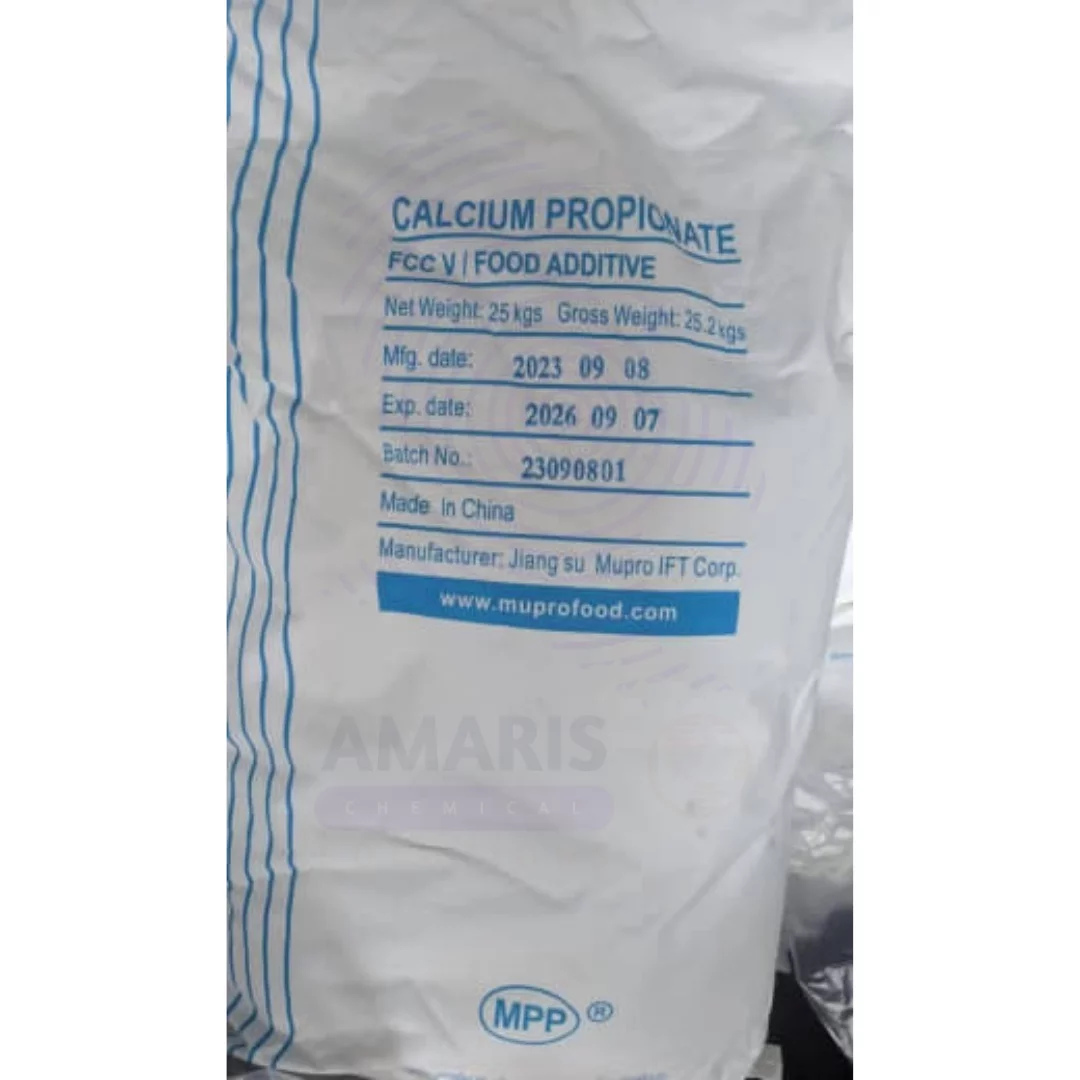
Calcium Propionate Supplier in Kenya | Olinc Chemical Suppliers
Welcome to Olinc Chemical Suppliers, your chemical supply partner in Nairobi, Kenya.
Are you looking for Calcium Propionate for bread production, bakery manufacturing, food processing or other commercial applications? Calcium Propionate is a widely used preservative valued for its ability to inhibit mould growth and help maintain the quality and shelf life of suitable food products.
In commercial baking, mould development can lead to product spoilage, financial losses and customer dissatisfaction. Calcium Propionate helps manufacturers manage this challenge by slowing the growth of moulds and certain microorganisms, particularly in bread and other baked products.
It is commonly used by bakeries, food manufacturers, commercial baking operations and food-processing businesses that require effective preservation as part of their production process.
Olinc Chemical Suppliers provides Calcium Propionate product enquiries in Nairobi, Kenya, serving customers looking for food-processing and industrial chemical supplies. Whether you operate a small bakery, a large commercial baking facility or a food manufacturing company, you can contact us for information about product specifications, grades, packaging and supply arrangements.
What Is Calcium Propionate?
Calcium Propionate is the calcium salt of propionic acid. It is primarily used as a food preservative to help prevent mould growth and improve the shelf-life management of various food products.
It is particularly important in the baking industry because bread and other bakery products can be susceptible to mould contamination during storage and distribution.
Calcium Propionate works by making conditions less favourable for the growth of certain moulds and microorganisms. Its preservative activity is influenced by the acidity of the product, formulation, moisture content, storage conditions and the microorganisms present.
It is available commercially in powder or granular form, depending on the manufacturer and product specification. Food-grade Calcium Propionate is commonly used in food production where permitted by the applicable food regulations.
Chemical Identification and General Properties
| Property | Details |
|---|---|
| Product name | Calcium Propionate |
| Chemical name | Calcium propanoate |
| Chemical formula | Ca(C₃H₅O₂)₂ |
| Molecular weight | Approximately 186.22 g/mol |
| CAS number | 4075-81-4 |
| EC number | 223-795-8 |
| Food additive number | E282 |
| Appearance | White crystalline powder or granules |
| Odour | Generally odourless or with a slight characteristic odour |
| Solubility | Soluble in water |
| Chemical category | Organic acid salt |
| Main function | Food preservative, particularly against moulds |
The exact appearance, assay, moisture content, particle size and other technical properties may vary by manufacturer and grade. Buyers should consult the current product Technical Data Sheet (TDS) and Certificate of Analysis (COA).
Other Names for Calcium Propionate
Calcium Propionate may be listed under several alternative names in supplier catalogues, technical documents and food ingredient databases.
Common names include:
- Calcium Propionate
- Calcium Propanoate
- Calcium Salt of Propionic Acid
- Propionic Acid Calcium Salt
- Calcium Dipropionate
- E282
- INS 282
- Calcium 2-Propanoate
These names generally refer to the same chemical preservative. When purchasing, it is important to confirm the CAS number, grade and product specifications to avoid confusion with other propionate salts, such as sodium propionate and potassium propionate.
How Does Calcium Propionate Work?
Calcium Propionate helps preserve food by inhibiting the growth of moulds and certain microorganisms that can cause spoilage.
In bread and bakery products, mould contamination can develop during cooling, packaging, storage or distribution. Calcium Propionate helps reduce the likelihood of mould growth when properly incorporated into a suitable formulation.
Its preservative action is associated with propionic acid. The effectiveness of the preservative depends partly on the pH of the food product because the proportion of propionic acid in its active form changes with acidity.
Calcium Propionate is particularly useful in products where manufacturers need to manage mould growth without significantly changing the intended taste, texture or appearance when used correctly.
Important: Calcium Propionate is not a sterilising agent. It does not replace good manufacturing practices, hygienic production, proper cooling, suitable packaging or appropriate storage conditions.
Main Applications and Uses of Calcium Propionate
Calcium Propionate is widely used in food preservation, particularly in commercial bakery production.
Bread Manufacturing
Bread is one of the major applications of Calcium Propionate. It helps inhibit mould growth that may develop during storage and distribution.
It is used in the production of:
- White bread
- Brown bread
- Wholemeal bread
- Sliced bread
- Sandwich bread
- Burger buns
- Hot dog rolls
- Bread rolls
- Commercial packaged bread
For bakeries supplying supermarkets, shops, hotels, restaurants and institutions, controlling mould growth is important for maintaining product quality and reducing spoilage.
Bakery Products
Beyond ordinary bread, Calcium Propionate is used in selected bakery formulations to help manage mould development.
Applications may include:
- Cakes
- Muffins
- Doughnuts
- Buns
- Rolls
- Pastries
- Tortillas
- Flatbreads
- Other commercially manufactured baked goods
Its suitability depends on the particular product, its moisture content, acidity, processing conditions and the applicable food additive regulations.
Flour-Based Food Products
Some flour-based food products may benefit from mould control, depending on their formulation and regulatory requirements.
Calcium Propionate may be considered in suitable products such as certain prepared doughs, baking mixes and flour-based manufactured foods.
Cheese and Dairy Applications
Calcium Propionate may be used in certain cheese and dairy-related applications where permitted. Its role is to help control mould development in suitable products.
The appropriate preservative and permitted use level depend on the specific dairy product and applicable regulations.
Food Processing and Commercial Manufacturing
Food manufacturers may use Calcium Propionate as part of a wider preservation strategy. Its use should be based on the product formulation, food safety requirements and the applicable regulatory limits.
Why Do Bakeries Use Calcium Propionate?
Calcium Propionate is valued by commercial bakeries for several reasons.
Helps control mould growth: It inhibits the growth of many moulds associated with bakery spoilage.
Supports shelf-life management: By slowing mould development, it can help maintain the usable shelf life of suitable baked products.
Suitable for commercial baking: It is used in a variety of bread and bakery formulations.
Water solubility: Its solubility makes it suitable for incorporation into many food-processing systems, depending on the manufacturing process.
Supports product quality: When correctly selected and used, it helps manufacturers manage spoilage while maintaining the intended characteristics of their products.
Useful for large-scale production: It is an established preservative ingredient in commercial bakery operations.
Available Grades of Calcium Propionate
Calcium Propionate is supplied in different grades depending on its intended application.
Food Grade Calcium Propionate
Food-grade Calcium Propionate is intended for use as a preservative in food products where its use is permitted.
Typical users include:
- Bread manufacturers
- Commercial bakeries
- Food-processing companies
- Cake and pastry manufacturers
- Food ingredient distributors
Buyers should verify the product’s food-grade documentation, applicable food additive specifications and regulatory compliance before using it in food production.
Feed Grade Calcium Propionate
Calcium Propionate may also be manufactured for certain animal-feed applications. Feed-grade material should only be used for the purposes and species covered by its product documentation and applicable feed regulations.
Food-grade and feed-grade products should not automatically be treated as interchangeable.
Industrial or Technical Grade
Technical-grade material may be manufactured for selected non-food applications. It should not be used in food production unless the manufacturer provides documentation establishing its suitability and regulatory compliance for that purpose.
Purchasing recommendation: Always specify the intended application when requesting Calcium Propionate so that the correct grade can be identified.
Typical Technical Specifications
The following table provides a general guide to the parameters buyers may encounter when evaluating Calcium Propionate. Actual acceptance limits depend on the manufacturer’s specification and the applicable standard.
| Parameter | General description |
|---|---|
| Appearance | White crystalline powder or granules |
| Identification | Conforms to Calcium Propionate identity tests |
| Assay | Common commercial specifications are around 99% or higher, depending on the standard |
| Solubility | Soluble in water |
| Moisture / loss on drying | Controlled according to product specification |
| pH | Depends on the concentration and test method |
| Heavy metals | Must meet applicable food-grade limits where relevant |
| Arsenic and lead | Controlled according to the relevant food-grade specification |
| Particle size | Depends on the manufacturer’s grade |
These are general purchasing reference points, not a guaranteed specification for every batch. Request the current TDS and COA to confirm the exact values for the product being supplied.
Calcium Propionate Dosage and Usage in Food Production
The appropriate amount of Calcium Propionate depends on the type of food, recipe, moisture content, acidity, processing method and applicable food regulations.
In bread production, it is commonly incorporated into the dry ingredients or flour during mixing to achieve even distribution. The manufacturer’s instructions and the bakery’s validated formulation should guide the mixing procedure.
The following factors should be considered when determining its use:
- The type of bread or bakery product being manufactured.
- The product’s pH and moisture content.
- The expected storage and distribution conditions.
- The preservative’s specification and purity.
- The relevant national food additive limits.
- The interaction with other ingredients in the formulation.
There is no single dosage that is suitable for every food product or every market. Manufacturers should follow the applicable legal maximum levels and conduct formulation and shelf-life validation before commercial production.
Calcium Propionate Packaging
Calcium Propionate is commonly supplied in industrial and food-ingredient packaging suitable for dry chemical powders or granules.
A common commercial packaging format is a 25 kg bag, although the actual packaging options depend on the manufacturer and current supply arrangements.
Packaging should:
- Protect the material from moisture.
- Prevent contamination during transport and storage.
- Remain properly sealed until use.
- Clearly identify the product and grade.
- Include appropriate batch and traceability information.
For bulk or regular purchasing requirements, customers can contact Olinc Chemical Suppliers to confirm available packaging and supply arrangements.
Storage and Handling of Calcium Propionate
Proper storage helps maintain the quality and usability of Calcium Propionate.
Recommended precautions include:
- Store in a cool, dry and well-ventilated area.
- Keep the material in its original sealed packaging where possible.
- Protect it from moisture and direct water exposure.
- Avoid storing it alongside incompatible chemicals.
- Keep packaging away from direct sunlight and excessive heat.
- Prevent contamination by dust, dirt and other materials.
- Use clean, dry handling equipment.
- Reseal opened bags carefully after use.
- Follow the manufacturer’s SDS and storage recommendations.
For food manufacturing, store the product in a designated ingredient area that meets the facility’s hygiene and pest-control requirements.
Safety Precautions
Calcium Propionate is used as a food additive when it meets the relevant food-grade requirements and is used within permitted limits. However, industrial handling of powdered material should still be carried out carefully.
Recommended precautions include:
- Avoid unnecessary inhalation of dust.
- Use suitable protective gloves when handling.
- Wear safety glasses where dust or splashing may occur.
- Use appropriate respiratory protection where a dust assessment indicates it is necessary.
- Wash hands after handling.
- Keep the product away from food intended for consumption until it has been properly incorporated into a compliant formulation.
- Do not consume the raw chemical directly.
- Keep the product out of reach of children.
- Consult the product Safety Data Sheet (SDS) for specific first-aid and handling instructions.
If dust enters the eyes or causes irritation, follow the SDS first-aid instructions and seek medical advice where necessary.
Calcium Propionate Compared with Other Preservatives
Food manufacturers may compare Calcium Propionate with other preservatives when selecting ingredients for a particular formulation.
| Preservative | Common food application | Main consideration |
|---|---|---|
| Calcium Propionate (E282) | Bread and bakery products | Commonly used to control mould growth |
| Sodium Propionate (E281) | Selected bakery and food applications | Sodium salt of propionic acid |
| Potassium Sorbate (E202) | Beverages, sauces, bakery and other foods | Effective against many yeasts and moulds in suitable acidic formulations |
| Sodium Benzoate (E211) | Acidic beverages and food products | Most useful in appropriately acidic formulations |
| Sorbic Acid (E200) | Various food applications | Used to inhibit moulds and yeasts |
These preservatives are not automatically interchangeable. Their suitability depends on the food category, pH, formulation, regulatory limits and desired preservation effect.
Factors to Consider When Buying Calcium Propionate
Before purchasing Calcium Propionate, buyers should confirm the following details to ensure they receive a product suitable for their intended application.
Intended application
State whether the product is required for bread manufacturing, bakery production, dairy processing, animal feed or another application.
Product grade
Confirm whether you require food grade, feed grade or technical grade. Do not assume that a product labelled Calcium Propionate is automatically suitable for food use.
Purity and assay
Check the assay and other quality parameters against your manufacturing requirements.
Documentation
For food manufacturing, request the appropriate COA, TDS and SDS, together with relevant food-grade and regulatory documentation.
Packaging
Confirm the available bag size and whether it suits your storage and production requirements.
Quantity required
Indicate whether you need a single bag, several bags or a regular supply arrangement.
Delivery location
Provide your delivery location so that transport and delivery arrangements can be confirmed.
Calcium Propionate Supplier in Nairobi, Kenya
If you are searching for Calcium Propionate in Nairobi or elsewhere in Kenya, Olinc Chemical Suppliers welcomes enquiries from bakeries, food manufacturers, commercial processors and businesses requiring chemical and food ingredient supplies.
We serve customers seeking product information and supply arrangements for different industrial and food-processing chemicals.
Whether you are sourcing Calcium Propionate for bread production, bakery preservation or another suitable application, contact us with your required grade, quantity and location.
Why Contact Olinc Chemical Suppliers?
- Nairobi-based chemical supplier.
- Product enquiries for commercial and industrial requirements.
- Support for customers seeking product specifications and grade information.
- Convenient communication by phone, email or WhatsApp.
- Enquiries welcome for single purchases and larger requirements.
Customers in other parts of Kenya, as well as buyers making enquiries from Uganda and Tanzania, can contact us to discuss supply and delivery arrangements.
Frequently Asked Questions About Calcium Propionate
What is Calcium Propionate used for?
Calcium Propionate is mainly used as a food preservative to inhibit mould growth and help extend the shelf life of suitable food products. It is especially common in bread and bakery manufacturing.
What is the E-number of Calcium Propionate?
The food additive number for Calcium Propionate is E282. Its international numbering system designation is INS 282.
Is Calcium Propionate used in bread?
Yes. It is widely used in commercial bread production to help control mould growth during storage and distribution.
Does Calcium Propionate prevent bread from becoming mouldy?
It helps inhibit mould growth, but it does not guarantee that bread will never develop mould. Hygiene, packaging, moisture, cooling, storage conditions and the initial level of contamination also affect mould development.
Is Calcium Propionate soluble in water?
Yes. Calcium Propionate is soluble in water, which helps make it suitable for incorporation into various food-processing formulations.
Is Calcium Propionate the same as Sodium Propionate?
No. Both are salts of propionic acid, but Calcium Propionate contains calcium while Sodium Propionate contains sodium. Their formulation characteristics and suitability may differ.
What is the difference between Calcium Propionate and Potassium Sorbate?
Both are preservatives, but they have different chemical compositions and application characteristics. Calcium Propionate is especially established in bread and bakery preservation, while Potassium Sorbate is widely used to control yeasts and moulds in suitable acidic foods and beverages.
Is Calcium Propionate safe for food production?
Food-grade Calcium Propionate is an authorised food additive in many jurisdictions when used in permitted food categories and within applicable limits. Manufacturers must follow the food regulations that apply in their market and maintain appropriate quality documentation.
What packaging is available?
A common commercial packaging format is 25 kg bags. Actual packaging should be confirmed with the supplier before ordering.
Where can I buy Calcium Propionate in Kenya?
You can contact Olinc Chemical Suppliers in Nairobi, Kenya, to enquire about Calcium Propionate, including its grade, specifications, packaging and supply arrangements.
What documents should I request before purchasing?
For food-processing applications, request the current Technical Data Sheet, Certificate of Analysis and Safety Data Sheet. Also confirm any required food-grade or regulatory documentation.
Request a Quote for Calcium Propionate from Olinc Chemical Suppliers
Are you looking for a reliable source of Calcium Propionate in Nairobi, Kenya, for bread manufacturing, bakery production or food processing?
Contact Olinc Chemical Suppliers for product enquiries, specifications, packaging information and supply arrangements.
Company: Olinc Chemical Suppliers
Location: Enterprise Road, Avon Business Center, Nairobi, Kenya
Phone / WhatsApp: 0793062849
Alternative Phone: 0743657810
Email: sales@olincinchemicals.com
Website: www.olincchemicalsl.com
When making an enquiry, kindly indicate the quantity required, intended application and preferred grade so that the appropriate product and supply details can be confirmed.
Contact Olinc Chemical Suppliers today for Calcium Propionate enquiries in Kenya.

Reviews
There are no reviews yet.