
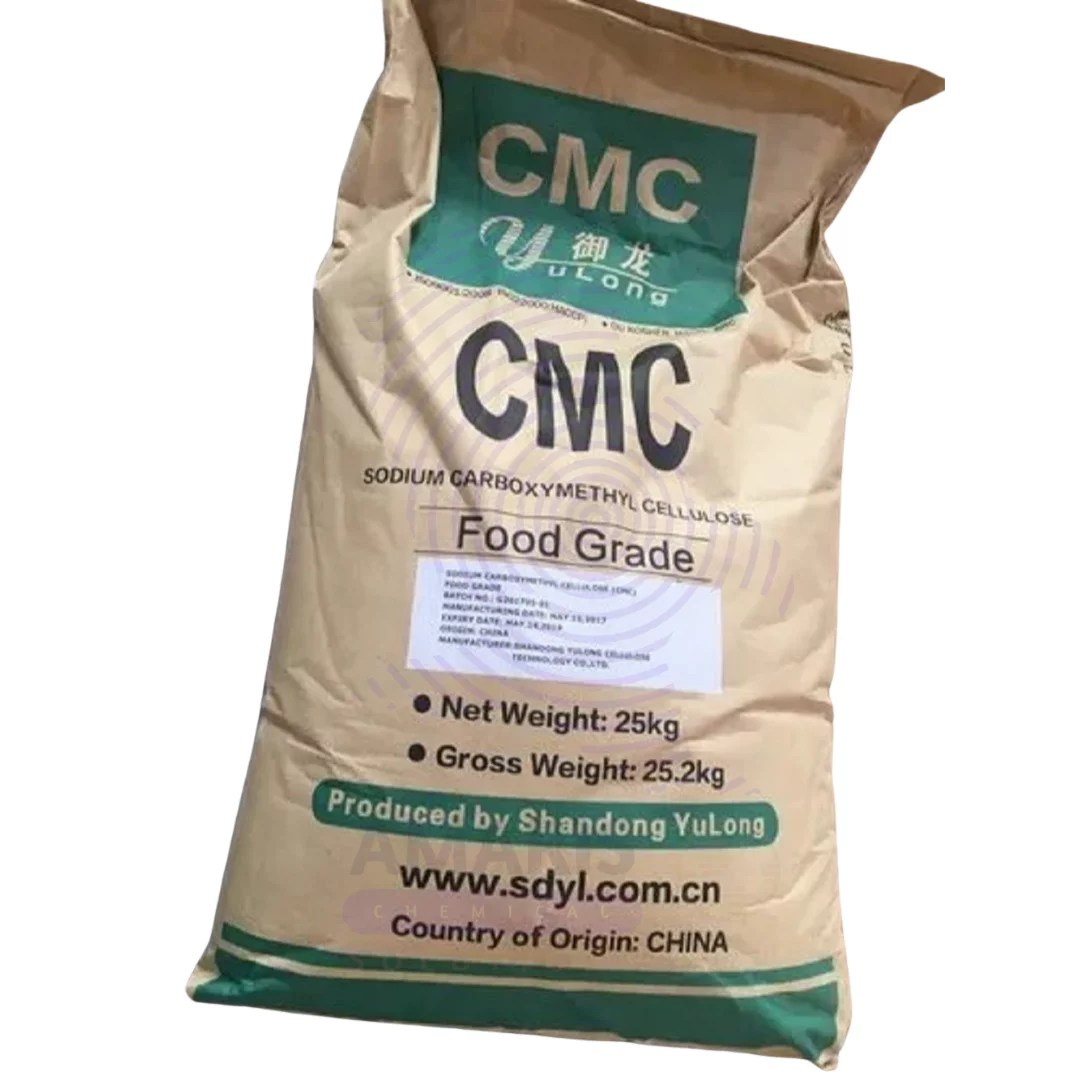
Carboxymethyl Cellulose (CMC) Food Grade
Welcome to Olinc Chemical Suppliers, your chemical and food ingredient supply partner in Nairobi, Kenya.
Are you looking for Carboxymethyl Cellulose (CMC) Food Grade for food manufacturing, beverage production, bakery processing, dairy products or other food-processing applications? Carboxymethyl Cellulose is a versatile food additive widely used as a thickener, stabiliser, water-binding agent and texture modifier.
It is particularly valued for its ability to improve the consistency of food products, prevent unwanted separation, retain moisture and create smooth textures. From ice cream and yoghurt to sauces, fruit drinks, bakery fillings and processed foods, CMC plays an important role in modern food formulation.
Also known as Sodium Carboxymethyl Cellulose, Sodium CMC or Cellulose Gum, it is identified by the food additive number E466.
Food manufacturers choose CMC because different grades can be selected to achieve specific viscosity levels and stabilisation requirements. Whether you need a low-viscosity grade for beverages or a higher-viscosity grade for sauces and other thickened products, selecting the correct specification is important for achieving the desired result.
Olinc Chemical Suppliers welcomes enquiries from food manufacturers, bakeries, beverage producers, dairy processors and other commercial businesses looking for CMC Food Grade in Nairobi and across Kenya.
Contact us for information about available grades, technical specifications, packaging and supply arrangements.
What Is Carboxymethyl Cellulose (CMC)?
Carboxymethyl Cellulose is a water-soluble cellulose derivative produced by chemically modifying cellulose, a natural polymer found in plant cell walls.
In food manufacturing, the product commonly referred to as CMC is its sodium salt, known as Sodium Carboxymethyl Cellulose.
The modification introduces carboxymethyl groups into the cellulose structure, making the resulting material capable of interacting with water and forming viscous solutions.
When added to water under suitable mixing conditions, CMC hydrates and increases the viscosity of the liquid. Depending on its grade and concentration, it can produce anything from a slightly thickened solution to a highly viscous mixture.
Its main functions in food processing include:
- Thickening liquids and semi-liquid products.
- Stabilising emulsions and food dispersions.
- Binding and retaining water.
- Improving mouthfeel and texture.
- Suspending particles in beverages and other liquids.
- Reducing moisture separation in suitable formulations.
- Improving consistency during processing and storage.
CMC is especially useful because manufacturers can select different viscosity grades depending on the final product requirements.
Chemical Identification and General Properties
| Property | Details |
|---|---|
| Product name | Carboxymethyl Cellulose Food Grade |
| Common commercial name | Sodium Carboxymethyl Cellulose |
| Other name | Cellulose Gum |
| Chemical name | Sodium salt of the carboxymethyl ether of cellulose |
| Chemical formula | Variable polymeric formula |
| CAS number | 9004-32-4 |
| EC number | 618-378-6 |
| Food additive number | E466 |
| International numbering | INS 466 |
| Appearance | White or slightly yellowish powder |
| Odour | Generally odourless |
| Taste | Generally tasteless |
| Solubility | Forms a viscous colloidal solution in water |
| Chemical category | Modified cellulose polymer |
| Main functions | Thickener, stabiliser, suspending agent and water binder |
CMC is a polymer, so it does not have one fixed molecular weight like a simple chemical compound. Its molecular characteristics depend on the degree of polymerisation and degree of substitution.
The exact appearance, viscosity, moisture content and other properties depend on the manufacturer’s grade and specification.
Other Names for Carboxymethyl Cellulose
Carboxymethyl Cellulose is sold and described under several names in chemical catalogues, food ingredient databases and technical documents.
Common alternative names include:
- Carboxymethyl Cellulose
- Carboxymethylcellulose
- Sodium Carboxymethyl Cellulose
- Sodium Carboxymethylcellulose
- Sodium CMC
- NaCMC
- CMC
- CMC Powder
- Cellulose Gum
- Sodium Cellulose Glycolate
- Sodium Cellulose Ether
- Cellulose Carboxymethyl Ether, Sodium Salt
- E466
- INS 466
For food manufacturing, the most commonly used commercial names are Sodium CMC, Carboxymethyl Cellulose and Cellulose Gum.
When purchasing, ensure that the product is specifically identified as food grade and that the CAS number is 9004-32-4.
Do not confuse ordinary food-grade CMC (E466) with cross-linked sodium carboxymethyl cellulose (E468), which is a different modified cellulose food additive with different functional properties.
How Does CMC Work in Food Formulations?
CMC works primarily through hydration and viscosity development.
When the powder is dispersed and hydrated in water, its polymer chains interact with the surrounding water molecules. This increases the resistance of the mixture to flow and produces a thicker, more consistent solution.
Its functionality can be explained through several important properties.
Thickening
CMC increases the viscosity of liquid and semi-liquid food products.
This is useful when manufacturers need a thicker sauce, a creamier beverage or a more consistent dairy product.
Water Binding
CMC helps bind water within a food formulation. This can reduce unwanted moisture movement and help maintain the desired texture.
It is particularly useful in bakery products, fillings, sauces and processed foods.
Stabilisation
It helps maintain the uniformity of suitable food formulations by reducing the tendency of ingredients to separate.
For example, it can help improve the stability of dairy beverages and sauces.
Suspension
CMC can help keep solid particles suspended in liquids.
This is useful in fruit beverages, flavoured drinks, sauces and other products containing dispersed ingredients.
Texture Improvement
It can improve mouthfeel by creating a smoother and more consistent texture.
In products such as ice cream, yoghurt and sauces, this can contribute to the desired eating experience.
Reduced Moisture Separation
In suitable formulations, CMC helps reduce syneresis, which is the unwanted release of liquid from a gel or semi-solid food product.
This can be important in dairy products, fillings, sauces and other moisture-sensitive foods.
Main Applications and Uses of CMC Food Grade
CMC Food Grade is used in a wide range of food and beverage manufacturing applications.
Ice Cream Manufacturing
Ice cream production is one of the important applications of food-grade CMC.
It acts as a stabiliser and thickening agent, helping improve the structure and consistency of ice cream.
Its functions include:
- Helping control ice crystal growth during storage.
- Improving smoothness and mouthfeel.
- Supporting product stability during temperature fluctuations.
- Reducing unwanted texture changes.
- Helping maintain a consistent frozen dessert structure.
- Supporting resistance to melting and texture deterioration, depending on the overall formulation.
CMC may be used in:
- Vanilla ice cream.
- Chocolate ice cream.
- Strawberry ice cream.
- Commercial dairy ice cream.
- Frozen desserts.
- Ice cream mixes.
- Selected non-dairy frozen desserts.
For ice cream manufacturers, selecting the correct viscosity grade is important because excessive thickening can negatively affect the final texture.
Yoghurt and Dairy Products
CMC is used in selected dairy formulations to improve viscosity, texture and stability.
It can help reduce the separation of liquid whey and improve the consistency of certain yoghurt products.
Applications include:
- Drinking yoghurt.
- Flavoured yoghurt.
- Set yoghurt.
- Stirred yoghurt.
- Dairy desserts.
- Milk-based beverages.
- Flavoured milk.
- Dairy-based dessert mixes.
In acidified milk beverages, specialised CMC grades may be selected to help stabilise proteins under acidic conditions.
Not every CMC grade performs equally well in acidic dairy systems. Manufacturers should select a grade designed for the product’s pH, protein content and processing conditions.
Beverage Manufacturing
CMC is widely used in selected beverage formulations where viscosity control, suspension and stability are required.
Applications include:
- Fruit juices.
- Fruit drinks.
- Flavoured beverages.
- Concentrated drinks.
- Powdered beverage mixes.
- Syrups.
- Nutritional beverages.
- Selected dairy drinks.
It can help suspend fruit particles, improve mouthfeel and maintain a more uniform beverage appearance.
For beverages, lower-viscosity or specially designed grades may be preferred to avoid making the final drink excessively thick.
Sauce and Condiment Manufacturing
CMC is useful in sauce production because it helps develop the required thickness and consistency.
It can also help reduce separation and improve the suspension of spices and other ingredients.
Common applications include:
- Tomato sauce.
- Ketchup.
- Chilli sauce.
- Barbecue sauce.
- Salad dressings.
- Mayonnaise-style dressings.
- Cooking sauces.
- Gravy.
- Marinades.
- Dipping sauces.
The appropriate grade depends on the desired flow behaviour, acidity, salt content and other formulation ingredients.
Bakery Manufacturing
CMC is used in selected bakery formulations as a thickener, stabiliser and water-binding ingredient.
It can help improve moisture retention and texture in suitable products.
Applications include:
- Bread.
- Cakes.
- Biscuits.
- Cookies.
- Pastries.
- Bakery fillings.
- Cake creams.
- Icings.
- Glazes.
- Dough-based products.
It can be particularly useful in certain gluten-free bakery formulations, although its functionality differs from that of gluten and must be considered alongside the other ingredients.
Processed Meat Products
CMC may be used in certain processed meat formulations as a water-binding and texture-modifying ingredient where permitted.
Potential applications include:
- Sausages.
- Processed meat preparations.
- Meat patties.
- Selected restructured meat products.
Its suitability depends on the specific product category, processing conditions and regulatory requirements.
Confectionery Manufacturing
CMC can help control texture and consistency in selected confectionery products.
Applications may include:
- Fillings.
- Dessert toppings.
- Fruit preparations.
- Sweet sauces.
- Confectionery coatings.
- Certain gel-like preparations.
Instant Food and Powdered Mixes
CMC can be included in selected dry food mixes to provide thickening and stabilising functionality after hydration.
Examples include:
- Instant soups.
- Gravy mixes.
- Sauce powders.
- Dessert mixes.
- Beverage powders.
- Bakery premixes.
The grade should be selected according to its dispersibility, hydration behaviour and desired final viscosity.
Other Industrial Applications of CMC
Although this product page focuses on food-grade CMC, carboxymethyl cellulose is also manufactured for other industries.
These applications require suitable non-food grades and should not automatically be associated with food-grade material.
Pharmaceutical Manufacturing
CMC and certain specialised cellulose derivatives are used in pharmaceutical formulations as binders, thickeners and stabilisers.
Cosmetics and Personal Care
CMC may be used in selected formulations such as:
- Toothpaste.
- Creams.
- Lotions.
- Cleansing products.
- Cosmetic gels.
Detergent Manufacturing
Selected grades are used in detergent formulations and other cleaning products.
Paper and Textile Industries
CMC can be used as a binder, thickener and processing aid in selected paper and textile applications.
Paints and Coatings
Industrial grades may be used to control viscosity and improve suspension in selected water-based coatings.
Important: Food-grade CMC should be selected and documented for its intended food application. Industrial-grade CMC should not be substituted into food production.
Why Do Food Manufacturers Choose CMC?
CMC is valued by food manufacturers because it performs several functions in one ingredient.
1. Effective thickening: It increases viscosity and helps manufacturers achieve the desired consistency.
2. Improved product stability: It helps maintain uniformity and reduce unwanted separation.
3. Water retention: It helps control moisture movement in suitable products.
4. Better texture: It contributes to smoothness, body and mouthfeel.
5. Suspension capability: It helps keep dispersed particles evenly distributed.
6. Versatility: It can be used in dairy, beverages, sauces, bakery products and other food formulations.
7. Flexible viscosity grades: Manufacturers can choose a grade according to the thickness and processing performance they require.
8. Compatibility with other ingredients: It can be combined with selected starches, gums and other hydrocolloids to achieve specific formulation properties.
Understanding CMC Viscosity Grades
One of the most important factors when purchasing CMC is viscosity grade.
Different CMC products can have significantly different thickening capabilities even though they share the same chemical identity and CAS number.
Viscosity determines how thick a solution becomes under specified testing conditions.
Commercial CMC may be available in:
- Low-viscosity grades.
- Medium-viscosity grades.
- High-viscosity grades.
- Very-high-viscosity grades.
- Specialised acid-resistant grades.
- Rapid-dispersing grades.
Low-Viscosity CMC
Low-viscosity grades are generally considered for formulations where manufacturers need stabilisation and some thickening without making the product excessively thick.
Potential applications include selected beverages and liquid food products.
Medium-Viscosity CMC
Medium-viscosity grades can be suitable for products requiring moderate thickness and stability.
Potential applications include certain sauces, dairy products and food preparations.
High-Viscosity CMC
High-viscosity grades are considered where stronger thickening is required.
Potential applications include selected sauces, fillings, creams and other semi-solid products.
Acid-Resistant CMC
Certain specialised CMC grades are designed for use in acidic formulations, including selected acidified dairy beverages.
These grades may have higher degrees of substitution and improved performance under particular formulation conditions.
Always confirm the manufacturer’s actual specification before selecting an acid-resistant grade.
Degree of Substitution (DS) and Why It Matters
Degree of Substitution, commonly abbreviated as DS, describes the average number of hydroxyl groups on the cellulose structure that have been substituted with carboxymethyl groups.
It is an important technical characteristic of CMC because it influences water solubility, hydration, viscosity behaviour and performance in different formulations.
Different CMC grades may have different DS values.
The degree of substitution can affect:
- Solubility in water.
- Hydration behaviour.
- Compatibility with salts and other ingredients.
- Performance in acidic formulations.
- Viscosity development.
- Stability in different processing conditions.
A grade with a higher DS is not automatically better for every application. The appropriate specification depends on the food being manufactured.
For buyers, it is useful to request the DS value alongside the viscosity specification.
Typical Technical Specifications of Food-Grade CMC
The following table provides general reference values found in commercial food-grade specifications. Actual requirements vary by manufacturer and applicable standard.
| Parameter | Typical specification or description |
|---|---|
| Appearance | White or slightly yellowish powder |
| Identification | Sodium Carboxymethyl Cellulose |
| CAS number | 9004-32-4 |
| Food additive number | E466 |
| Purity, dry basis | Common food-grade specification: not less than 99.5% |
| Moisture / loss on drying | Often specified at 8–10% maximum, depending on grade and standard |
| pH of 1% solution | Commonly around 6.5–8.5 |
| Degree of substitution | Common commercial range approximately 0.7–0.9; specialised grades may differ |
| Viscosity | Depends on grade and test conditions |
| Sodium chloride | Controlled according to the applicable specification |
| Sodium glycolate | Controlled according to the applicable specification |
| Heavy metals | Must meet the applicable food-grade limits |
| Microbiological quality | Must comply with the relevant food-grade specification |
| Solubility | Produces a viscous colloidal solution in water |
Understanding Viscosity Measurements
CMC viscosity is often measured using a specified concentration of solution, temperature, instrument and spindle or rotational speed.
For example, a supplier may state a viscosity range for a 1% solution at 25°C.
When comparing two products, ensure that the test conditions are the same. A viscosity result obtained at 1% concentration cannot be directly compared with a result obtained at 2%.
The current manufacturer’s TDS and batch-specific COA should be used to confirm the exact values.
How to Use CMC Food Grade in Food Manufacturing
Correct dispersion and hydration are important when incorporating CMC into a formulation.
If the powder is added too quickly to water, the outside of the particles may hydrate rapidly and form lumps, preventing the inside from dispersing properly.
General incorporation guidance includes:
- Determine the required quantity according to the formulation.
- Ensure the mixing equipment and vessel are clean.
- Start agitation before introducing the powder.
- Add CMC gradually while maintaining suitable mixing.
- Allow sufficient time for complete hydration.
- Check the viscosity and consistency of the mixture.
- Make controlled adjustments based on formulation trials.
Dry Blending Method
CMC can be premixed with other dry ingredients, such as sugar or other powdered components, before being introduced into the liquid phase.
This can improve particle separation and reduce lump formation.
High-Shear Mixing
Some manufacturing operations use high-shear mixers or specialised powder-induction equipment to improve dispersion and hydration.
The appropriate method depends on the CMC grade, batch size and production equipment.
Recommended Usage Levels of CMC
The quantity of CMC required depends on the intended food product, viscosity grade, formulation and processing conditions.
Some food formulations use CMC at approximately 0.1–1.0% of the finished product, although the required amount can fall outside this range.
The following table provides illustrative starting points for formulation development only.
| Application | Illustrative starting range |
|---|---|
| Beverages | 0.05–0.30% |
| Drinking yoghurt | 0.10–0.50% |
| Ice cream | 0.10–0.50% |
| Sauces and dressings | 0.10–0.50% |
| Bakery products | 0.10–0.50% |
| Fillings and toppings | 0.10–0.80% |
| Selected processed foods | Formulation-dependent |
These are not universal recommendations or legal maximum levels. The correct concentration must be established through formulation trials and verified against the applicable food additive regulations for the destination market.
Excessive CMC can make a product too thick, sticky or gummy, so manufacturers should optimise the concentration rather than simply increasing the quantity.
CMC Compared with Other Food Thickeners and Stabilising Agents
Food manufacturers may compare CMC with other hydrocolloids when selecting ingredients for their products.
| Product | Main function | Common applications |
|---|---|---|
| CMC (E466) | Thickening, stabilising and water binding | Ice cream, dairy, sauces and beverages |
| Xanthan Gum (E415) | Thickening, suspension and stabilisation | Sauces, dressings and beverages |
| Guar Gum (E412) | Thickening and water binding | Dairy, bakery and frozen desserts |
| Carrageenan (E407) | Gelling, thickening and stabilisation | Dairy products and desserts |
| Pectin (E440) | Gelling and thickening | Jams, fruit preparations and confectionery |
| Gelatin | Gelling and texture formation | Desserts and confectionery |
| Modified Starch | Thickening, binding and texture control | Sauces, soups and processed foods |
CMC vs Xanthan Gum
Both are used as thickeners and stabilisers, but their flow properties and formulation behaviour differ.
CMC is particularly useful for water binding and viscosity control in selected dairy, bakery and beverage products. Xanthan Gum is valued for its strong shear-thinning behaviour and suspension capabilities.
The best choice depends on the desired texture and processing requirements.
CMC vs Guar Gum
Both are cellulose or plant-derived hydrocolloid ingredients used to increase viscosity.
Guar Gum is a powerful water-binding thickener, while CMC offers useful viscosity control and stabilisation in a variety of formulations.
They can also be combined in some formulations to achieve specific performance characteristics.
CMC vs Carrageenan
CMC and Carrageenan have different functional properties. Carrageenan is particularly useful for gel formation and dairy protein interactions, depending on the type.
CMC is generally used for thickening, stabilising and water binding. They should not be treated as direct substitutes without formulation testing.
Packaging of CMC Food Grade
Food-grade CMC is commonly supplied as a fine powder in sealed packaging designed to protect the product from moisture and contamination.
A common commercial packaging format is:
- 25 kg bags.
Other packaging formats may be available depending on the manufacturer and supplier.
When purchasing, confirm:
- Net weight per bag.
- Packaging material.
- Whether the bag has an appropriate moisture barrier.
- Product batch number.
- Manufacturing and expiry or retest dates, as applicable.
- Food-grade identification.
- Manufacturer details.
For large food-processing operations, customers can enquire about bulk purchasing and regular supply arrangements.
Storage and Handling of CMC Food Grade
CMC is hygroscopic, meaning it can absorb moisture from its surroundings. Proper storage is therefore important.
Recommended storage practices include:
- Store in a cool, dry and well-ventilated area.
- Keep the product in its original sealed packaging.
- Protect it from moisture and humidity.
- Avoid direct contact with water before use.
- Keep bags away from direct sunlight and excessive heat.
- Store away from strong odours and possible contaminants.
- Use clean, dry handling equipment.
- Reseal opened bags properly after use.
- Follow the manufacturer’s recommended storage conditions and shelf life.
For food manufacturing, CMC should be stored in a clean ingredient-storage area that meets the facility’s hygiene and pest-control requirements.
Safety Precautions
Food-grade CMC is widely used in food formulations, but the powdered material should still be handled responsibly.
Recommended precautions include:
- Avoid unnecessary inhalation of airborne powder.
- Minimise dust generation during handling.
- Wear suitable protective gloves when handling bulk quantities.
- Use safety glasses where dust exposure is possible.
- Use appropriate respiratory protection where required by the workplace risk assessment.
- Wash hands after handling.
- Keep bags sealed when not in use.
- Follow the product-specific Safety Data Sheet.
For food production, use only material supported by appropriate food-grade documentation and maintain hygienic handling procedures.
Quality and Regulatory Considerations
Before using CMC in commercial food production, manufacturers should verify that the product complies with the relevant food additive specifications.
Important standards and documentation may include:
JECFA specifications: The Joint FAO/WHO Expert Committee on Food Additives has published specifications for Sodium Carboxymethyl Cellulose, including identity, purity and functional-use information.
FCC specifications: The Food Chemicals Codex may be relevant where a customer requires FCC-compliant food ingredients.
National food regulations: Food additive permissions and maximum use levels depend on the product category and destination market.
Certificate of Analysis: This document provides batch-specific quality results.
Technical Data Sheet: This provides technical properties such as viscosity, moisture, pH, DS and particle size.
Safety Data Sheet: This provides storage, handling and safety information.
For customers supplying food products to different markets, the relevant destination-market requirements should be checked before production.
Factors to Consider When Buying CMC Food Grade
Selecting the correct CMC is important because different grades can produce different results in the same formulation.
Before purchasing, consider the following:
Intended Application
State whether you need CMC for ice cream, yoghurt, beverages, sauces, bakery products or another food application.
Viscosity Grade
Specify whether you require low, medium or high viscosity. If you have a target viscosity, share the test method and measurement conditions.
Degree of Substitution
Confirm the DS requirement, especially when working with acidic or specialised food formulations.
Food-Grade Documentation
Request the TDS, COA and SDS. Confirm that the material complies with the required food-grade standard.
Particle Size
Particle size can influence powder dispersion, dust formation and hydration behaviour.
Packaging
Confirm the available packaging and whether it meets your storage requirements.
Quantity Required
Indicate whether you need one bag, several bags or larger commercial quantities.
Delivery Location
Provide your delivery location so that supply and transport arrangements can be discussed.
CMC Food Grade Supplier in Nairobi, Kenya
Are you searching for Carboxymethyl Cellulose Food Grade in Nairobi or elsewhere in Kenya?
Olinc Chemical Suppliers welcomes enquiries from food manufacturers, bakeries, dairy processors, beverage producers and commercial food-processing businesses.
We understand that manufacturers require different grades depending on their production processes. A CMC grade suitable for thickening a sauce may not be the best choice for stabilising a drinking yoghurt or improving ice cream texture.
When making an enquiry, let us know your intended application and required quantity so that the appropriate product specification can be discussed.
Whether you manufacture ice cream, yoghurt, sauces, beverages, bakery products or other processed foods, contact Olinc Chemical Suppliers for CMC Food Grade product and supply information.
Why Contact Olinc Chemical Suppliers?
- Nairobi-based chemical supplier.
- Product enquiries for food-processing and manufacturing requirements.
- Support for customers seeking grade and specification information.
- Convenient communication through phone, email and WhatsApp.
- Enquiries welcome for different commercial quantities.
We also welcome enquiries from businesses in other parts of Kenya and customers in Uganda and Tanzania seeking supply arrangements.
Frequently Asked Questions About CMC Food Grade
What is CMC Food Grade used for?
CMC Food Grade is used as a thickener, stabiliser, suspending agent and water-binding ingredient in food manufacturing. It is commonly used in ice cream, yoghurt, beverages, sauces, bakery products and other processed foods.
What is the full meaning of CMC?
CMC stands for Carboxymethyl Cellulose. In food applications, it commonly refers to Sodium Carboxymethyl Cellulose.
What is the E-number of CMC?
The food additive number for Sodium Carboxymethyl Cellulose is E466. Its international numbering system designation is INS 466.
What is the CAS number of CMC?
The CAS number is 9004-32-4.
Is CMC soluble in water?
CMC disperses and hydrates in water to form a viscous colloidal solution. It is commonly used in aqueous food formulations.
Is CMC used in ice cream?
Yes. CMC is used as a stabiliser and thickening agent in ice cream. It helps control ice crystal growth, improve texture and support product stability.
Can CMC be used in yoghurt?
Yes. Suitable food-grade CMC products are used in selected yoghurt and dairy formulations to improve consistency and reduce unwanted liquid separation.
Can CMC be used in beverages?
Yes. It is used in selected beverages to improve viscosity, suspend particles and help maintain formulation stability.
Is CMC a preservative?
No. Its primary functions are thickening, stabilising, suspending and water binding. It should not be treated as an antimicrobial preservative or a replacement for an appropriate food preservation system.
What is the difference between CMC and Sodium CMC?
In commercial food ingredient terminology, CMC commonly refers to Sodium Carboxymethyl Cellulose. Sodium CMC is the specific sodium salt form widely used as food additive E466.
What is the difference between CMC and Xanthan Gum?
Both are thickeners and stabilisers, but they have different chemical structures and formulation properties. CMC is valued for viscosity control and water binding, while Xanthan Gum is known for strong suspension and shear-thinning properties.
What is the difference between low-viscosity and high-viscosity CMC?
Low-viscosity grades produce less thickening under specified test conditions, while high-viscosity grades produce greater thickening. The correct grade depends on the required consistency and the food manufacturing process.
How much CMC should I use in food production?
The required quantity depends on the product, viscosity grade and formulation. Some applications use approximately 0.1–1.0%, but this is not a universal dosage or legal limit. Manufacturers should conduct formulation trials and follow applicable regulations.
Can CMC be mixed with Xanthan Gum or Guar Gum?
Yes. CMC can be combined with other hydrocolloids in selected formulations to achieve specific texture, stability and viscosity properties. The appropriate combination should be established through testing.
What packaging is available?
A common commercial packaging format is 25 kg bags. Actual pack sizes should be confirmed with the supplier.
What documents should I request before purchasing?
Request the current Technical Data Sheet, Certificate of Analysis and Safety Data Sheet. For food production, confirm the relevant food-grade compliance documentation.
Where can I buy CMC Food Grade in Kenya?
You can contact Olinc Chemical Suppliers in Nairobi, Kenya, to enquire about CMC Food Grade, including viscosity grades, technical specifications, packaging and supply arrangements.
Request a Quote for CMC Food Grade from Olinc Chemical Suppliers
Are you looking for a supplier of Carboxymethyl Cellulose Food Grade in Nairobi, Kenya, for ice cream production, yoghurt manufacturing, beverage processing, sauce production or other food applications?
Olinc Chemical Suppliers welcomes your enquiry.
Contact us with your required quantity and intended application so that the appropriate grade, specifications, packaging and supply arrangements can be discussed.
Company: Olinc Chemical Suppliers
Location: Enterprise Road, Avon Business Center, Nairobi, Kenya
Phone / WhatsApp: 0793062849
Alternative Phone: 0743657810
Email: sales@olincinchemicals.com
Website: www.olincchemicalsl.com
Looking for CMC Food Grade in Kenya? Contact Olinc Chemical Suppliers for product enquiries and supply information.

Reviews
There are no reviews yet.