
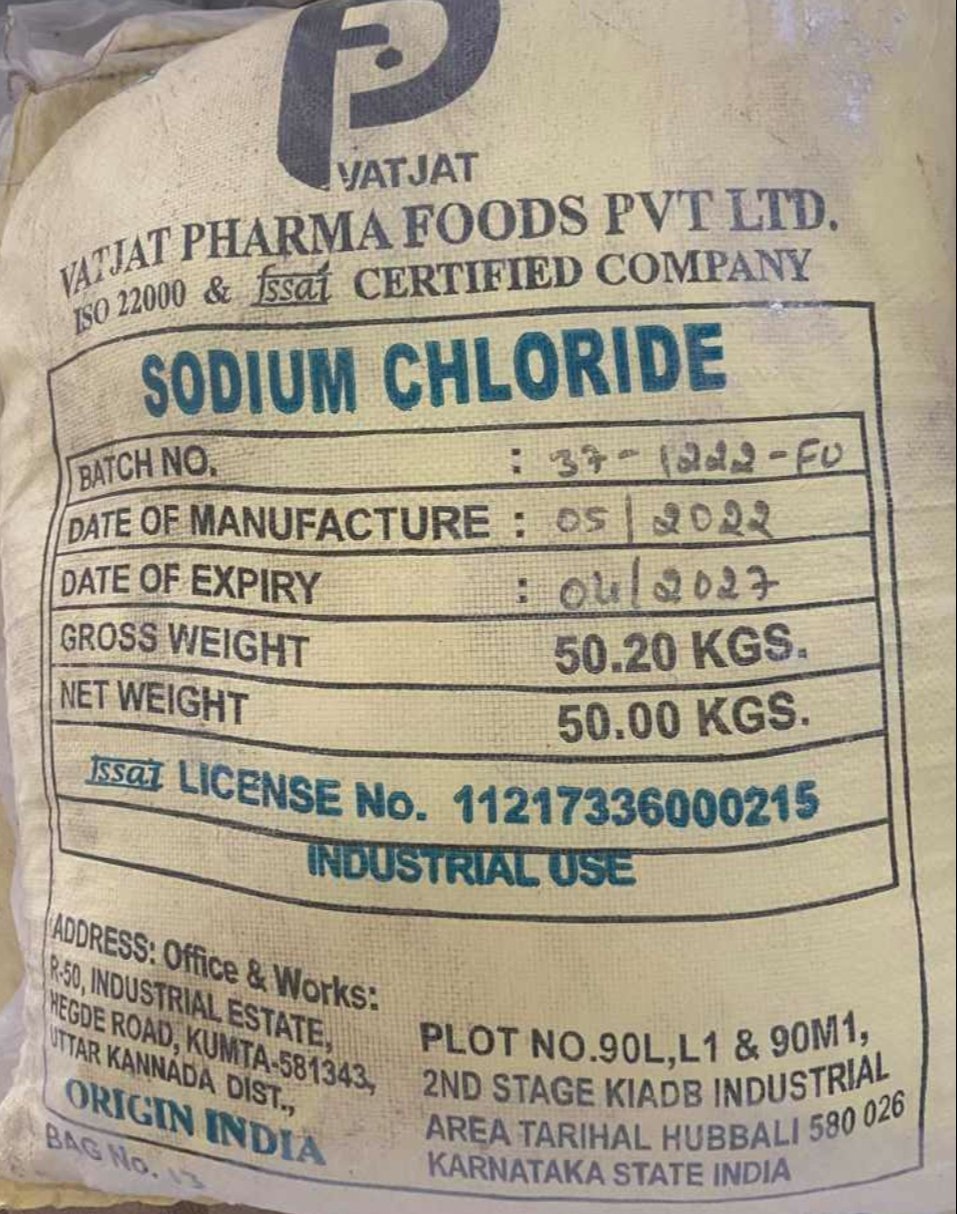
Sodium Chloride (Industrial Salt) Supplier in Kenya | Olinc Chemical Suppliers
Olinc Chemical Suppliers supplies sodium chloride, commonly known as salt, for industrial, commercial and water treatment applications in Nairobi, Kenya. We welcome enquiries from manufacturers, water treatment companies, textile processors and other businesses seeking suitable salt for their operations.
Sodium chloride is an inorganic chemical compound with the formula NaCl. It occurs naturally in seawater and mineral deposits and is commercially produced through the evaporation of seawater or brine, and through the mining and processing of rock salt.
It is widely used in chemical manufacturing, water softening, textile processing, food production and other industrial applications. Its suitability depends on the purity, moisture content, particle size and grade required by the application.
At Olinc Chemical Suppliers, customers can enquire about available sodium chloride grades, packaging, quantities and current prices.
Whether you require industrial salt for a manufacturing process, water softening or chemical production, selecting the correct grade helps ensure reliable performance and consistent results.
What Is Sodium Chloride?
Sodium chloride is a crystalline ionic compound made up of sodium ions and chloride ions. In its pure form, it appears as a white or colourless crystalline solid and dissolves readily in water.
Sodium chloride has several important properties that make it valuable to industry. It provides chloride ions for chemical reactions, increases the ionic strength of solutions and supports regeneration processes in certain water softeners.
It is used in many sectors, including:
-
Industrial chemical manufacturing.
-
Water treatment and water softening.
-
Textile and dyeing operations.
-
Soap and detergent manufacturing.
-
Food processing, when a suitable food-grade product is used.
-
Selected pharmaceutical and laboratory applications.
-
Brine preparation and other industrial processes.
Although sodium chloride is commonly called salt, not all commercial salt meets the same quality standards. Industrial salt may contain moisture or mineral impurities that are acceptable for one application but unsuitable for another.
Alternative Names for Sodium Chloride
Customers may search for sodium chloride under several different names.
| Name | Description |
|---|---|
| Sodium chloride | Standard chemical name. |
| NaCl | Chemical formula. |
| Common salt | Widely used general name. |
| Industrial salt | Salt intended for specified industrial applications. |
| Rock salt | Salt obtained from underground mineral deposits. |
| Vacuum salt | Refined salt produced by evaporating purified brine under controlled conditions. |
| Brine salt | A term sometimes used for salt intended for preparing brine solutions. |
| Refined salt | Salt processed to achieve specified purity and physical characteristics. |
These terms are related, but they do not guarantee identical purity, particle size or suitability. Buyers should confirm the exact product specification before placing an order.
Types and Grades of Sodium Chloride
Different sodium chloride grades are designed to meet different commercial requirements.

Industrial-Grade Sodium Chloride
Industrial salt is used in manufacturing and processing operations where the specified purity and impurity limits meet process requirements.
Common applications include selected chemical production, brine preparation, textile processing and other industrial processes.

Water Softener Salt
This grade is used to regenerate ion-exchange resin in compatible water softening systems. It helps restore the resin’s capacity to remove hardness-causing calcium and magnesium ions.
Depending on the equipment, suitable products may be supplied as crystals, granules, tablets or pellets. The salt must meet the equipment manufacturer’s requirements.

Food-Grade Sodium Chloride
Food-grade salt is intended for food processing and must comply with applicable food safety and purity requirements.
It is used in seasoning, food preservation, baking, meat processing and other food applications. Iodised and non-iodised products may be available depending on the supplier.

Laboratory or High-Purity Sodium Chloride
High-purity grades are manufactured for applications requiring controlled impurity levels and defined specifications.
These may be used in laboratory testing, analytical preparation and specialised industrial processes. Buyers should specify the required analytical or reagent grade.
The grades and physical forms available from Olinc Chemical Suppliers should be confirmed when requesting a quotation.
Uses of Sodium Chloride in Different Industries
Water Treatment and Water Softening
Sodium chloride plays an important role in many water softening systems.
Water hardness is mainly caused by dissolved calcium and magnesium ions. In conventional ion-exchange softeners, the resin captures these ions and releases sodium ions into the treated water.
When the resin becomes exhausted, a concentrated sodium chloride solution, known as brine, is used to regenerate it.
Sodium chloride is therefore used for:
-
Regenerating ion-exchange water softener resin.
-
Supporting water softening in commercial buildings.
-
Treating process water in industrial facilities.
-
Supporting compatible boiler-feed water preparation systems.
-
Preparing brine for selected treatment processes.
Important: Sodium chloride does not remove hardness simply by being added to hard water. It is used as part of a suitable regeneration system. It is also not a general-purpose disinfectant.
Chemical Manufacturing
Sodium chloride is a major raw material in the chlor-alkali industry.
Through the electrolysis of purified brine, manufacturers can produce important chemicals, including chlorine, sodium hydroxide and hydrogen, depending on the process technology.
These chemicals are subsequently used in the production of plastics, detergents, water treatment chemicals and other industrial materials.
Sodium chloride is also used to prepare brine for various chemical processes. In these applications, purity is important because impurities may interfere with production, affect equipment or contaminate the final product.
Textile and Dyeing Industry
Sodium chloride is used in certain textile dyeing processes, particularly in dye systems where salt helps control dye exhaustion onto fibres.
Applications include:
-
Supporting dye uptake in suitable dyeing processes.
-
Preparing dye baths.
-
Maintaining the required salt concentration in selected textile operations.
The required grade and dosage depend on the fibre type, dye chemistry and production method. Salt is not required in every dyeing process, so manufacturers should follow their formulation and process specifications.
Soap and Detergent Manufacturing
Sodium chloride is used in some soap and detergent formulations.
In traditional soap manufacturing, salt can help separate soap from the aqueous mixture during certain production processes. In selected liquid detergent formulations, it may also be used to adjust viscosity.
Its effect depends on the formulation. Excess salt can reduce viscosity or cause separation in some products, so controlled addition and testing are important.
Food Processing
Food-grade sodium chloride is widely used in food manufacturing because it contributes to flavour, preservation and product functionality.
Common applications include:
-
Meat and fish processing.
-
Bakery products.
-
Snack foods and seasonings.
-
Pickling and brining.
-
Cheese and selected dairy processing.
-
General food preparation and preservation.
Food manufacturers must use an appropriate food-grade product and comply with applicable food safety requirements.
Brine Preparation
Sodium chloride dissolves in water to form brine, a solution used in various industrial processes.
Brine is used in selected applications such as:
-
Industrial chemical manufacturing.
-
Food processing and pickling.
-
Compatible cooling and refrigeration systems.
-
Selected industrial process operations.
The required salt purity and brine concentration depend on the application. High-purity brine may be required for electrolysis and other sensitive chemical processes.
Other Industrial Applications
Depending on the grade and process, sodium chloride may also be used in:
-
Mineral processing.
-
Selected laboratory procedures.
-
Specialised manufacturing operations.
-
Certain industrial separation processes.
-
Other applications where a controlled source of sodium and chloride ions is required.
Customers should provide their intended use when requesting a quotation so that the appropriate grade can be identified.
Benefits of Sodium Chloride
Sodium chloride offers several practical advantages for commercial and industrial users.
-
Versatile raw material: Used in numerous chemical and manufacturing processes.
-
Water softening support: Enables regeneration of compatible ion-exchange resins.
-
Brine preparation: Dissolves in water to produce solutions for industrial processing.
-
Chemical production: Provides the chloride source for chlor-alkali production and other suitable processes.
-
Multiple physical forms: Available in different crystal sizes and processed forms, depending on the application.
-
Wide industrial use: Serves food processing, textile, detergent, water treatment and chemical manufacturing sectors.
-
Scalable purchasing: Commercial and industrial buyers can specify the quantity and packaging required.
Performance depends on the quality of the salt and the conditions of the process in which it is used.
Technical Specifications of Sodium Chloride
When purchasing sodium chloride, it is important to review the technical data sheet and, where required, the certificate of analysis.
| Specification | Description |
|---|---|
| Chemical name | Sodium chloride |
| Chemical formula | NaCl |
| CAS number | 7647-14-5 |
| Appearance | White or colourless crystalline solid |
| Odour | Odourless |
| Solubility | Readily soluble in water |
| Molar mass | Approximately 58.44 g/mol |
| Purity | Depends on grade and supplier specification |
| Moisture content | Depends on processing and storage |
| Particle size | Fine, medium, coarse or a specified form |
| Main quality checks | Sodium chloride assay, moisture and relevant impurity limits |
These are general identifying properties, not a guarantee of the specifications of every supplied product.
For specialised applications, customers may also need limits for calcium, magnesium, sulphates, insoluble matter, iron and other impurities.
Why is sodium chloride purity important?
Purity affects how sodium chloride performs in industrial processes.
For example, high levels of calcium and magnesium may be undesirable in brine used for certain chemical production processes. In water softening, the suitability of the salt depends on the softener design and the manufacturer’s specifications.
For food production, the product must meet the required food safety standards. A product that is acceptable for general industrial use is not automatically suitable for food or pharmaceutical use.
Sodium Chloride Packaging and Bulk Supply
Sodium chloride is commonly supplied in bags or larger bulk packaging, depending on the grade and order size.
Commercial packaging options in the market may include:
-
Smaller bags for low-volume commercial requirements.
-
25 kg bags for many industrial and manufacturing applications.
-
50 kg bags where available.
-
Larger bulk deliveries for high-volume industrial users.
These are common market packaging formats, not a confirmation of current Olinc stock. Packaging should be verified when placing an order.
Salt should be stored in a dry area and protected from moisture and contamination. For sensitive manufacturing applications, appropriate packaging helps maintain the required product quality during storage and transport.
When enquiring from Olinc Chemical Suppliers, state the required grade, quantity, preferred bag size and delivery location.
How to Choose the Right Sodium Chloride
Before purchasing sodium chloride, consider the following:
-
Intended application: Is the salt for water softening, chemical production, textiles, food processing or another purpose?
-
Required grade: Does your process need industrial, food-grade or high-purity material?
-
Purity requirements: Are there limits for calcium, magnesium, sulphates or insoluble matter?
-
Particle size: Does your equipment require fine crystals, coarse crystals, granules or tablets?
-
Packaging: Do you need 25 kg bags, 50 kg bags or bulk delivery?
-
Documentation: Do you require a technical data sheet or certificate of analysis?
-
Quantity and delivery: How much do you need, and where should it be delivered?
Providing these details helps prevent purchasing the wrong grade and makes it easier to receive an accurate quotation.
Safety, Handling and Storage
Sodium chloride is generally a low-hazard material under ordinary handling conditions, but industrial users should still apply good chemical-handling practices.
-
Avoid inhaling excessive dust, particularly when handling fine powders.
-
Wear suitable protective equipment where dust exposure is possible.
-
Keep the product dry and protect it from contamination.
-
Store in clean, suitable packaging in a dry location.
-
Follow the supplier’s handling instructions for specialised grades.
-
Avoid discharging large quantities of concentrated salt solutions into the environment, as excess salinity can harm plants and aquatic organisms.
Food-grade salt should be stored and handled in a manner that prevents contamination from industrial chemicals or other unsuitable materials.
Frequently Asked Questions About Sodium Chloride
What is sodium chloride commonly called?
Sodium chloride is commonly known as salt or common salt. In industrial supply, it is often called industrial salt when intended for manufacturing and other technical applications.
What is the chemical formula of sodium chloride?
The chemical formula is NaCl. It consists of sodium and chloride ions in a one-to-one ratio.
Is sodium chloride the same as industrial salt?
Industrial salt is generally sodium chloride intended for industrial applications. However, industrial salt grades can vary in purity, moisture content, particle size and impurities.
Is sodium chloride used in water treatment?
Yes. It is commonly used to regenerate ion-exchange resin in water softening systems. It can also be used to prepare brine for selected industrial treatment processes.
Does sodium chloride remove hardness from water?
In a conventional water softener, sodium chloride is used to regenerate the resin that removes calcium and magnesium ions. Simply adding salt to hard water does not soften it.
Is industrial salt the same as table salt?
Both are principally sodium chloride, but their purity, processing, additives and quality requirements may differ. Industrial salt should not be used for food unless it is specifically suitable and compliant with the applicable food safety standards.
What is sodium chloride used for in chemical manufacturing?
It is an important raw material for brine-based chemical production, including the manufacture of chlorine and sodium hydroxide through chlor-alkali electrolysis. It also serves as a source of chloride ions in other processes.
What packaging is available for sodium chloride?
Packaging varies by supplier and grade. Commercial bags, including 25 kg and 50 kg formats, are common market options, but availability should be confirmed with Olinc Chemical Suppliers.
How much does sodium chloride cost in Kenya?
Pricing depends on the grade, purity, packaging, quantity and delivery location. Contact Olinc Chemical Suppliers for an up-to-date quotation.
Where can I buy sodium chloride in Nairobi, Kenya?
Contact Olinc Chemical Suppliers at Enterprise Road, Avon Business Center, Nairobi, to enquire about available grades, packaging and current prices.
Can I order sodium chloride in bulk?
Bulk enquiries are welcome. Provide the required grade, quantity, packaging and delivery location so that availability and pricing can be confirmed.
Request a Quotation for Sodium Chloride
Are you looking for a sodium chloride or industrial salt supplier in Nairobi, Kenya?
Olinc Chemical Suppliers welcomes enquiries from manufacturing companies, water treatment operators, textile processors, chemical manufacturers and other commercial buyers.
Contact us to discuss your required grade, product specifications, packaging and order quantity.
Olinc Chemical Suppliers
-
Location: Enterprise Road, Avon Business Center, Nairobi, Kenya
-
Email: sales@olincinchemicals.com
-
Website: www.olincinchemicalsl.com
-
Phone/WhatsApp: 0793062849
When requesting a quotation, mention whether you need sodium chloride for water softening, chemical manufacturing, textile processing, food production or another application.
Contact Olinc Chemical Suppliers today to enquire about sodium chloride for your business in Kenya, Uganda or Tanzania.


Reviews
There are no reviews yet.