
Glycerol Monostearate (GMS) Supplier in Nairobi, Kenya | Olinc Chemical Suppliers
Looking for a reliable supplier of Glycerol Monostearate (GMS) in Nairobi, Kenya, Uganda or Tanzania? Olinc Chemical Suppliers supplies industrial and specialty chemicals to manufacturers, wholesalers, laboratories and businesses across East Africa. Glycerol Monostearate is a versatile fatty acid ester widely used in food processing, cosmetics, pharmaceuticals and industrial manufacturing.
GMS is valued for its ability to improve emulsion stability, texture, consistency and product performance. It is commonly used in bakery products, ice cream, margarine, creams, lotions, hair conditioners, personal-care products and other formulations where emulsification or texture control is required.
Whether you are manufacturing food products, cosmetics, personal-care formulations or industrial products, choosing the correct GMS grade is important. Contact Olinc Chemical Suppliers for product availability, grade information, packaging options and competitive quotations.
What Is Glycerol Monostearate (GMS)?
Glycerol Monostearate, commonly abbreviated as GMS, is a non-ionic emulsifier produced by combining glycerol (glycerine) with stearic acid, a fatty acid commonly obtained from vegetable or animal fats and oils.
It belongs to a group of compounds known as monoglycerides. Its molecular structure contains a glycerol component and a stearic acid component, giving it both oil-compatible and water-compatible characteristics. This makes it useful in formulations containing ingredients that would otherwise separate.
GMS is widely used as an emulsifier, stabiliser, thickening aid, texture modifier and processing aid. In food manufacturing, it can improve softness, aeration and consistency. In cosmetics, it helps create smooth creams and lotions. In industrial applications, it can provide lubrication and modify surface properties.
Commercial GMS is generally supplied as white to off-white flakes, beads, granules or powder, depending on the grade and manufacturer.
Other Names for Glycerol Monostearate
When searching for GMS, buyers may encounter several related names. These include:
- Glycerol Monostearate
- Glyceryl Monostearate
- GMS
- Glyceryl Stearate
- Glycerol Stearate
- Monostearin
- Glycerol Monostearate 40–60
- Distilled Monoglycerides
- DMG (Distilled Monoglycerides)
- Food Emulsifier E471 (when supplied as a compliant food-additive preparation)
Important: These names are related, but they do not always describe exactly the same commercial product. For example, distilled monoglycerides generally contain a higher proportion of monoglycerides than standard commercial GMS. Glyceryl stearate used in cosmetics may also have different specifications or be supplied as part of a blended emulsifier system. Always confirm the manufacturer’s product specification before ordering.
Chemical and Physical Properties of GMS
| Property | Description |
|---|---|
| Product name | Glycerol Monostearate |
| Common abbreviation | GMS |
| Chemical family | Fatty acid glycerol ester |
| Common CAS number | 31566-31-1 for commercial glyceryl monostearate mixtures |
| Related CAS number | 123-94-4 for 1-monostearin |
| Appearance | White to off-white solid |
| Physical form | Flakes, beads, granules or powder |
| Odour | Generally mild or characteristic fatty odour |
| Solubility | Practically insoluble in water; disperses or melts in suitable formulation phases |
| Melting range | Commonly around 55–65°C, depending on grade and composition |
| Main functions | Emulsification, stabilisation and texture modification |
| Food additive identification | E471, where the product meets applicable food-grade requirements |
The exact specifications depend on the manufacturer, raw materials and grade. Buyers should request a Technical Data Sheet (TDS), Safety Data Sheet (SDS) and, where applicable, Certificate of Analysis (COA) to verify the product being supplied.
Main Functions and Benefits of Glycerol Monostearate
GMS performs several important functions in manufacturing.
Emulsifier
GMS helps improve the compatibility of oil-based and water-based ingredients. It supports the formation and stability of emulsions, helping reduce unwanted separation in suitable formulations.
Emulsion Stabiliser
In creams, lotions and food products, GMS can help maintain a more uniform structure. It is frequently used together with other emulsifiers because the correct emulsifier combination depends on the formulation.
Thickening and Texture Modification
GMS can improve body, viscosity and consistency in creams, lotions and other formulated products. It helps manufacturers achieve the desired texture and feel.
Moisture and Softness Improvement
In bakery applications, GMS can help improve crumb softness and maintain product quality during storage. It is also used in formulations where moisture management and texture are important.
Aeration and Foam Support
In certain food formulations, GMS helps support air incorporation and maintain a stable structure. This makes it useful in selected whipped, frozen and aerated products.
Processing Aid
Depending on the application, GMS can improve processing characteristics, product consistency and the performance of finished formulations.
Applications of Glycerol Monostearate
GMS is used in several industries because of its emulsifying and stabilising properties.
Food and Beverage Manufacturing
Glycerol Monostearate is widely used as a food emulsifier in suitable food-grade formulations. It helps improve texture, stability and product quality.
Common applications include:
- Bread and bakery products: Helps improve crumb softness, texture and freshness retention.
- Cakes and pastries: Supports texture and aeration in suitable recipes.
- Ice cream: Helps improve body, texture and the stability of the frozen structure.
- Margarine and spreads: Supports emulsion stability and consistency.
- Whipped toppings: Helps support aeration and structure.
- Confectionery: Used in selected formulations to modify texture and processing properties.
- Non-dairy creamers: Helps stabilise fat-containing formulations.
- Processed foods: Used where emulsification and texture improvement are required.
Food manufacturers should purchase a grade specifically documented for food use. The product must meet the relevant food-additive specifications and applicable regulations in the intended market.
Cosmetics and Personal-Care Manufacturing
GMS is an important ingredient in cosmetic and personal-care formulations. It can help improve texture, consistency and emulsion stability.
Common applications include:
- Body lotions
- Face creams
- Moisturising creams
- Body butters
- Hair conditioners
- Hair creams
- Hand creams
- Sunscreen formulations
- Cleansing creams
- Selected skin-care products
In lotions and creams, GMS helps create a smooth, rich texture. It is often combined with other emulsifiers, fatty alcohols and oils to achieve the desired formulation.
Pharmaceutical Manufacturing
Depending on its grade and regulatory documentation, GMS can be used in selected pharmaceutical formulations and manufacturing processes.
Potential applications include:
- Excipients in selected formulations
- Tablet and capsule manufacturing aids
- Lubrication and processing applications
- Emulsion-based preparations
Pharmaceutical manufacturers must confirm pharmacopeial compliance, purity and suitability before use. Ordinary industrial or cosmetic-grade GMS should not automatically be treated as pharmaceutical grade.
Industrial Manufacturing
GMS is also used in selected industrial formulations because of its fatty-acid ester structure and surface-modifying properties.
Applications may include:
- Industrial lubricants and processing aids
- Plastic and polymer processing
- Surface treatment formulations
- Textile processing
- Selected mould-release and anti-static applications
The suitability of GMS depends on the required performance and the manufacturer’s specification.
Different Grades and Types of GMS
Choosing the correct grade is one of the most important purchasing decisions.
Standard Glycerol Monostearate
Standard commercial GMS may contain a mixture of mono-, di- and triglycerides. Some products are marketed with a monoester content around 40–60%, but the actual specification must be checked.
It is used in selected food, cosmetic and industrial applications depending on its certification and composition.
Distilled Glycerol Monostearate (DMG)
Distilled monoglycerides have a higher concentration of monoglycerides than standard GMS. Many commercial products are specified at approximately 90% or higher monoester content, although the exact specification varies.
They are commonly selected for applications requiring more concentrated emulsifying performance, including certain bakery and food formulations.
Self-Emulsifying GMS
Some GMS products are blended with additional ingredients, such as soaps or other emulsifying agents, to improve their ability to disperse in water and form emulsions.
These products are not identical to pure GMS. Their composition and recommended use should be checked carefully.
Food-Grade GMS
Food-grade GMS is intended for permitted food applications and must meet the relevant purity, quality and regulatory requirements. It may be identified as E471 when it meets the applicable specifications.
Cosmetic-Grade GMS
Cosmetic-grade GMS is used in personal-care and skin-care formulations. Buyers should verify the ingredient declaration, purity and intended application.
Before ordering: Tell us whether you need GMS for food manufacturing, cosmetics, pharmaceuticals or industrial use so that the appropriate grade can be confirmed.
How Is GMS Used in Formulations?
The method of incorporation depends on the product being manufactured.
GMS is generally introduced into a suitable heated oil or fat phase so that it melts and can be distributed evenly. The oil phase is then combined with the appropriate water phase under controlled mixing conditions when preparing an emulsion.
For creams and lotions, the emulsifier system must be selected according to the oil phase, water phase, desired texture and stability requirements.
For food manufacturing, the incorporation method depends on the recipe, equipment, temperature and intended food application.
There is no single dosage that is correct for every GMS formulation. The required amount depends on the grade and application. Manufacturers should follow the supplier’s technical recommendations, applicable food regulations and formulation testing.
What Should You Check Before Buying GMS?
Before placing an order, consider the following:
- Application: Is the product intended for food, cosmetics, pharmaceutical or industrial manufacturing?
- Monoester content: Does the formulation require standard GMS or a higher-concentration distilled monoglyceride?
- Physical form: Do you require flakes, beads, granules or powder?
- Purity and specifications: Check the manufacturer’s TDS and COA.
- Regulatory documentation: Food and pharmaceutical buyers should verify the relevant compliance documents.
- Packaging: Confirm the available pack size and whether it suits your production requirements.
- Storage requirements: Ensure you can store the material in a cool, dry environment.
These checks help prevent purchasing a grade that does not match your manufacturing process.
Packaging and Supply Information
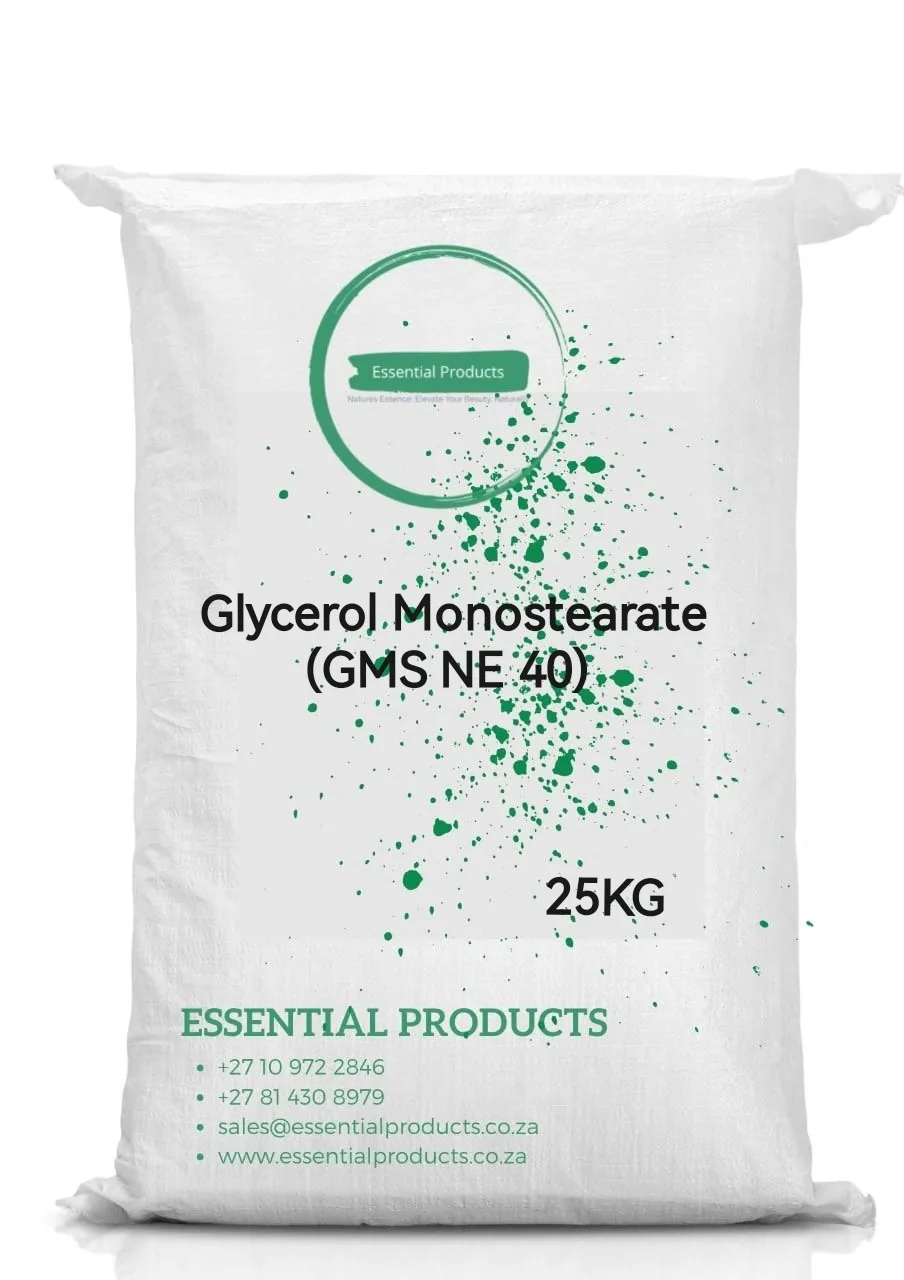
Glycerol Monostearate is commonly supplied in industrial packaging, often in sealed bags. A 25 kg bag is a common commercial packaging format in the market, but packaging varies by manufacturer and product.
At Olinc Chemical Suppliers, contact our team to confirm:
- Available GMS grade
- Current stock and origin
- Available packaging sizes
- Bulk-order quantities
- Price per kilogram or bag
- Delivery and collection arrangements
For bulk requirements, share your estimated quantity and intended application so that we can assist with the appropriate quotation.
Storage and Handling of GMS
Correct storage helps maintain the quality of GMS.
- Store in a cool, dry and well-ventilated area.
- Keep the product in its original, tightly sealed packaging.
- Protect it from moisture and contamination.
- Avoid excessive heat and direct sunlight.
- Keep away from incompatible materials as indicated in the SDS.
- Use clean, dry handling equipment.
- Follow the manufacturer’s shelf-life and storage recommendations.
When handling GMS in powder or fine-particle form, avoid creating or inhaling dust. Use suitable protective equipment and follow the product-specific Safety Data Sheet.
Why Choose Olinc Chemical Suppliers for GMS?
Olinc Chemical Suppliers serves manufacturers, businesses and industrial customers looking for chemical products in Nairobi and across East Africa.
When enquiring about Glycerol Monostearate from Olinc, you can:
- Request information on the available GMS grade.
- Confirm suitability for your intended application.
- Enquire about packaging and bulk quantities.
- Request current pricing and a quotation.
- Arrange collection or discuss delivery options.
We serve customers in Nairobi, across Kenya, Uganda and Tanzania. Whether you are a small-scale manufacturer or a business purchasing for larger production requirements, contact us with your specifications and quantity.
Frequently Asked Questions About Glycerol Monostearate (GMS)
What is Glycerol Monostearate used for?
GMS is used as an emulsifier, stabiliser and texture modifier in food, cosmetics, personal-care, pharmaceutical and selected industrial formulations. It helps improve consistency and supports the mixing of ingredients that may otherwise separate.
Is GMS the same as Glyceryl Monostearate?
The names Glycerol Monostearate and Glyceryl Monostearate are commonly used for the same general chemical ingredient. However, commercial products may differ in monoester content, composition and grade. Always check the technical specification.
Is GMS a food emulsifier?
Yes. Suitable food-grade GMS is used as an emulsifier in permitted food applications and is commonly associated with food additive E471. Buyers must confirm that the particular product meets the required food-grade specifications and regulations.
What is the difference between GMS and distilled monoglycerides?
Standard GMS may contain a mixture of mono-, di- and triglycerides. Distilled monoglycerides have a higher concentration of monoglycerides and are used where a more concentrated emulsifier is required.
Is GMS used in cosmetics?
Yes. Cosmetic-grade GMS is used in creams, lotions, body butters, conditioners and other personal-care formulations to help improve texture and emulsion stability.
Is GMS soluble in water?
GMS is practically insoluble in water. It is generally incorporated by melting it into a suitable oil or fat phase or using a grade specifically designed for easier dispersion.
Can GMS be used in liquid soap?
GMS may be suitable for selected personal-care or cleansing formulations, but it is not a direct replacement for primary surfactants such as SLES or LABSA. Its suitability depends on the formulation and the intended product texture.
What is the appearance of GMS?
Commercial GMS is commonly supplied as white to off-white flakes, beads, granules or powder, depending on the manufacturer.
What is the melting point of GMS?
Many commercial GMS grades have a melting range around 55–65°C. The exact melting range depends on the product composition and should be verified from the manufacturer’s TDS.
What packaging is available for GMS?
Packaging depends on the manufacturer and grade. Industrial bags, including 25 kg bags, are common in the market. Contact Olinc Chemical Suppliers to confirm available packaging.
Where can I buy Glycerol Monostearate in Nairobi, Kenya?
You can contact Olinc Chemical Suppliers in Nairobi, Enterprise Road, Avon Business Center, to enquire about Glycerol Monostearate availability, grade, packaging and pricing.
Does Olinc supply GMS to Uganda and Tanzania?
Olinc Chemical Suppliers serves customers in Nairobi and receives enquiries from across Kenya, Uganda and Tanzania. Contact us to discuss your quantity, location and supply requirements.
Order Glycerol Monostearate (GMS) from Olinc Chemical Suppliers
Are you looking for a dependable source of Glycerol Monostearate in Nairobi, Kenya, Uganda or Tanzania? Contact Olinc Chemical Suppliers for current availability, grade specifications, packaging information and a quotation.
When requesting a quotation, please provide:
- Product: Glycerol Monostearate (GMS)
- Intended application: Food, cosmetics, pharmaceutical or industrial
- Required quantity
- Preferred packaging
- Delivery location
Olinc Chemical Suppliers
Location: Nairobi, Enterprise Road, Avon Business Center
Phone / WhatsApp: 0793062849
Email: sales@olincinchemicals.com
Website: www.olincinchemicalsl.com
Contact us today for your GMS supply enquiry and let our team assist you with your chemical requirements.
Reviews
There are no reviews yet.