
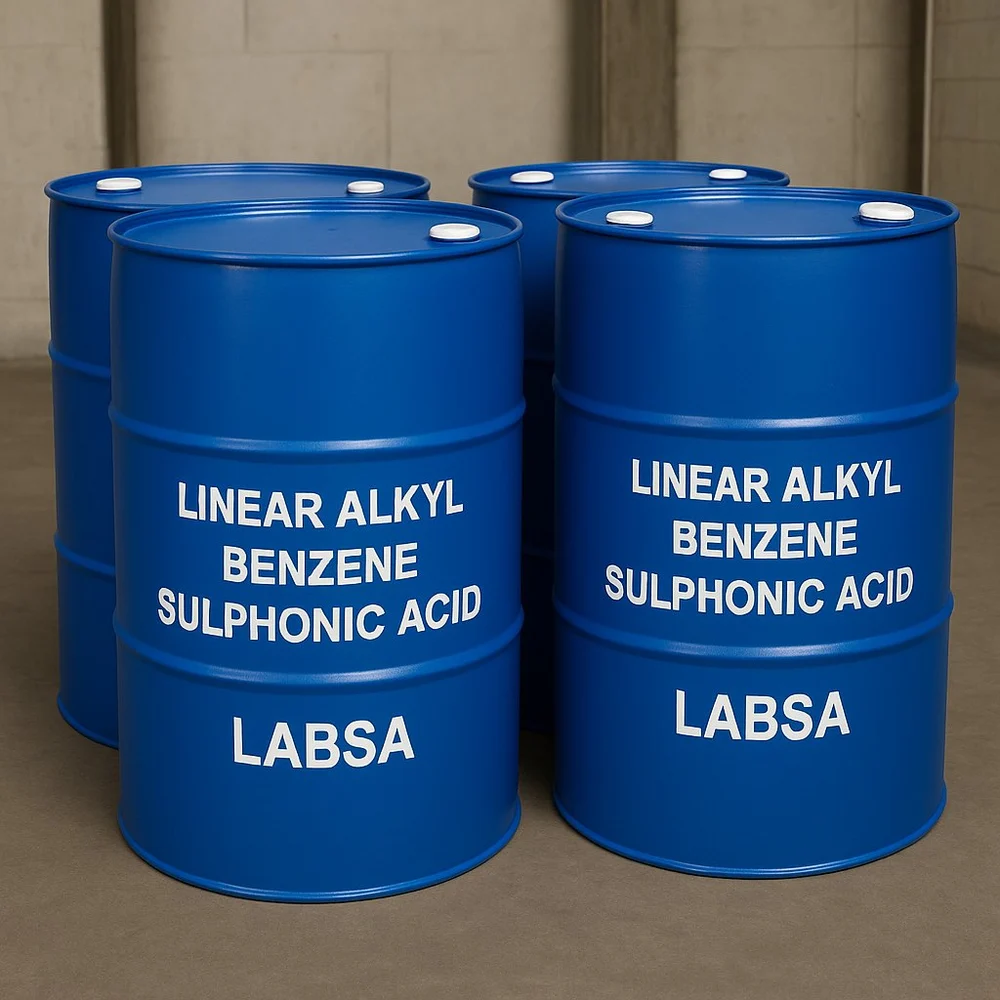
LABSA 96% Supplier in Kenya | Olinc Chemical Suppliers
LABSA 96% (Linear Alkyl Benzene Sulphonic Acid) is a widely used anionic surfactant raw material in the manufacture of liquid detergents, washing powders, dishwashing liquids, multipurpose cleaners and other cleaning products. It is valued for its excellent detergency, grease-removal ability and strong surface-active properties.
LABSA 96% is particularly important in detergent manufacturing because it can be neutralised with an alkali, such as caustic soda, to produce the active surfactant used in many cleaning formulations.
Olinc Chemical Suppliers welcomes enquiries for LABSA 96% in Nairobi, Kenya, Uganda and Tanzania. Whether you manufacture liquid soap, laundry detergent, dishwashing liquid or industrial cleaning products, contact us to enquire about availability, packaging, pricing and bulk supply.
What is LABSA 96%?
LABSA stands for Linear Alkyl Benzene Sulphonic Acid. It is an organic sulfonic acid and an important raw material in the detergent industry. The 96% grade commonly refers to a product with approximately 96% active matter, although the exact specification should be confirmed from the manufacturer’s Technical Data Sheet (TDS) and Certificate of Analysis (COA).
LABSA is normally supplied as a viscous liquid or paste, usually brown to dark brown in appearance. It has strong acidic properties and is commonly used as an intermediate in the production of anionic surfactants.
In detergent manufacturing, LABSA is typically neutralised using an alkali such as sodium hydroxide (caustic soda). This produces sodium linear alkylbenzene sulfonate, commonly abbreviated as LAS, which provides the cleansing and foaming action in the finished detergent.
Why is LABSA important in detergent production?
-
Helps remove grease, oil and dirt from surfaces and fabrics.
-
Provides strong detergency in household and commercial cleaning products.
-
Can be neutralised to produce an effective anionic surfactant.
-
Works in a variety of liquid and powder detergent formulations.
-
Can be blended with other compatible surfactants and formulation ingredients.
-
Is widely used by manufacturers of laundry detergents, dishwashing liquids and multipurpose cleaners.
Other names for LABSA 96%
LABSA is known by several names in the chemical and detergent manufacturing industries. Buyers may use different spellings, abbreviations or commercial descriptions when searching for this product.
Common names and related search terms include:
-
Linear Alkyl Benzene Sulphonic Acid
-
Linear Alkylbenzene Sulphonic Acid
-
Linear Alkyl Benzene Sulfonic Acid
-
Linear Alkylbenzene Sulfonic Acid
-
LABSA
-
LABSA 96%
-
LABSA 96
-
LABSA Acid
-
LABSA 96 Percent
-
Linear Alkyl Benzene Acid
-
Alkylbenzene Sulphonic Acid
-
Alkylbenzene Sulfonic Acid
-
Linear Alkylbenzene Sulfonate Precursor
-
Detergent Acid Slurry
-
Acid Slurry
-
Sulphonic Acid (a common informal trade description)
Important distinction: LABSA is the acid form. When it is neutralised with an alkali, it forms a salt such as Sodium Linear Alkylbenzene Sulfonate (LAS). These names are related but do not describe exactly the same supplied chemical. Always confirm whether a supplier is offering LABSA acid or pre-neutralised LAS.
Chemical identity and product information
| Property | Details |
|---|---|
| Product name | Linear Alkyl Benzene Sulphonic Acid |
| Common abbreviation | LABSA |
| Commercial grade | LABSA 96% |
| Chemical family | Organic sulfonic acid |
| Main function | Anionic surfactant raw material |
| Typical active matter | Approximately 96% |
| Appearance | Viscous liquid or paste |
| Typical colour | Brown to dark brown |
| Solubility | Disperses/reacts in water; neutralisation affects the resulting product |
| Main applications | Liquid detergents, washing powders and cleaning products |
| CAS number | Commonly 27176-87-0; confirm against supplier documentation |
The exact composition depends on the manufacturer’s raw materials and production process. LABSA specifications may include active matter, free oil, sulphuric acid content, colour, moisture and other quality parameters.
Main uses and applications of LABSA 96%
LABSA 96% is an important raw material for manufacturers of household, commercial and industrial cleaning products.
Liquid soap and liquid detergent manufacturing
LABSA is widely used in the manufacture of liquid detergents and liquid cleaning products. Before or during formulation, it is neutralised using a suitable alkali to produce the active detergent ingredient.
It is used in formulations for:
-
General-purpose liquid detergents.
-
Multipurpose household cleaning liquids.
-
Liquid laundry detergents.
-
Household washing liquids.
-
Commercial cleaning detergents.
-
Selected industrial cleaning formulations.
The resulting surfactant helps lift grease and dirt from surfaces, allowing them to be removed during washing and rinsing.
Dishwashing liquid production
LABSA is a key raw material in many dishwashing liquid formulations. Once appropriately neutralised, it provides detergency and helps remove oily residues and food grease from kitchen utensils.
It may be used in the manufacture of:
-
Manual dishwashing liquids.
-
Lemon dishwashing liquids.
-
Commercial kitchen detergents.
-
General-purpose dishwashing products.
-
Heavy-duty dishwashing formulations.
It is often combined with other surfactants, foam boosters, viscosity modifiers, fragrances, preservatives and other ingredients to achieve the desired product performance.
Laundry detergent and washing powder manufacturing
LABSA is extensively used in laundry detergent manufacturing. After neutralisation, the resulting LAS provides cleaning action that helps remove dirt, grease and oily stains from fabrics.
Applications include:
-
Powder laundry detergents.
-
Hand-washing detergents.
-
Machine-washing detergent formulations.
-
Liquid laundry detergents.
-
Commercial laundry cleaning products.
It is a valuable raw material for detergent manufacturers looking to produce cleaning products for household and institutional use.
Multipurpose household cleaners
LABSA-derived surfactants can be incorporated into multipurpose cleaners designed for washable household surfaces.
Potential applications include:
-
General-purpose cleaning liquids.
-
Kitchen surface cleaners.
-
Floor cleaning formulations.
-
Commercial surface detergents.
-
Selected heavy-duty household cleaning products.
The formulation should be tested for compatibility with the intended surface and cleaning method.
Industrial and commercial cleaning products
LABSA is also used in the production of selected industrial and institutional cleaning detergents.
Applications may include:
-
Industrial detergents.
-
Commercial cleaning liquids.
-
Equipment-cleaning formulations.
-
Institutional cleaning products.
-
Selected degreasing detergent formulations.
Its suitability depends on the cleaning requirements, formulation, pH and compatibility with the equipment or surface being cleaned.
Textile and fabric cleaning applications
LABSA-derived surfactants are useful in textile washing and cleaning formulations because they help remove oily and particulate contaminants from fabrics.
Depending on the formulation and process, they may be used in:
-
Textile washing detergents.
-
Fabric-cleaning products.
-
Industrial laundry formulations.
-
Certain textile wetting and cleaning systems.
Car wash and vehicle cleaning formulations
LABSA-derived surfactants may be used in selected vehicle-washing detergent formulations to help remove road dirt, oily deposits and other contaminants.
Potential applications include:
-
Car wash shampoo.
-
Vehicle washing liquids.
-
Commercial vehicle-cleaning detergents.
-
Selected workshop cleaning products.
The finished product should be tested to ensure it does not damage vehicle paint, protective coatings, plastics or other intended surfaces.
Institutional and hospitality cleaning products
Manufacturers supplying hotels, restaurants, schools, hospitals and cleaning contractors may use LABSA as a raw material in suitable detergent formulations.
Examples include:
-
Bulk dishwashing liquids.
-
Commercial laundry detergents.
-
General-purpose cleaning liquids.
-
Kitchen cleaning detergents.
-
Institutional washing products.
For specialised environments, the final product must meet the relevant cleaning, safety and regulatory requirements.
How LABSA 96% works in detergent manufacturing
LABSA is an acid-form surfactant raw material. To use it in many conventional detergent formulations, manufacturers neutralise it with a suitable alkali.
For example, when LABSA is neutralised with sodium hydroxide (caustic soda), it forms Sodium Linear Alkylbenzene Sulfonate (LAS), an anionic surfactant responsible for much of the cleaning performance in many detergents.
The general process involves:
-
Preparing the required formulation water and suitable mixing equipment.
-
Carefully incorporating LABSA according to a validated manufacturing procedure.
-
Adding the appropriate neutralising alkali under controlled conditions.
-
Monitoring pH and temperature throughout the process.
-
Blending in other compatible ingredients as required by the formulation.
-
Testing the finished product for pH, appearance, viscosity, stability and cleaning performance.
Important: LABSA is acidic and neutralisation can release heat. It should only be handled by trained personnel using suitable protective equipment, controlled addition and an appropriate manufacturing procedure. The amount of caustic soda required depends on the actual LABSA specification, its acid value and the desired finished-product pH. Do not rely on a fixed recipe without testing and calculation.
Key benefits of LABSA 96%
| Benefit | Importance to manufacturers |
|---|---|
| Strong detergency | Helps remove oily dirt, grease and other contaminants |
| High active matter | Provides a concentrated raw material for detergent production |
| Effective surfactant precursor | Can be neutralised to produce LAS |
| Good foaming performance | Supports foam production in suitable detergent formulations |
| Wetting properties | Helps cleaning liquids spread across surfaces |
| Emulsifying properties | Helps disperse oily substances in water-based formulations |
| Formulation flexibility | Can be combined with other compatible detergent ingredients |
| Wide industrial use | Suitable for many household, commercial and industrial detergent applications |
Typical manufacturer data sheets describe LABSA 96% as an anionic surfactant raw material with detergency, wetting, foaming and emulsifying functions.
Yeser Chemicals+2
LABSA 96% versus LABSA 90%
LABSA is commercially available in different active matter concentrations. Two grades that buyers may encounter are LABSA 96% and LABSA 90%.
| Feature | LABSA 96% | LABSA 90% |
|---|---|---|
| Active matter | Approximately 96% | Approximately 90% |
| Concentration | Higher | Lower |
| Non-active components | Generally lower proportion | Generally higher proportion |
| Formulation adjustment | Based on 96% active matter | Must account for 90% active matter |
| Applications | Detergent and cleaning product manufacturing | Detergent and cleaning product manufacturing |
Which grade should you choose?
LABSA 96% is a suitable choice when your formulation or production specification calls for a higher-active-matter acid slurry. LABSA 90% may be appropriate where the formulation has been designed around that concentration.
The grades should not be substituted weight-for-weight without adjusting the formulation. Always check the active matter and other quality parameters on the batch COA.
LABSA versus SLES, SLS and other detergent chemicals
It is important to distinguish LABSA from other surfactants and detergent raw materials before purchasing.
| Product | What it is | Common applications |
|---|---|---|
| LABSA 96% | Acidic surfactant raw material, usually neutralised before use | Washing powder, liquid detergents and dishwashing liquid |
| SLES 70% | Concentrated anionic surfactant supplied as a sodium salt | Shampoo, hand wash, body wash and detergents |
| SLS | Sodium Lauryl Sulfate, an anionic surfactant | Personal care and cleaning products |
| CAPB | Amphoteric surfactant | Shampoo, body wash and hand wash |
| CDEA | Non-ionic surfactant and foam/viscosity aid | Selected liquid detergents and personal-care formulations |
| Caustic soda | Strong alkali used for neutralisation and other industrial processes | LABSA neutralisation and various manufacturing processes |
Is LABSA the same as sulphonic acid?
LABSA is a specific type of sulphonic acid: Linear Alkyl Benzene Sulphonic Acid. In detergent trading, the phrase “sulphonic acid” is sometimes used informally to refer to LABSA, but it can be ambiguous. When ordering, specify LABSA 96% to avoid receiving a different acid or surfactant.
Is LABSA the same as SLES?
No. LABSA is supplied in its acidic form and is commonly neutralised before use in detergent formulations. SLES is supplied as an anionic surfactant salt, commonly in concentrated paste form. Both are used in cleaning products, but they have different chemical identities and formulation roles.
Can LABSA be used together with SLES?
Yes, LABSA-derived LAS and SLES may be used together in some detergent formulations. The formulation must account for neutralisation, pH, active matter, compatibility and the desired finished-product properties.
Technical specifications to check when buying LABSA 96%
Not all LABSA 96% products have identical specifications. If you manufacture detergents commercially, checking the technical parameters helps you maintain consistent production quality.
| Specification | What it tells the buyer |
|---|---|
| Active matter | The proportion of active surfactant acid |
| Free sulphuric acid | The amount of residual inorganic acid |
| Free oil / NDOM | The amount of unsulphonated organic material |
| Colour | Important for the appearance of the finished detergent |
| Acid value | Helps determine the neutralisation requirement |
| Moisture / water content | Indicates the amount of water present |
| Appearance | Helps identify the expected physical condition of the product |
| Density | Useful for handling, storage and formulation calculations |
Typical LABSA 96% specification range
The following are representative values found in commercial technical data sheets. They are not a guaranteed specification for every manufacturer’s product.
| Test parameter | Example specification |
|---|---|
| Active matter | Minimum 96% |
| Free sulphuric acid | Maximum approximately 1.5% |
| Free oil / NDOM | Maximum approximately 2.0% |
| Colour | Often specified using a Klett colour test |
| Appearance | Brown viscous liquid |
| Acid value | Commonly around 180–190 mg KOH/g |
Actual limits and testing methods vary by manufacturer. Request the batch-specific COA and TDS to confirm the product you intend to purchase.
Packaging and supply options for LABSA 96%
LABSA 96% is commonly supplied in industrial containers suitable for transporting and storing concentrated chemical raw materials
Common commercial packaging formats include:
-
HDPE plastic drums: Industrial drums, with common net weights around 210–225 kg depending on the supplier.
-
IBC tanks: Often approximately 1,000–1,050 kg, depending on the container and supplier.
-
Bulk tanker supply: Used for larger industrial requirements where suitable facilities and transport arrangements are available.
These are typical market packaging formats, not a confirmation of current Olinc stock or packaging. Confirm the available container size and net weight when requesting a quotation.
ucf.ae+2
Information to provide when placing an order:
-
Required quantity in kilograms or drums.
-
Confirmation that you need LABSA 96%.
-
Intended application, such as liquid soap or washing powder production.
-
Preferred packaging.
-
Delivery destination.
-
Any special technical specifications or documentation required.
Storage and handling of LABSA 96%
LABSA 96% is an acidic chemical raw material and must be handled with care. Proper storage and handling help maintain product quality and reduce workplace risks.
Storage recommendations
-
Keep in the original, compatible and tightly closed container.
-
Store in a cool, dry and well-ventilated chemical storage area.
-
Protect from direct sunlight and excessive heat.
-
Keep away from strong alkalis and incompatible chemicals during storage.
-
Use compatible storage tanks, drums, pumps and transfer equipment.
-
Keep containers clearly labelled.
-
Store away from food, beverages and unauthorised access.
-
Follow the manufacturer’s recommended storage temperature and shelf life.
Safety precautions
-
Wear chemical-resistant gloves, protective clothing and chemical splash goggles or a face shield.
-
Avoid direct contact with skin and eyes.
-
Avoid splashing when transferring or mixing.
-
Use appropriate ventilation.
-
Keep an eyewash station and emergency washing facilities accessible.
-
Train workers on the product SDS and spill-response procedures.
-
Do not mix LABSA with caustic soda or other chemicals without a controlled procedure.
LABSA 96% can cause serious skin and eye burns. Dilution and neutralisation can generate heat. In case of skin or eye contact, immediately rinse with plenty of clean water and seek urgent medical attention in accordance with the product SDS. Do not attempt to neutralise chemical contamination on the body.
For spills, restrict access, use trained personnel and follow the product-specific SDS. Prevent uncontrolled release into drains, waterways and the environment.
Factors to consider before buying LABSA 96%
Before purchasing LABSA for your manufacturing business, consider these important points:
1. Confirm the active matter
Make sure the product is LABSA 96% and not a lower-concentration grade. Active matter affects the amount required in your formulation.
2. Confirm the intended application
Tell your supplier whether you manufacture liquid detergent, washing powder, dishwashing liquid, multipurpose cleaner or another product. This helps establish the right technical requirements.
3. Request the COA and TDS
The Certificate of Analysis provides batch-specific test results, while the Technical Data Sheet explains the product’s technical properties and recommended handling.
4. Check the packaging
Confirm the net weight of each drum or IBC and make sure your storage and handling facilities can accommodate the container.
5. Consider supply consistency
If you manufacture detergents regularly, consistent quality and dependable replenishment are important for maintaining your production schedule.
6. Understand neutralisation requirements
Because LABSA is acidic, ensure your production process has a suitable neutralisation procedure, trained personnel and appropriate safety equipment.
Frequently asked questions about LABSA 96%
What is LABSA 96% used for?
LABSA 96% is mainly used as a raw material in the manufacture of laundry detergents, washing powders, dishwashing liquids, liquid soaps, multipurpose cleaners and industrial cleaning products.
What does LABSA stand for?
LABSA stands for Linear Alkyl Benzene Sulphonic Acid. It is an acidic anionic surfactant raw material used extensively in detergent manufacturing.
What is the difference between LABSA and acid slurry?
Acid slurry is a common commercial name used for LABSA in the detergent industry. When purchasing, specify LABSA 96% to make sure you get the required concentration and product.
Is LABSA 96% used for making liquid soap?
Yes. It is commonly used in liquid detergent and liquid soap manufacturing. It is generally neutralised using an appropriate alkali before being incorporated into the finished formulation.
Can LABSA be used to make washing powder?
Yes. LABSA is an important raw material in the manufacture of washing powder and laundry detergent formulations. It is neutralised and processed according to the manufacturer’s production method.
Can LABSA remove grease?
Yes. Once appropriately formulated and neutralised, LABSA-derived surfactants help remove grease, oily residues and dirt from washable surfaces and fabrics.
Is LABSA 96% the same as sulphonic acid?
LABSA is a specific type of sulphonic acid. However, the general term sulphonic acid can refer to other chemicals. Always confirm the full product name and concentration before ordering.
What is the difference between LABSA 96% and LABSA 90%?
The main difference is active matter concentration. LABSA 96% contains approximately 96% active matter, while LABSA 90% contains approximately 90%. Formulations must be adjusted when changing between the two grades.
Can LABSA be mixed with caustic soda?
Yes. Caustic soda is commonly used to neutralise LABSA during detergent production. However, the process releases heat and requires controlled addition, suitable protective equipment and pH monitoring.
Can LABSA be mixed with SLES?
Yes. LABSA-derived surfactants and SLES can be used together in some detergent formulations. The formulation must be properly designed to achieve the required pH, active matter, viscosity and cleaning performance.
11. What colour is LABSA 96%?
LABSA 96% is commonly brown or dark brown and has a viscous liquid or paste-like appearance. The precise colour depends on the manufacturer’s specification.
12. What packaging is available for LABSA 96%?
Common industrial packaging includes HDPE drums of approximately 210–225 kg and IBC containers of around 1,000–1,050 kg. Actual availability and net weight should be confirmed before ordering.
13. Is LABSA 96% corrosive?
Yes. LABSA 96% is an acidic and corrosive chemical that can cause serious skin and eye burns. It requires suitable PPE, careful handling and appropriate storage.
14. What documents should I request when buying LABSA?
You should request the Technical Data Sheet (TDS), Certificate of Analysis (COA) and Safety Data Sheet (SDS). These documents help confirm product specifications, batch quality and safe handling requirements.
15. Where can I buy LABSA 96% in Nairobi, Kenya?
You can contact Olinc Chemical Suppliers in Nairobi, Enterprise Road, Avon Business Center, to enquire about LABSA 96% availability, pricing and packaging options.
16. Does Olinc Chemical Suppliers serve customers in Uganda and Tanzania?
Olinc welcomes chemical supply enquiries from Kenya, Uganda and Tanzania. Contact us with your required quantity and delivery destination to discuss supply arrangements.
17. How do I request a quotation for LABSA 96%?
Contact Olinc Chemical Suppliers with your required quantity, preferred packaging and delivery location. You can also specify whether the LABSA is intended for liquid detergent, dishwashing liquid or washing powder production.
14. Why buy LABSA 96% from Olinc Chemical Suppliers?
Olinc Chemical Suppliers is a Nairobi-based chemical supplier serving manufacturers, businesses and industrial customers looking for quality chemical raw materials.
When enquiring about LABSA 96%, you can contact us for assistance with:
-
Current product availability and pricing.
-
Available packaging options.
-
Small and bulk quantity enquiries.
-
Product specifications and relevant documentation.
-
Chemical supply enquiries across Kenya, Uganda and Tanzania.
Whether you are starting a detergent manufacturing business or operating an established production facility, Olinc welcomes your enquiry for LABSA 96%.
15. Order LABSA 96% from Olinc Chemical Suppliers
LABSA 96% – Linear Alkyl Benzene Sulphonic Acid
Anionic surfactant raw material for detergent manufacturing
Olinc Chemical Suppliers
Nairobi, Enterprise Road, Avon Business Center
Phone / WhatsApp: 0793062849
Email: sales@olincinchemicals.com
Website: www.olincinchemicalsl.com
Enquire on WhatsApp


Reviews
There are no reviews yet.