
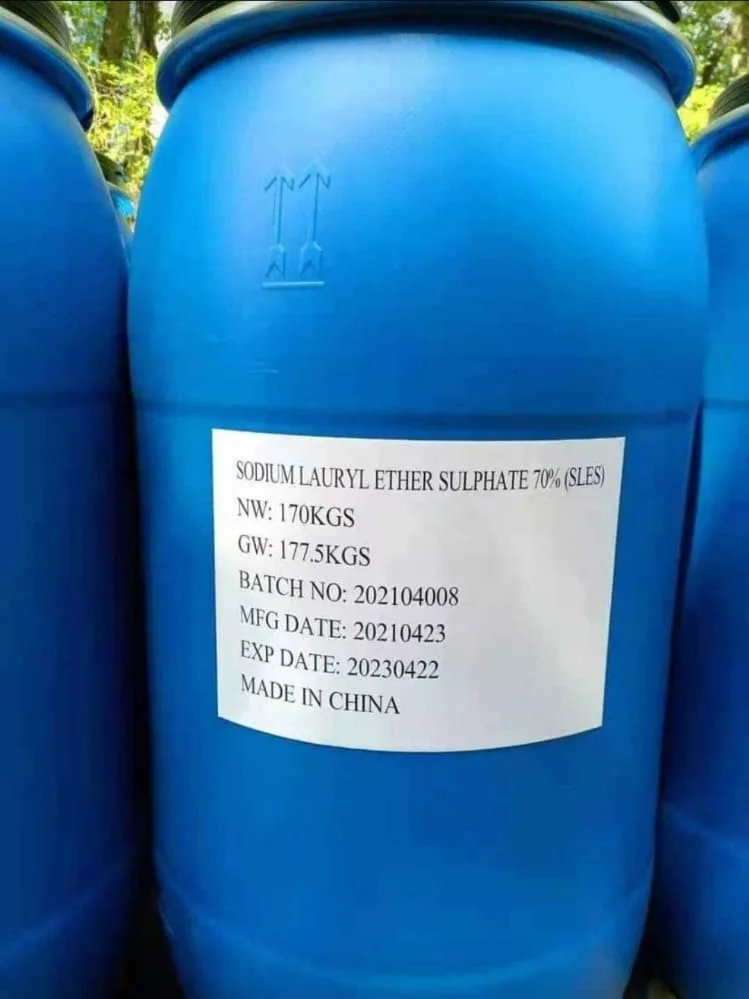
SLES 70% Supplier in Kenya | Olinc Chemical Suppliers
SLES 70% (Sodium Laureth Sulfate 70%) is a widely used anionic surfactant and cleansing ingredient in the manufacture of liquid detergents, shampoos, body washes, hand washes, dishwashing liquids and other cleaning and personal-care products. It is valued for its strong foaming ability, effective cleansing performance, good water solubility and compatibility with many other detergent ingredients.
Olinc Chemical Suppliers welcomes enquiries for SLES 70% in Nairobi, Kenya, Uganda and Tanzania. Whether you manufacture household detergents, cosmetics, personal-care products or industrial cleaning formulations, contact us to enquire about available grades, packaging, pricing and bulk supply.
What is SLES 70%?
SLES 70% is the abbreviation for Sodium Laureth Sulfate, an anionic surfactant commonly supplied as a thick, concentrated paste containing approximately 70% active matter. It is used to help water mix with oils, grease and dirt so that they can be lifted from surfaces, suspended in water and rinsed away.
It also produces abundant foam, making it a popular ingredient in products where customers expect a rich lather, such as shampoo, shower gel, liquid hand soap and dishwashing liquid.
SLES is manufactured by ethoxylating fatty alcohols, commonly derived from coconut or palm-kernel-based feedstocks, and then converting the resulting material into its sodium salt. The exact composition and performance can vary by manufacturer and grade.
Why do manufacturers choose SLES 70%?
-
Produces rich, abundant foam.
-
Helps remove grease, oils and everyday dirt.
-
Works in a wide range of liquid cleaning formulations.
-
Can be blended with other surfactants to improve product performance.
-
Is suitable for many household, commercial and personal-care products when the correct grade is selected.
-
Its concentrated 70% form allows manufacturers to formulate products using a smaller quantity of supplied material than a ready-diluted surfactant.
Other names for SLES 70%
Customers and manufacturers may search for this chemical using different names. Including these related terms helps buyers identify the product and helps your product page appear for relevant searches.
Common names and related search terms include:
-
Sodium Laureth Sulfate
-
Sodium Lauryl Ether Sulfate
-
Sodium Lauryl Ether Sulphate
-
Sodium Laureth Sulphate
-
SLES
-
SLES 70
-
SLES 70%
-
SLES 70 Percent
-
Sodium Laureth Sulfate 70%
-
Sodium Lauryl Ether Sulfate 70%
-
Sodium Lauryl Ether Sulphate 70%
-
Sodium Laureth Sulfate Paste
-
Sodium Laureth Sulfate Concentrate
-
Sodium Laureth Sulfate Surfactant
-
Anionic Surfactant
-
Ether Sulfate
-
AES (Alcohol Ether Sulfate)
-
Sodium Alcohol Ether Sulfate
Important naming clarification: SLES is not the same chemical as SLS (Sodium Lauryl Sulfate). They are related surfactants, but SLES contains ethoxy groups in its molecular structure. This affects its formulation properties and how it behaves in cleansing products. Buyers should not treat SLES and SLS as interchangeable without checking their formulation requirements.
Chemical identity and product information
| Property | Details |
|---|---|
| Product name | Sodium Laureth Sulfate 70% |
| Common abbreviation | SLES 70% |
| Chemical family | Anionic surfactant |
| Typical active matter | Approximately 70% |
| Physical form | Thick paste or viscous liquid |
| Colour | Usually white to pale yellow, depending on grade |
| Solubility | Soluble or dispersible in water |
| Main function | Cleansing, foaming and emulsifying |
| Typical applications | Detergents, shampoos, body wash and cleaning products |
| CAS number | Commonly 68891-38-3; confirm against supplier documentation |
The precise chemical composition, active matter, colour, pH, salt content and other specifications can differ between manufacturers. Always request the product’s Technical Data Sheet (TDS), Certificate of Analysis (COA) and Safety Data Sheet (SDS) to confirm the specification of the batch being purchased.
Main uses and applications of SLES 70%
SLES 70% is used across the detergent, cleaning and personal-care industries. Its ability to produce foam and help remove dirt makes it particularly useful in liquid formulations.
Liquid detergent manufacturing
SLES 70% is used in the production of liquid laundry detergents and general-purpose cleaning liquids. It helps lift dirt and oily residues from fabrics and washable surfaces.
It is useful in formulations for:
-
Liquid laundry detergents.
-
General-purpose household cleaners.
-
Multipurpose cleaning liquids.
-
Commercial cleaning detergents.
-
Some floor and surface cleaning formulations.
Dishwashing liquid production
SLES 70% is an important ingredient in many dishwashing liquid formulations. It helps produce foam and remove grease and food residues from plates, cups, cookware and kitchen utensils.
Manufacturers use it to develop:
-
Hand dishwashing liquids.
-
Lemon dishwashing liquids.
-
Commercial kitchen detergents.
-
General-purpose washing-up liquids.
It is often combined with other surfactants and formulation ingredients to improve grease removal, viscosity, foam quality and overall product performance.
Shampoo manufacturing
SLES 70% is widely used in shampoos because it provides cleansing and foaming properties. It helps remove excess oils, dirt and product build-up from the hair and scalp.
It may be used in:
-
Regular shampoos.
-
Daily-use shampoos.
-
Deep-cleansing shampoos.
-
Some salon and professional hair-care formulations.
For personal-care products, manufacturers must select an appropriate cosmetic grade and formulate the finished product to meet the intended skin and scalp compatibility requirements. SLES can cause irritation in some users, particularly at high concentrations or in poorly balanced formulations.
Liquid hand wash and hand soap
SLES 70% is used in liquid hand wash formulations to provide cleansing and foam. It helps remove everyday dirt, oils and residues from the hands.
It is commonly considered for:
-
Liquid hand wash.
-
Antibacterial hand-wash bases, where an appropriate antimicrobial active is separately included.
-
Commercial washroom hand soap.
-
Foaming hand-cleaning products.
SLES itself should not be described as an antibacterial or disinfecting agent unless the finished product contains a separately validated antimicrobial system.
Shower gel and body wash
SLES 70% is used in shower gels and body washes to provide cleansing and foam. It helps remove sweat, excess oil and dirt during bathing.
It is suitable for consideration in:
-
Shower gels.
-
Liquid bath soaps.
-
Body washes.
-
Some bubble bath formulations.
-
General personal-care cleansing products.
The finished formula may include conditioning agents, moisturisers, foam boosters and other surfactants to achieve the desired mildness, viscosity and skin feel.
Car wash shampoo and vehicle cleaning products
SLES 70% may be used in certain vehicle-cleaning formulations to help produce foam and remove dirt and oily residues.
Potential applications include:
-
Car wash shampoo.
-
Vehicle washing liquids.
-
Some commercial vehicle-cleaning detergents.
-
General-purpose cleaning formulations for washable vehicle surfaces.
The final formulation should be tested for compatibility with vehicle finishes, protective coatings and the intended cleaning method.
Industrial and commercial cleaning
SLES 70% may also be used in selected commercial and industrial cleaning products, particularly where foaming and detergent action are required.
Applications may include:
-
Commercial cleaning liquids.
-
Equipment-washing detergents.
-
General-purpose industrial detergents.
-
Selected institutional cleaning products.
-
Certain textile and processing formulations.
Its suitability depends on the cleaning process, required foam level, water conditions and compatibility with other ingredients.
Bubble bath and foam bath products
SLES 70% is used in bubble bath and foam bath products because it helps create and maintain a rich lather. It can be combined with other surfactants and suitable formulation ingredients to achieve the desired foam, texture and cleansing performance.
Other personal-care and speciality formulations
Depending on the grade and formulation requirements, SLES may also be used in:
-
Certain liquid cleansing products.
-
Some toothpaste formulations.
-
Cosmetic cleansing bases.
-
Selected textile wetting and cleaning formulations.
-
Certain emulsifying and wetting applications.
Not every SLES grade is suitable for every application. For cosmetics, oral-care or other regulated uses, the manufacturer should confirm the grade, impurity limits and applicable regulatory requirements before purchasing.
How does SLES 70% work in cleaning products?
SLES is a surfactant, which means it helps reduce the surface tension of water and improves its ability to interact with oily and dirty surfaces.
It works through several functions:
Cleansing: SLES helps loosen oils, grease and dirt so that they can be carried away when the product is rinsed.
Foaming: It creates foam when mixed with water and agitated. This is especially useful in shampoos, dishwashing liquids, hand washes and body washes.
Wetting: It helps a liquid spread across a surface instead of remaining in isolated droplets.
Emulsifying: It assists in dispersing oily materials in water-based formulations, depending on the formulation and the other ingredients used.
Formulation compatibility: It can be combined with a range of anionic, non-ionic and amphoteric surfactants. However, compatibility must be checked, particularly when using cationic ingredients.
These functions make SLES 70% a versatile raw material for manufacturers producing liquid cleaning and personal-care products.
Breckenridge Technologies+2
Key benefits of using SLES 70%
| Benefit | Why it matters to manufacturers |
|---|---|
| High foaming ability | Helps create rich lather in shampoos, hand wash and dishwashing liquids |
| Effective cleansing | Helps remove dirt, oil and grease |
| Concentrated active matter | Allows manufacturers to formulate from a concentrated raw material |
| Water compatibility | Can be incorporated into water-based cleaning formulations |
| Versatile applications | Suitable for many household, commercial and personal-care products |
| Formulation flexibility | Can be blended with other compatible surfactants |
| Viscosity development | Can contribute to the desired thickness when used with suitable formulation systems |
| Broad industry use | Useful in detergent, cosmetics and cleaning-product manufacturing |
SLES 70% versus SLES 28%
SLES is available in different concentrations. Two common commercial forms are SLES 70% and SLES 28%.
| Feature | SLES 70% | SLES 28% |
|---|---|---|
| Active matter | Approximately 70% | Approximately 28% |
| Appearance | Thick paste or viscous gel | More fluid liquid |
| Concentration | More concentrated | More diluted |
| Water content | Lower | Higher |
| Handling | Requires careful incorporation and mixing | Generally easier to pour and handle |
| Transport | More concentrated material per unit weight | More diluted material per unit weight |
| Typical use | Detergent and personal-care manufacturing | Detergent and personal-care manufacturing |
Which one should you buy?
Choose SLES 70% if you need a concentrated surfactant for manufacturing and have the equipment and formulation process to incorporate a viscous raw material. Choose SLES 28% if you prefer a more diluted, easier-to-handle liquid and your formulation is designed for that concentration.
Remember that the same weight of SLES 70% and SLES 28% does not provide the same amount of active surfactant. Formulations must be adjusted to account for the active matter content.
SLES 70% versus SLS, LABSA and other surfactants
Manufacturers sometimes confuse SLES with other detergent raw materials. Understanding the differences helps you select the right ingredient.
| Product | Main characteristics | Common applications |
|---|---|---|
| SLES 70% | Anionic surfactant with strong foaming and cleansing performance | Shampoo, hand wash, dishwashing liquid, body wash |
| SLS (Sodium Lauryl Sulfate) | Anionic surfactant with strong cleansing and foaming properties | Personal-care products, detergents and speciality formulations |
| LABSA | Acidic surfactant raw material that is commonly neutralised during detergent production | Liquid detergents and powder detergents |
| CAPB (Cocamidopropyl Betaine) | Amphoteric surfactant often used alongside anionic surfactants | Shampoo, body wash and hand wash |
| Non-ionic surfactants | Surfactants without an ionic charge; useful for wetting and grease removal | Household and industrial cleaners |
Is SLES the same as SLS?
No. SLES is ethoxylated Sodium Lauryl Sulfate. The ethoxy groups distinguish it chemically from SLS and affect its formulation characteristics. They are related but are not identical ingredients.
Is SLES the same as LABSA?
No. SLES is supplied as a sodium salt surfactant, while LABSA is an acidic surfactant raw material that normally requires neutralisation during detergent manufacturing. They have different handling and formulation requirements.
Can SLES be mixed with CAPB?
Yes. SLES is commonly combined with Cocamidopropyl Betaine (CAPB) in personal-care cleansing formulations. The combination can help adjust foam quality, viscosity and the overall cleansing profile. The appropriate proportions depend on the intended finished product.
Grades and specifications to consider when buying SLES 70%
Not all SLES 70% products have exactly the same specifications. When buying, consider the intended application and request the manufacturer’s technical documentation.
Common product variations
SLES 70% 2EO: A common commercial grade based on an average ethoxylation level of approximately two moles of ethylene oxide. It is widely used in household detergents and personal-care cleansing products.
SLES 70% 1EO or other ethoxylation levels: Other grades may be available depending on the manufacturer. Ethoxylation level can influence properties such as solubility and formulation behaviour.
Technical or detergent grade: Generally intended for household and industrial detergent applications.
Cosmetic or personal-care grade: Selected for personal-care formulations with appropriate specifications and impurity controls. Confirm the manufacturer’s documentation and regulatory suitability.
Important technical specifications
When assessing a batch of SLES 70%, buyers may want to check:
-
Active matter: Commonly around 70%, often specified as 68–72%.
-
Appearance: May be a white paste, colourless paste or pale-yellow viscous material, depending on the product.
-
pH: Usually reported on a diluted aqueous solution; the exact value depends on the test concentration and grade.
-
Sodium sulphate: A measure of inorganic salt content.
-
Sodium chloride: May be specified separately.
-
Unsulphated matter: Indicates residual unsulphated material.
-
Colour: Important where a light-coloured finished product is required.
-
1,4-dioxane: A process-related impurity that should be controlled, particularly for personal-care applications.
-
Viscosity: Affects handling, pumping and incorporation into a formulation.
The values above are not a guaranteed Olinc batch specification. Different manufacturers publish different limits and testing conditions, so request the actual batch COA and TDS before confirming a purchase.
Packaging and supply options
SLES 70% is a concentrated, viscous raw material and is commonly supplied in industrial containers.
Typical commercial packaging options in the market include:
-
Plastic drums, commonly around 170 kg or 220 kg.
-
Larger industrial drums, depending on the manufacturer.
-
IBC containers for bulk industrial requirements.
-
Other manufacturer-approved packaging formats where available.
For your order, confirm:
-
Required quantity in kilograms or drums.
-
Whether you need SLES 70% or SLES 28%.
-
Intended application: detergent, shampoo, hand wash or another product.
-
Required grade and technical specifications.
-
Preferred packaging size.
-
Delivery destination in Kenya, Uganda or Tanzania.
Packaging sizes and availability depend on the supplied manufacturer’s product and current stock. Contact Olinc Chemical Suppliers to enquire about the available options.
How to use SLES 70% in detergent manufacturing
SLES 70% is a concentrated paste, so it needs to be incorporated carefully into a formulation.
In general, manufacturers disperse or dilute it into water using controlled mixing, then combine it with other compatible ingredients according to the product formulation.
A typical manufacturing process may involve:
-
Preparing the required quantity of clean water.
-
Adding SLES gradually while mixing to help it disperse.
-
Allowing sufficient time for the concentrated surfactant to blend uniformly.
-
Adding other compatible surfactants and formulation ingredients in the recommended order.
-
Adjusting pH and viscosity using suitable ingredients.
-
Checking the finished product for appearance, foam, stability, viscosity and cleaning performance.
Important formulation advice: There is no single mixing ratio that works for every detergent or personal-care product. The required amount depends on the desired active matter, product type, other surfactants, water quality and finished-product specifications. Avoid adding salt automatically to thicken every SLES formulation; excess salt can reduce viscosity or destabilise some formulations.
For commercial production, use a tested formulation and carry out stability and quality-control checks before selling the finished product.
Storage and handling of SLES 70%
Correct storage helps maintain the quality and performance of SLES 70%.
Storage recommendations:
-
Store in the original, tightly closed container.
-
Keep in a cool, dry and well-ventilated storage area.
-
Protect from direct sunlight, excessive heat and contamination.
-
Avoid freezing and prolonged exposure to unsuitable temperatures.
-
Follow the storage temperature recommended on the manufacturer’s TDS.
-
Keep containers properly labelled.
-
Use clean equipment when transferring the material.
-
Do not return contaminated or used material to the original container.
SLES 70% can become very thick, particularly when stored at low temperatures. This can make pumping and mixing difficult. Follow the supplier’s instructions for temperature conditioning and handling rather than applying uncontrolled heat.
Safety precautions:
-
Wear suitable chemical-resistant gloves and safety goggles.
-
Avoid direct contact with eyes and prolonged skin contact.
-
Avoid splashing when transferring or mixing.
-
Use appropriate ventilation and good workplace hygiene.
-
Wash exposed skin with water after handling.
-
If the product enters the eyes, rinse cautiously with clean water and seek medical advice according to the SDS.
-
Keep away from food, drinks and unauthorised access.
-
Consult the product-specific Safety Data Sheet before use.
Although SLES is widely used in cleaning and personal-care products, the concentrated raw material can cause irritation, particularly to the eyes and skin. The safety of a finished shampoo, hand wash or body wash depends on its complete formulation and testing.
Factors to consider before purchasing SLES 70%
If you are a detergent manufacturer, cosmetics producer, soap maker or industrial buyer, consider the following before placing an order:
1. Active matter concentration
Confirm that the product is SLES 70%, rather than SLES 28%. This affects the amount of surfactant in your formulation.
2. Intended application
Tell your supplier whether you are manufacturing dishwashing liquid, shampoo, liquid hand wash, shower gel, laundry detergent or industrial cleaning products.
3. Product grade
A technical detergent grade may not automatically meet the requirements for cosmetic or oral-care production. Request the appropriate grade and supporting documentation.
4. Quality documentation
Request a TDS, COA and SDS to confirm the product’s specifications, batch quality and safe handling requirements.
5. Packaging and quantity
Confirm the net weight per container and whether the packaging suits your storage and production arrangements.
6. Consistency of supply
For businesses manufacturing products regularly, a reliable supply arrangement helps maintain production schedules and consistent formulations.
Why buy SLES 70% from Olinc Chemical Suppliers?
Olinc Chemical Suppliers supplies industrial and specialty chemical raw materials to businesses and manufacturers in Nairobi and the wider East African market.
When enquiring about SLES 70%, you can contact us for assistance with:
-
Product availability and current pricing.
-
Available packaging options.
-
Quantity requirements for small or bulk orders.
-
Product information and relevant technical documentation.
-
Supply enquiries for customers in Nairobi, Kenya, Uganda and Tanzania.
Whether you manufacture liquid detergents, dishwashing liquids, shampoos, hand washes or body washes, we welcome your enquiry.
Looking for a Sodium Laureth Sulfate 70% supplier in Kenya? Contact Olinc Chemical Suppliers to request a quotation and enquire about current availability.
Frequently asked questions about SLES 70%
What is SLES 70% used for?
SLES 70% is used as a cleansing and foaming surfactant in liquid detergents, dishwashing liquids, shampoos, body washes, hand washes, bubble baths and selected industrial cleaning products.
What does SLES stand for?
SLES stands for Sodium Laureth Sulfate. It is also commonly called Sodium Lauryl Ether Sulfate or Sodium Lauryl Ether Sulphate.
What is the difference between SLES and SLES 70%?
SLES refers to the surfactant itself, while SLES 70% identifies a concentrated commercial form containing approximately 70% active matter.
Is SLES 70% used to make liquid soap?
Yes. SLES 70% is commonly used in liquid soap and detergent manufacturing. It provides cleansing and foam and is often combined with other ingredients to achieve the desired thickness, appearance and cleaning performance.
Can SLES 70% be used to make dishwashing liquid?
Yes. It is widely used in dishwashing liquid formulations because it helps produce foam and remove grease and food residues.
Can SLES 70% be used in shampoo?
Yes. SLES is a common cleansing surfactant in shampoo manufacturing. The finished formulation should be properly balanced and tested for its intended use and skin compatibility.
Is SLES 70% the same as Texapon N70?
Texapon N70 is a well-known commercial product name associated with concentrated Sodium Laureth Sulfate. It is commonly used as a reference when buyers are looking for SLES 70%. However, brand names and specific product specifications should be checked against the manufacturer’s documentation.
What is the difference between SLES 70% and Texapon?
SLES 70% is the general chemical/product description. Texapon is a trade name used for certain surfactant products. Buyers should check the particular Texapon grade because not every product under a trade name necessarily has identical specifications.
Can SLES 70% be mixed with LABSA?
They may be incorporated into the same detergent formulation, but LABSA is acidic and normally requires appropriate neutralisation. The order of addition, pH and compatibility must be controlled to achieve a stable finished product.
Can SLES 70% be mixed with salt?
Salt is sometimes used to adjust the viscosity of SLES-based formulations. However, the thickening response depends on the complete formulation. Adding too much salt can make the product thinner or affect stability.
Is SLES 70% suitable for making shampoo and body wash?
Yes, provided the selected grade and the finished formulation meet the relevant personal-care requirements. Manufacturers should pay attention to pH, impurity specifications, skin compatibility and product stability.
What is the difference between SLES 70% and SLES 28%?
SLES 70% contains approximately 70% active matter, while SLES 28% contains approximately 28%. SLES 70% is more concentrated and requires less supplied material to provide an equivalent amount of active surfactant.
What is the appearance of SLES 70%?
Depending on the manufacturer, it may appear as a thick white paste, a colourless viscous paste or a pale-yellow viscous material.
How is SLES 70% packaged?
Common industrial packaging includes plastic drums of approximately 170 kg or 220 kg and larger IBC containers. Actual packaging options depend on the manufacturer and supply arrangement.
Where can I buy SLES 70% in Nairobi, Kenya?
You can contact Olinc Chemical Suppliers in Nairobi, Enterprise Road, Avon Business Center, to enquire about SLES 70% availability, pricing and packaging options.
Does Olinc Chemical Suppliers serve customers outside Nairobi?
Olinc welcomes enquiries from customers across Kenya, Uganda and Tanzania. Contact us to discuss your required quantity and delivery arrangements.
How can I request a quotation for SLES 70%?
Send us your required quantity, preferred packaging, intended application and delivery location. Our team can assist with an enquiry for current pricing and availability.
Order SLES 70% from Olinc Chemical Suppliers
Anionic surfactant for detergent and personal-care manufacturing
Olinc Chemical Suppliers
Nairobi, Enterprise Road, Avon Business Center
Phone / WhatsApp: 0793062849
Email: sales@olincinchemicals.com
Website: www.olincinchemicalsl.com
Enquire on WhatsApp


Reviews
There are no reviews yet.