
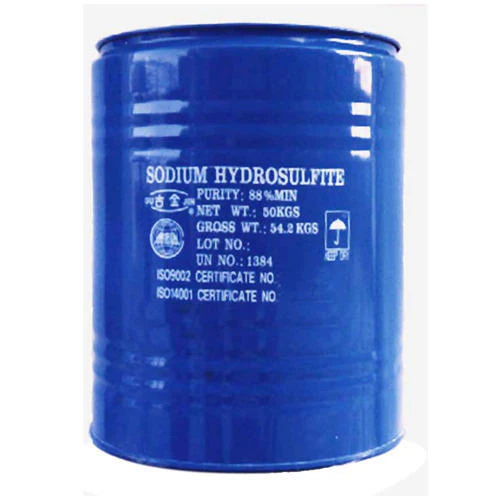
Sodium Hydrosulphite Supplier in Nairobi, Kenya, Tanzania and Uganda
Olinc Chemical Suppliers supplies Sodium Hydrosulphite for industrial and commercial applications in Nairobi, Kenya and across East Africa, including Tanzania and Uganda.
Sodium Hydrosulphite, also known as Sodium Dithionite, is a powerful reducing agent widely used in textile manufacturing, paper and pulp processing, industrial bleaching, dyeing and selected water treatment applications.
It is particularly valued for its ability to remove certain unwanted colours, reduce dyes into more soluble forms and assist in bleaching processes. These properties make it an important raw material for manufacturers and industrial processing companies.
Whether you are involved in textile production, paper manufacturing, garment processing, dyeing operations or industrial chemical formulation, Sodium Hydrosulphite can play an important role in your production processes.
At Olinc Chemical Suppliers, we welcome enquiries from manufacturers, distributors, contractors and industrial buyers looking for Sodium Hydrosulphite in different quantities.
Contact our sales team for product availability, specifications, packaging options and quotations.
What Is Sodium Hydrosulphite?
Sodium Hydrosulphite is an inorganic chemical compound commonly supplied as a white to greyish-white crystalline powder.
Its chemical name is Sodium Dithionite, and it is recognised for its strong reducing properties.
A reducing agent is a chemical substance that participates in oxidation-reduction reactions by donating electrons to another substance.
In industrial applications, Sodium Hydrosulphite is used to reduce certain coloured compounds, making it useful in textile dyeing, colour removal and bleaching operations.
For example, in textile manufacturing, it can be used in vat dyeing processes to convert certain insoluble dyes into soluble forms that can penetrate textile fibres. It is also used in stripping and correction processes where unwanted colours need to be reduced.
In paper manufacturing, it is used as a bleaching chemical to improve pulp brightness while helping preserve cellulose compared with some harsher bleaching processes.
Its strong reducing action makes it valuable in industries where controlled chemical reduction and colour removal are required.
Sodium Hydrosulphite Chemical Identification
| Property | Description |
|---|---|
| Product name | Sodium Hydrosulphite |
| Chemical name | Sodium Dithionite |
| Alternative spelling | Sodium Hydrosulfite |
| Chemical formula | Na₂S₂O₄ |
| CAS number | 7775-14-6 |
| Molecular weight | 174.11 g/mol |
| Appearance | White to greyish-white crystalline powder |
| Odour | May have a slight sulphurous odour |
| Chemical classification | Inorganic reducing agent |
| Solubility | Soluble in water, with decomposition possible |
| Main function | Reducing agent and bleaching chemical |
| Common grades | Industrial and application-specific grades |
Important: Sodium Hydrosulphite is chemically different from sodium bisulphite, sodium metabisulphite and sodium sulphite. These chemicals should not be treated as interchangeable.
Properties and Characteristics of Sodium Hydrosulphite
Understanding the chemical properties of Sodium Hydrosulphite helps industrial buyers determine whether it is appropriate for their production requirements.
A. Strong reducing properties
Sodium Hydrosulphite is a powerful reducing agent. It can chemically reduce certain dyes, pigments and coloured compounds, making it useful in industrial colour removal and bleaching.
B. Effective bleaching action
It is widely used in reductive bleaching processes, particularly in textile and paper manufacturing.
C. Water solubility
It dissolves in water and is commonly introduced into industrial processes through aqueous solutions. However, its solutions are unstable and should generally be prepared shortly before use.
D. Colour removal capability
It can reduce certain coloured substances, helping remove unwanted colour from materials and processing systems.
E. Sensitivity to moisture and air
Sodium Hydrosulphite is sensitive to moisture and oxygen. Exposure to humid air can cause decomposition and loss of reducing strength.
F. Temperature sensitivity
It can decompose when exposed to excessive heat. Appropriate storage and handling conditions are therefore essential.
G. Versatile industrial applications
Its reducing properties make it useful in textile dyeing, paper processing, industrial cleaning and selected chemical manufacturing operations.
4. Main Industrial Applications of Sodium Hydrosulphite
Sodium Hydrosulphite is used in several industries because of its powerful reducing and bleaching properties.
Textile Manufacturing and Dyeing
The textile industry is one of the largest users of Sodium Hydrosulphite.
It is widely used in dyeing operations, particularly in processes involving vat dyes, sulphur dyes and indigo.
Some dyes are naturally insoluble in water. Sodium Hydrosulphite helps convert certain dyes into soluble forms, allowing them to penetrate textile fibres during the dyeing process.
Benefits in textile processing include:
-
Helps dissolve and reduce certain insoluble dyes.
-
Supports vat dyeing and indigo dyeing processes.
-
Helps achieve consistent dye application.
-
Used in reduction clearing of dyed synthetic fabrics.
-
Helps remove unwanted colours from certain fabrics.
-
Useful in dye stripping and colour correction.
-
Supports specialised textile bleaching processes.
Common applications include:
-
Cotton fabric dyeing.
-
Denim and jeans manufacturing.
-
Indigo dyeing.
-
Vat dyeing.
-
Sulphur dye processing.
-
Textile printing.
-
Garment washing and finishing.
-
Textile colour removal.
For textile manufacturers and garment processing companies, Sodium Hydrosulphite is an important processing chemical.
Paper and Pulp Manufacturing
Sodium Hydrosulphite is widely used in the paper and pulp industry as a reductive bleaching agent.
It helps improve the brightness of mechanical pulp and recycled paper fibres by reducing certain coloured substances.
Unlike some oxidative bleaching processes, reductive bleaching can help preserve the fibre structure when correctly applied.
Benefits in paper manufacturing include:
-
Improves pulp brightness.
-
Helps reduce unwanted colour in paper fibres.
-
Supports recycled paper processing.
-
Used in mechanical pulp bleaching.
-
Helps improve the appearance of selected paper products.
-
Can be used in multi-stage pulp bleaching processes.
Common applications include:
-
Paper mills.
-
Recycled paper manufacturing.
-
Printing paper production.
-
Packaging paper manufacturing.
-
Pulp processing.
-
Tissue and paperboard manufacturing.
Industrial Bleaching and Colour Removal
Sodium Hydrosulphite is used in various industrial bleaching processes where reducing unwanted colour is required.
Its reducing action makes it suitable for treating selected coloured materials and industrial products.
Applications include:
-
Removal of certain stains.
-
Colour correction in industrial processing.
-
Bleaching of selected fibres.
-
Treatment of coloured raw materials.
-
Industrial cleaning formulations.
-
Selected bleaching processes in manufacturing.
The effectiveness depends on the chemical composition of the material being treated.
Water Treatment and Wastewater Treatment
Sodium Hydrosulphite is used in selected industrial water treatment applications because of its reducing properties.
It can help reduce certain oxidising substances and metal ions under controlled treatment conditions.
Applications include:
-
Reduction of selected oxidising agents.
-
Dechlorination in certain industrial water systems.
-
Treatment of selected industrial wastewater streams.
-
Reduction of certain metal species.
-
Oxygen scavenging in specialised industrial processes.
For example, it can be used in suitable wastewater treatment systems to reduce hexavalent chromium (Cr VI) to trivalent chromium (Cr III), which can then be treated through an appropriate precipitation and separation process.
It is important to note that Sodium Hydrosulphite is not a complete water purification chemical. Treatment conditions, pH, dosage and wastewater composition must be assessed before use.
Leather Processing and Tanning
Sodium Hydrosulphite is used in selected leather processing applications as a reducing and bleaching chemical.
It can assist with colour reduction and treatment of certain leather-processing materials.
Applications include:
-
Leather processing.
-
Selected hide and skin treatment operations.
-
Colour correction.
-
Industrial bleaching processes.
-
Preparation of selected leather-processing materials.
Kaolin Clay and Mineral Processing
Sodium Hydrosulphite is used in mineral processing, particularly in the bleaching of kaolin and selected industrial minerals.
Certain minerals contain iron compounds that affect their whiteness and appearance.
Under suitable chemical conditions, Sodium Hydrosulphite can reduce certain iron-containing impurities, helping improve the brightness of the processed mineral.
Applications include:
-
Kaolin clay bleaching.
-
Mineral colour improvement.
-
Industrial clay processing.
-
Selected ceramic raw material preparation.
-
Mineral beneficiation.
This is particularly relevant to manufacturers that require improved whiteness in their mineral raw materials.
Sugar and Other Industrial Processing
Sodium Hydrosulphite has also been used in selected industrial sugar-processing and bleaching applications.
Its reducing properties can assist in colour reduction under specific processing conditions.
However, applications involving food products require strict regulatory compliance and a specifically approved food-processing grade. Industrial-grade material must never be assumed suitable for food use.
Chemical Manufacturing
Sodium Hydrosulphite is also used as a reducing reagent in various chemical manufacturing operations.
Its applications include:
-
Reduction reactions in chemical processing.
-
Preparation of selected chemical intermediates.
-
Industrial colour removal.
-
Specialised manufacturing processes.
-
Selected laboratory and analytical applications.
Grades of Sodium Hydrosulphite
Selecting the right grade is important because different industrial processes require different levels of purity, reducing strength and product consistency.
Common commercial specifications include the following:
| Grade / specification | Typical applications |
|---|---|
| Industrial grade | General industrial reducing and bleaching processes |
| Textile grade | Dyeing, indigo processing and textile bleaching |
| Paper and pulp grade | Pulp brightening and recycled paper processing |
| Higher-purity grade | Specialised industrial applications requiring tighter specifications |
| Food-processing grade | Only specific permitted food applications with appropriate certification |
Sodium Hydrosulphite is commercially available in different active-content specifications, commonly around 85%, 88% and 90%, depending on the manufacturer and product type.
Which grade should you choose?
-
Textile manufacturers should request a specification suitable for their dyeing or bleaching process.
-
Paper mills should select a grade designed for pulp brightness improvement.
-
Water treatment companies should confirm the active content and suitability for the specific treatment process.
-
Mineral processors should request specifications appropriate for clay or mineral bleaching.
-
Specialised chemical manufacturers should assess purity, reducing strength and compatibility.
Always request the current Technical Data Sheet (TDS) and Certificate of Analysis (COA) before confirming an industrial purchase.
Technical Specifications of Sodium Hydrosulphite
The following table provides indicative information for commercial industrial Sodium Hydrosulphite.
| Parameter | Typical information |
|---|---|
| Product name | Sodium Hydrosulphite |
| Chemical name | Sodium Dithionite |
| Chemical formula | Na₂S₂O₄ |
| CAS number | 7775-14-6 |
| Molecular weight | 174.11 g/mol |
| Appearance | White to light yellow crystalline powder |
| Odour | Slight sulphurous odour |
| Active content | Commonly 85–90%, depending on grade |
| Solubility | Soluble in water |
| Chemical function | Reducing and bleaching agent |
| pH | Alkaline in aqueous solution; depends on concentration and grade |
Important specification note: These are indicative commercial values. They are not a guaranteed specification for Olinc stock. Actual active content, moisture, insoluble matter, pH and other quality parameters must be confirmed from the manufacturer’s documentation.
How Does Sodium Hydrosulphite Work?
Sodium Hydrosulphite works through chemical reduction.
During a reduction reaction, it transfers electrons to another chemical substance, changing that substance’s chemical state.
This property explains its importance in textile dyeing and industrial bleaching.
Example in textile dyeing
Certain vat dyes are insoluble in water. Sodium Hydrosulphite reduces these dyes into a more soluble form called the leuco form.
The soluble dye can then penetrate the textile fibres. After the dyeing process, exposure to oxygen converts the dye back into its insoluble coloured form within the fibres.
Example in paper manufacturing
In reductive pulp bleaching, Sodium Hydrosulphite reduces certain coloured compounds responsible for unwanted pulp coloration, helping improve brightness.
These processes demonstrate why Sodium Hydrosulphite is widely used in industries that require controlled colour reduction and bleaching.
Sodium Hydrosulphite Dosage and Usage
The correct dosage depends on the application, the product’s active content, the material being treated and the operating conditions.
There is no universal dosage suitable for all industrial processes.
Textile dyeing
Dosage depends on the type of dye, fabric, dye bath conditions and desired colour strength.
Manufacturers should follow the dye and chemical supplier’s processing recommendations.
Paper and pulp bleaching
Dosage depends on pulp quality, brightness requirements, chemical consumption and process conditions.
Water and wastewater treatment
The required amount depends on the concentration of the oxidising agent or metal species being treated, water chemistry and treatment objective.
Mineral bleaching
Dosage depends on the mineral composition, impurity levels, pH and desired whiteness.
For all applications, conduct controlled trials and follow the supplier’s TDS. Do not mix Sodium Hydrosulphite with acids or incompatible chemicals.
Packaging and Storage of Sodium Hydrosulphite
Sodium Hydrosulphite is sensitive to moisture and air, making proper packaging and storage particularly important.
Common commercial packaging options include:
-
25 kg sealed drums or suitable moisture-resistant packages.
-
50 kg industrial packages, subject to supplier availability.
-
Other bulk packaging depending on the manufacturer.
Packaging must be suitable for this moisture-sensitive and self-heating chemical.
Storage recommendations
-
Store in a cool, dry and well-ventilated location.
-
Keep containers tightly sealed.
-
Protect the product from moisture and water.
-
Keep away from direct sunlight and heat sources.
-
Keep away from acids and incompatible chemicals.
-
Separate from oxidising agents such as hydrogen peroxide, sodium hypochlorite and sodium chlorite.
-
Follow the manufacturer’s storage and shelf-life recommendations.
-
Do not return contaminated or spilled material to its original container.
Sodium Hydrosulphite can self-heat when exposed to moisture and air. It can also decompose and release hazardous sulphur-containing gases. Therefore, proper storage and handling are essential.
Safety and Handling Information
Sodium Hydrosulphite requires careful handling because of its chemical reactivity.
It can cause harm through inappropriate exposure, and contact with water, acids or incompatible materials can result in hazardous decomposition.
Recommended precautions:
-
Wear suitable chemical-resistant gloves.
-
Use appropriate chemical safety goggles.
-
Avoid inhaling dust.
-
Handle in a well-ventilated area.
-
Keep away from acids and strong oxidising agents.
-
Avoid contact with moisture.
-
Keep away from ignition sources and combustible materials.
-
Follow the product-specific Safety Data Sheet.
-
Ensure that workers understand emergency handling procedures.
Sodium Hydrosulphite must not be mixed with acids or oxidising chemicals. Decomposition can release sulphur dioxide and other hazardous products. Contact with moisture can cause heat generation and may create a fire hazard.
Store and handle it according to its SDS and applicable dangerous-goods requirements.
For commercial transport, the commonly assigned classification is UN 1384, Class 4.2, Packing Group II, subject to the actual product and applicable transport regulations.
Difference Between Sodium Hydrosulphite and Other Similar Chemicals
Customers sometimes confuse Sodium Hydrosulphite with other sulphur-based chemicals. Understanding the differences helps prevent purchasing the wrong product.
| Chemical | Main function |
|---|---|
| Sodium Hydrosulphite | Strong reducing and bleaching agent |
| Sodium Metabisulphite | Reducing agent, antioxidant and preservative in permitted applications |
| Sodium Bisulphite | Reducing agent and dechlorination chemical |
| Sodium Sulphite | Oxygen scavenger and reducing agent |
| Sodium Thiosulphate | Dechlorination and photographic processing chemical |
| Sodium Sulphate | Mainly used as an industrial salt and manufacturing raw material |
Although some of these chemicals have overlapping applications, their chemical properties and performance differ.
Important: Sodium Hydrosulphite is also not the same as sodium hypochlorite. Sodium hypochlorite is an oxidising bleaching agent, while Sodium Hydrosulphite is a reducing agent.
Industries That Purchase Sodium Hydrosulphite
Olinc Chemical Suppliers targets industrial and commercial buyers who use Sodium Hydrosulphite in their production processes.
Our potential customer groups include:
-
Textile manufacturers.
-
Denim and garment processing companies.
-
Indigo dye manufacturers and users.
-
Paper and pulp manufacturing companies.
-
Industrial bleaching companies.
-
Water and wastewater treatment companies.
-
Leather processing industries.
-
Kaolin and mineral processing companies.
-
Industrial chemical manufacturers.
-
Specialised chemical processing companies.
If your business uses Sodium Hydrosulphite as a production raw material, contact Olinc Chemical Suppliers for a quotation.
Why Buy Sodium Hydrosulphite from Olinc Chemicals Suppliers
Choosing the right chemical supplier is important for maintaining consistent production and avoiding unnecessary interruptions.
At Olinc Chemical Suppliers, we serve customers looking for industrial chemicals for different manufacturing and processing applications.
Reasons to contact us include:
Industrial chemical supply
We deal in a range of industrial chemicals serving textile, construction, water treatment, cleaning and manufacturing industries.
Competitive quotations
Contact our sales team for current Sodium Hydrosulphite prices based on the required grade, packaging and quantity.
Product information
We encourage customers to specify their intended application so that the appropriate product specifications can be established.
Bulk order enquiries
We welcome enquiries from manufacturers, distributors, contractors and businesses purchasing chemicals in commercial quantities.
Convenient ordering
You can contact our team through WhatsApp, telephone or email to discuss product availability and ordering arrangements.
Sodium Hydrosulphite Supplier in Kenya, Tanzania and Uganda
Olinc Chemical Suppliers welcomes Sodium Hydrosulphite enquiries from customers throughout Kenya and the wider East African region.
Sodium Hydrosulphite Supplier in Nairobi, Kenya
Are you searching for a Sodium Hydrosulphite supplier in Nairobi?
Olinc Chemical Suppliers serves industrial and commercial customers in Nairobi looking for Sodium Hydrosulphite for textile dyeing, paper processing, industrial bleaching and other manufacturing applications.
Whether you are a textile manufacturer, paper processor, garment washing company or industrial chemical buyer, contact us for availability, specifications and pricing.
Our business location is Enterprise Road, Avon Business Center, Nairobi, Kenya.
Sodium Hydrosulphite Supplier in Tanzania
Businesses in Tanzania looking for Sodium Hydrosulphite can contact Olinc Chemical Suppliers for supply enquiries.
We welcome enquiries from customers in Dar es Salaam, Arusha, Mwanza, Dodoma and other commercial and industrial centres.
Contact us to discuss your required quantity, packaging and delivery arrangements to Tanzania.
Sodium Hydrosulphite Supplier in Uganda
Olinc Chemical Suppliers welcomes Sodium Hydrosulphite enquiries from Uganda.
We cater to enquiries from textile processors, garment manufacturers, paper companies and other industrial buyers in Kampala, Jinja, Entebbe and surrounding areas.
Contact our sales team to discuss your product requirements, availability and supply arrangements to Uganda.
How to Order Sodium Hydrosulphite from Olinc Chemical Suppliers
Ordering Sodium Hydrosulphite is straightforward.
Contact our sales team
Send us an enquiry indicating that you require Sodium Hydrosulphite.
Specify your requirements
Provide the quantity, grade, packaging requirements and intended application.
Request a quotation
Our team will assist with a quotation based on confirmed availability and your requirements.
Confirm your order
Once the price, quantity and supply arrangements have been agreed upon, you can proceed with your purchase.
Arrange collection or delivery
Confirm the available collection or delivery arrangements with our sales team.
Looking for Sodium Hydrosulphite in Nairobi, Kenya, Tanzania or Uganda?
Contact Olinc Chemical Suppliers for pricing, specifications, packaging and bulk order enquiries.
WhatsApp / Phone: 0793062849
Alternative phone: 0743657810
sales@olincinchemicals.com
Enterprise Road, Avon Business Center, Nairobi, Kenya
Enquire on WhatsApp
Frequently Asked Questions About Sodium Hydrosulphite
1. What is Sodium Hydrosulphite used for?
Sodium Hydrosulphite is mainly used as a reducing and bleaching agent in textile dyeing, paper and pulp manufacturing, industrial bleaching, mineral processing and selected water treatment applications.
2. What is another name for Sodium Hydrosulphite?
It is also known as Sodium Dithionite, Sodium Hydrosulfite and commonly called Hydro in some industrial applications.
3. What is the CAS number for Sodium Hydrosulphite?
Its CAS number is 7775-14-6.
4. What is the chemical formula of Sodium Hydrosulphite?
Its chemical formula is Na₂S₂O₄.
5. Is Sodium Hydrosulphite used in textile manufacturing?
Yes. It is widely used in vat dyeing, indigo dyeing, sulphur dye processing, reduction clearing and dye stripping.
6. Can Sodium Hydrosulphite bleach fabrics?
Yes. It is used in reductive bleaching and colour-removal processes for certain fabrics. Its effectiveness depends on the fibre, dye and processing conditions.
7. Is Sodium Hydrosulphite used in paper manufacturing?
Yes. It is used in pulp bleaching to improve brightness and reduce unwanted colour in mechanical and recycled paper fibres.
8. Is Sodium Hydrosulphite soluble in water?
Yes. It dissolves in water, but aqueous solutions are unstable and can lose reducing strength. They should be prepared and used according to the manufacturer’s instructions.
9. What is the difference between Sodium Hydrosulphite and Sodium Metabisulphite?
Sodium Hydrosulphite is a strong reducing agent mainly used in textile and paper bleaching. Sodium Metabisulphite is used in different applications, including dechlorination, reducing processes and permitted food preservation.
10. What is the typical purity of Sodium Hydrosulphite?
Commercial industrial grades commonly have active contents around 85%, 88% or 90%, depending on the manufacturer and specification.
11. Can Sodium Hydrosulphite be used in water treatment?
Yes. It is used in selected industrial water and wastewater treatment processes, including certain dechlorination and metal-reduction applications.
12. What packaging is available for Sodium Hydrosulphite?
Common industrial packaging includes 25 kg sealed drums or moisture-resistant packages. Other packaging sizes may be available depending on the manufacturer.
13. How should Sodium Hydrosulphite be stored?
It should be stored in tightly sealed, moisture-resistant packaging in a cool, dry and well-ventilated area. Keep it away from acids, oxidising agents and heat.
14. Is Sodium Hydrosulphite dangerous?
It requires careful handling. Moisture exposure can cause self-heating and decomposition, while contact with acids or incompatible chemicals can release hazardous gases. Always follow the product SDS.
15. Where can I buy Sodium Hydrosulphite in Nairobi, Kenya?
You can contact Olinc Chemical Suppliers at Enterprise Road, Avon Business Center, Nairobi, for product availability and quotations.
16. Does Olinc Chemical Suppliers serve customers in Tanzania and Uganda?
Yes. We welcome enquiries from Tanzania and Uganda and can discuss supply and delivery arrangements with customers in these countries.

Reviews
There are no reviews yet.