
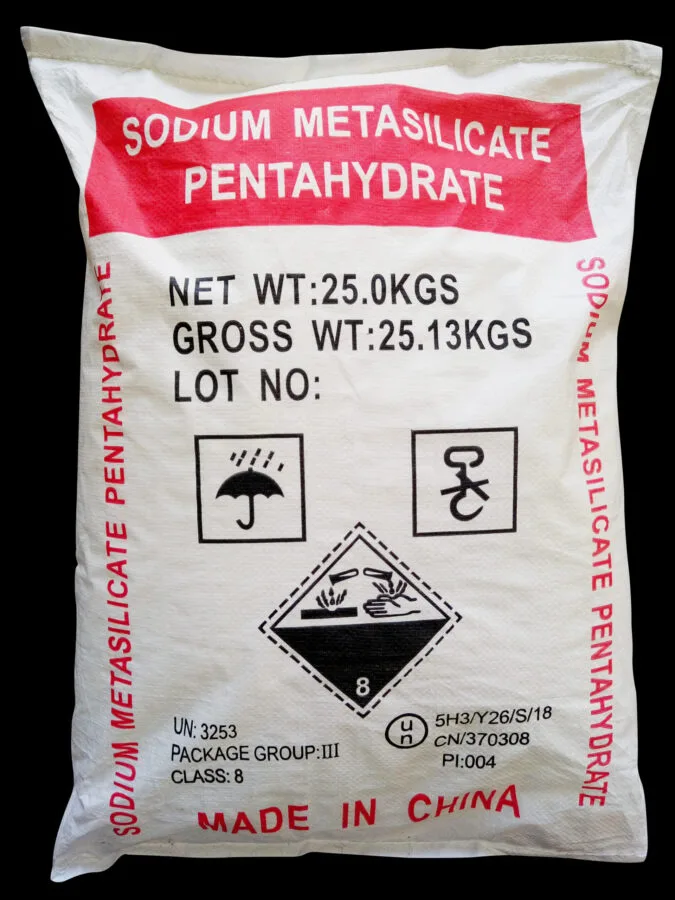
Sodium Metasilicate Supplier in Kenya | Olinc Chemical Suppliers
Sodium Metasilicate is an alkaline inorganic chemical widely used in the manufacture of heavy-duty detergents, industrial cleaning products, metal cleaners, textile-processing chemicals and other industrial formulations. It is valued for its strong alkalinity, cleaning support, grease-removal properties, corrosion-inhibition benefits in certain formulations and ability to help disperse dirt.
It is available in different forms, including anhydrous, pentahydrate and nonahydrate. Choosing the correct form is important because the water content, concentration, handling properties and formulation behaviour differ.
Whether you are manufacturing detergent powder, formulating industrial degreasers or sourcing a chemical for a specialised process, this guide explains the names, grades, properties, uses, packaging and buying considerations for Sodium Metasilicate.
What Is Sodium Metasilicate?
Sodium Metasilicate is an inorganic sodium silicate compound with the chemical formula Na₂SiO₃ in its anhydrous form. It is commonly supplied as a white powder, crystals or granules, depending on the grade and manufacturing process.
It is strongly alkaline when dissolved in water. This makes it useful in cleaning and industrial formulations where alkalinity is needed to help loosen grease, oils and other stubborn soils.
Sodium Metasilicate performs several functions in industrial applications:
-
Provides alkalinity in cleaning formulations.
-
Supports the removal of grease and oily dirt.
-
Helps disperse and suspend loosened soil.
-
Can help manage certain metal-corrosion issues in appropriately designed cleaning formulations.
-
Acts as a processing aid in selected industrial applications.
-
Supports detergent performance alongside surfactants and other formulation ingredients.
It is particularly important in heavy-duty cleaning products, where stronger cleaning action is required than that provided by ordinary household detergents.
Other Names of Sodium Metasilicate
Customers may search for this chemical using different names, abbreviations and descriptions. The following are commonly associated with Sodium Metasilicate:
-
Sodium Metasilicate
-
Sodium Meta Silicate
-
Sodium Metasilicate Anhydrous
-
Sodium Metasilicate Pentahydrate
-
Sodium Metasilicate Nonahydrate
-
Sodium Silicate Metasilicate
-
Disodium Metasilicate
-
Disodium Trioxosilicate
-
Sodium Silicate (a broader family name)
-
Metasilicate of Soda
-
Sodium Metasilicate Powder
-
Sodium Metasilicate Crystals
-
SMS (an abbreviation sometimes used in trade)
-
Sodium Metasilicate Industrial Grade
-
Sodium Metasilicate Detergent Grade
Important distinction: Sodium Metasilicate is not automatically the same product as liquid Sodium Silicate, also called Water Glass. Sodium Silicate is a broader family of compounds supplied in different ratios and forms. Always confirm the exact chemical identity, hydration state and specification before purchasing.
Chemical Identity and Basic Information
| Property | Information |
|---|---|
| Product name | Sodium Metasilicate |
| Chemical formula | Na₂SiO₃ (anhydrous) |
| Common abbreviation | SMS (trade usage varies) |
| Chemical type | Inorganic alkaline silicate salt |
| Appearance | White powder, crystals or granules |
| Odour | Odourless |
| Water solubility | Soluble in water; behaviour varies by form and conditions |
| Nature | Strongly alkaline in solution |
| Main functions | Cleaning, alkalinity, grease removal and soil dispersion |
CAS numbers by form
The CAS number depends on the hydration state:
| Form | Chemical formula | CAS number |
|---|---|---|
| Anhydrous Sodium Metasilicate | Na₂SiO₃ | 6834-92-0 |
| Sodium Metasilicate Pentahydrate | Na₂SiO₃·5H₂O | 10213-79-3 |
| Sodium Metasilicate Nonahydrate | Na₂SiO₃·9H₂O | 13517-24-3 |
This distinction matters when requesting quotations or comparing supplier specifications. Anhydrous material contains no water of crystallisation, while hydrated forms contain water as part of their crystal structure.
Types and Forms of Sodium Metasilicate
Sodium Metasilicate is commonly available in three forms. Each has different characteristics and may be more suitable for particular production processes.
Anhydrous Sodium Metasilicate
Anhydrous Sodium Metasilicate contains no water of crystallisation. It has a higher concentration of active Sodium Metasilicate by weight than hydrated forms.
Common characteristics:
-
White powder or granular solid.
-
Higher active content by weight compared with hydrated forms.
-
Strongly alkaline when dissolved.
-
Used in industrial cleaning and detergent formulations.
-
Requires careful moisture protection during storage.
Typical applications:
-
Heavy-duty detergent manufacturing.
-
Industrial degreasers.
-
Metal cleaning formulations.
-
Specialised industrial chemical processing.
Sodium Metasilicate Pentahydrate
Sodium Metasilicate Pentahydrate contains five molecules of water of crystallisation for each formula unit.
It is commonly supplied as white crystals, granules or powder and is widely used in industrial and detergent applications.
Common characteristics:
-
White crystalline or granular appearance.
-
Contains water of crystallisation.
-
Lower active Sodium Metasilicate content by weight than the anhydrous form.
-
Strongly alkaline in aqueous solution.
-
Used in cleaning products and industrial formulations.
Typical applications:
-
Laundry detergent powders.
-
Industrial cleaning products.
-
Metal cleaning.
-
Textile processing.
-
General industrial cleaning formulations.
Sodium Metasilicate Nonahydrate
Sodium Metasilicate Nonahydrate contains nine molecules of water of crystallisation.
It has a higher proportion of water by weight than the pentahydrate and anhydrous forms. This means that the amount required in a formulation may differ significantly.
Common characteristics:
-
Hydrated crystalline solid.
-
White or colourless crystals.
-
Lower active content by weight than pentahydrate and anhydrous forms.
-
Strongly alkaline when dissolved.
-
Requires appropriate storage to maintain product quality.
Typical applications:
-
Selected cleaning formulations.
-
Industrial chemical processes.
-
Applications where the hydrated grade is specified.
Which form should you buy?
The best form depends on your formulation, desired active content, production equipment and handling requirements. Do not replace pentahydrate with anhydrous material on a kilogram-for-kilogram basis without recalculating the formulation.
Main Uses and Applications of Sodium Metasilicate
Sodium Metasilicate is used in several industries because of its alkalinity and cleaning-support properties.
Detergent and Washing Powder Manufacturing
One of the most important applications of Sodium Metasilicate is the manufacture of laundry detergents and washing powders.
It helps improve cleaning performance by providing alkalinity and supporting the removal of greasy and oily soils.
In detergent formulations, it can:
-
Help loosen grease and oily dirt from fabrics.
-
Provide alkaline conditions that support cleaning.
-
Assist with dispersing loosened soil.
-
Support the performance of surfactants and other detergent ingredients.
-
Help protect certain metal components of washing equipment when the formulation is properly designed.
-
Contribute to the performance of heavy-duty laundry detergents.
It is particularly useful in formulations intended for commercial laundry, institutional washing and industrial cleaning.
Heavy-Duty Industrial Cleaning Products
Sodium Metasilicate is widely used in heavy-duty industrial cleaners because of its strong alkalinity.
It may be incorporated into products used for cleaning:
-
Factory floors.
-
Industrial equipment.
-
Machinery and work surfaces.
-
Workshop surfaces.
-
Certain manufacturing equipment.
-
Greasy industrial surfaces.
It helps loosen and remove stubborn oily soils when combined with suitable surfactants and other cleaning ingredients.
Industrial Degreasers
Sodium Metasilicate is an important ingredient in selected degreasing formulations.
Its alkaline nature supports the cleaning of surfaces contaminated with oils, grease and other organic soils. It is used in formulations for workshops, factories, maintenance operations and industrial cleaning.
The suitability of a particular formulation depends on the surface being cleaned. Strongly alkaline products can damage aluminium, zinc and other alkali-sensitive materials.
Metal Cleaning and Metal Treatment
Sodium Metasilicate is used in selected metal-cleaning formulations to help remove grease, oils and processing residues before further manufacturing or treatment.
Applications may include:
-
Industrial metal cleaning.
-
Degreasing before painting.
-
Cleaning before surface finishing.
-
Selected metal-treatment processes.
-
Cleaning of certain machinery components.
Some silicate-based formulations can help reduce corrosion of certain metals under controlled conditions. However, compatibility depends on the metal, concentration, temperature, contact time and complete formulation.
Car Wash and Vehicle Cleaning Products
Sodium Metasilicate may be included in selected vehicle-cleaning and heavy-duty detergent formulations.
It can support the removal of oily dirt, road grime and other stubborn soils.
It should not be assumed suitable for every vehicle surface, paint finish, aluminium component or automotive material. The final product should be properly formulated and tested to prevent surface damage.
Textile Processing
In textile manufacturing and processing, Sodium Metasilicate may be used in selected alkaline cleaning and preparation processes.
Its applications can include:
-
Scouring and cleaning.
-
Removal of oily residues.
-
Preparation of textiles before subsequent processing.
-
Selected industrial washing operations.
The correct concentration and processing conditions must be established for the fabric and process involved.
Paper and Pulp Processing
Sodium silicate compounds are used in various paper and pulp processes. Sodium Metasilicate may be used in selected applications where alkalinity or silicate chemistry is required.
Its suitability depends on the specific process, equipment and required chemical specification.
Ceramics and Mineral Processing
Sodium silicate compounds are used in ceramic and mineral-processing industries for applications involving dispersion and processing control.
Sodium Metasilicate may be suitable for selected processes, depending on the required silicate chemistry and formulation.
Water Treatment and Water Conditioning
Sodium Metasilicate may be used in selected industrial water-conditioning formulations where silicate chemistry is required.
Silicates can help manage corrosion in certain water systems under carefully controlled conditions. However, the appropriate chemical depends on water chemistry, system materials, pH, dosage and treatment objectives.
Sodium Metasilicate is not a universal replacement for dedicated water-treatment chemicals. A qualified water-treatment specialist should confirm its suitability for the intended system.
Construction and Cement-Related Applications
Sodium silicate chemistry is used in selected construction and building-material applications, including certain treatments and specialised formulations.
However, not every application involving liquid sodium silicate is suitable for solid Sodium Metasilicate. The specific product form and formulation must be checked before use.
Benefits of Using Sodium Metasilicate
Sodium Metasilicate is valued by chemical manufacturers because it performs several useful functions in industrial formulations.
1. Strong alkaline cleaning support
It creates alkaline conditions that help loosen grease, oils and stubborn dirt from suitable surfaces.
2. Improved detergent performance
It supports the action of surfactants and other detergent ingredients, making it useful in heavy-duty cleaning formulations.
3. Grease and oil removal
It is particularly useful in industrial cleaners and degreasers designed to remove oily contamination.
4. Soil dispersion
It can help disperse loosened dirt and reduce the tendency of some soils to settle back onto cleaned surfaces.
5. Formulation versatility
It is used in laundry detergents, industrial cleaners, metal-cleaning products and selected manufacturing processes.
6. Silicate-based protection in suitable formulations
Silicates can help inhibit corrosion on certain metal surfaces under controlled conditions. The effect depends on the complete formulation and operating conditions.
Sodium Metasilicate vs Sodium Silicate
These two products are related, but they are not identical in every respect.
| Feature | Sodium Metasilicate | Sodium Silicate |
|---|---|---|
| Chemical identity | Specific sodium silicate compound | Family of sodium silicate compounds |
| Common formula | Na₂SiO₃ (anhydrous) | Varies by silica-to-soda ratio |
| Physical form | Commonly powder, crystals or granules | Commonly supplied as liquid or solid |
| Appearance | Usually white solid | Liquid may be clear or slightly coloured; solid forms vary |
| Alkalinity | Strongly alkaline in solution | Depends on grade and silicate ratio |
| Applications | Detergents, degreasers and metal cleaning | Adhesives, detergents, construction and industrial processes |
Which one should you choose?
Choose Sodium Metasilicate when your formulation or process specifically requires that compound, particularly in solid alkaline cleaning applications.
Choose Sodium Silicate when your process requires a particular soluble silicate solution, silicate ratio or liquid product.
Always confirm the product specification before substituting one for the other.
Sodium Metasilicate vs Other Cleaning Chemicals
Sodium Metasilicate is often used alongside other detergent raw materials. However, each chemical performs a different function.
| Chemical | Main function | Common applications |
|---|---|---|
| Sodium Metasilicate | Alkalinity, cleaning support and soil dispersion | Heavy-duty detergents and degreasers |
| Soda Ash | Alkalinity and water-hardness management | Washing powders and detergents |
| STPP | Detergent building and sequestration | Washing powders and cleaning products |
| Sodium Sulphate | Filler and processing aid in some detergent powders | Detergent manufacturing |
| Caustic Soda | Strong alkalinity and chemical processing | Soap, cleaning and industrial production |
| SLES 70% | Anionic surfactant and foaming agent | Liquid detergents and personal-care products |
| LABSA 96% | Anionic surfactant raw material after neutralisation | Detergent manufacturing |
For detergent manufacturers, Sodium Metasilicate is often considered alongside Soda Ash, STPP, Sodium Sulphate, LABSA and other formulation ingredients.
The right combination depends on the type of detergent, desired cleaning strength, target cost, water conditions and compatibility of the ingredients.
Technical Specifications to Check When Buying Sodium Metasilicate
If you are purchasing Sodium Metasilicate for commercial or industrial production, checking the technical specifications is important.
Different manufacturers may supply different grades, hydration forms and particle sizes.
| Parameter | What it tells you |
|---|---|
| Chemical identity | Confirms that the product is Sodium Metasilicate |
| Hydration state | Identifies anhydrous, pentahydrate or nonahydrate |
| Purity | Indicates the amount of the specified chemical |
| Sodium oxide (Na₂O) | Helps establish the chemical composition |
| Silicon dioxide (SiO₂) | Indicates the silica component |
| SiO₂:Na₂O ratio | Important for confirming the silicate composition |
| Iron content | Relevant for applications sensitive to iron impurities |
| Water-insoluble matter | Indicates the amount of insoluble material |
| Moisture content | Important for product quality and formulation calculations |
| pH | Indicates alkalinity at the stated test concentration |
| Particle size | Helps determine handling, mixing and dissolution behaviour |
| Bulk density | Useful for storage, dosing and production planning |
Why is the SiO₂:Na₂O ratio important?
The silica-to-sodium oxide ratio is an important characteristic of silicate products. It helps distinguish different silicate compositions and can affect alkalinity, solubility and performance.
For Sodium Metasilicate, the anhydrous chemical has a theoretical SiO₂:Na₂O molar ratio of 1:1. Do not assume that all products sold under the general name Sodium Silicate have this same ratio.
For accurate purchasing, request the manufacturer’s Certificate of Analysis (COA) and Technical Data Sheet (TDS).
How to Use Sodium Metasilicate in Detergent Manufacturing
Sodium Metasilicate is commonly incorporated into powdered and heavy-duty detergent formulations.
Its role is to provide alkalinity and support cleaning performance. It is generally used alongside other ingredients such as:
-
Soda Ash.
-
STPP.
-
Sodium Sulphate.
-
LABSA or neutralised surfactant ingredients.
-
SLES, where appropriate.
-
Other builders, fillers and cleaning additives.
The required amount depends on the detergent type, the grade of Sodium Metasilicate, the hydration state and the desired cleaning performance.
Important formulation considerations
-
Confirm whether you are using anhydrous or hydrated Sodium Metasilicate.
-
Adjust formulation quantities to account for the water of crystallisation in hydrated grades.
-
Ensure that all ingredients are compatible.
-
Control dust during weighing and blending.
-
Test the finished product for cleaning performance, stability and material compatibility.
-
Check the final product’s pH and suitability for its intended use.
Do not use a fixed dosage without considering the formulation. A product made with anhydrous Sodium Metasilicate will not have the same active content by weight as one made with the pentahydrate or nonahydrate.
Sodium Metasilicate Packaging Options
Sodium Metasilicate is commonly supplied in industrial packaging suitable for manufacturing and bulk use.
Possible packaging formats include:
-
25 kg bags – suitable for small and medium-sized manufacturers.
-
50 kg bags – suitable for larger production requirements, where offered.
-
Bulk bags or jumbo bags – suitable for industrial buyers requiring larger quantities.
-
Other packaging formats – may depend on the manufacturer and available supply.
Packaging may use woven polypropylene bags with an inner liner or other moisture-protective packaging.
When requesting a quotation from Olinc Chemical Suppliers, specify the quantity you need and your preferred packaging. This will help us advise on available options.
Storage and Handling of Sodium Metasilicate
Sodium Metasilicate should be stored and handled carefully to preserve its quality and protect workers.
Storage recommendations
-
Store in a cool, dry and well-ventilated warehouse.
-
Keep bags tightly sealed when not in use.
-
Protect the product from moisture and rain.
-
Store away from acids and incompatible materials.
-
Keep packaging off wet floors.
-
Avoid contamination with other chemicals.
-
Follow the manufacturer’s recommended storage conditions.
Hydrated Sodium Metasilicate may be affected by unsuitable storage conditions, including moisture exposure and changes in its physical condition. Properly sealed packaging helps maintain product quality.
Handling precautions
Sodium Metasilicate is strongly alkaline and can cause serious eye damage and skin irritation or burns, depending on concentration and exposure.
When handling the material:
-
Wear chemical-resistant gloves.
-
Use appropriate chemical safety goggles.
-
Wear suitable protective clothing.
-
Avoid breathing dust.
-
Use appropriate ventilation and dust-control measures.
-
Avoid direct contact with eyes and skin.
-
Wash hands thoroughly after handling.
-
Keep away from children and unauthorised personnel.
First aid and emergency precautions
-
Eye contact: Immediately rinse cautiously with clean water for several minutes and seek urgent medical attention.
-
Skin contact: Remove contaminated clothing and rinse affected skin thoroughly with plenty of water. Seek medical advice if irritation or burns occur.
-
Inhalation: Move the affected person to fresh air and seek medical attention if symptoms develop.
-
Ingestion: Rinse the mouth. Do not induce vomiting. Seek immediate medical assistance.
Always consult the product-specific Safety Data Sheet (SDS) for detailed first-aid measures, spill response and disposal instructions.
Who Buys Sodium Metasilicate?
Sodium Metasilicate is relevant to several categories of industrial and commercial customers.
Potential buyers include:
-
Detergent manufacturers – companies producing washing powders and heavy-duty detergents.
-
Industrial cleaning companies – businesses producing degreasers and factory-cleaning chemicals.
-
Chemical formulators – manufacturers developing specialised cleaning products.
-
Car-care product manufacturers – companies producing selected vehicle-cleaning formulations.
-
Textile processors – businesses involved in textile preparation and cleaning.
-
Metal-processing companies – manufacturers requiring metal-cleaning and degreasing chemicals.
-
Ceramic and mineral processors – businesses using suitable silicate compounds in production.
-
Chemical distributors and wholesalers – companies purchasing industrial chemicals for resale.
If your business uses Sodium Metasilicate regularly, purchasing in suitable industrial quantities can help support consistent production and stock planning.
Factors to Consider Before Buying Sodium Metasilicate
Before placing an order, make sure you know the following:
1. Which form do you require?
Do you need anhydrous Sodium Metasilicate, pentahydrate or nonahydrate?
2. What is your application?
Are you manufacturing washing powder, industrial degreasers, metal cleaners or using it in another process?
3. What grade do you need?
Confirm the required industrial or technical specification.
4. What is your required quantity?
Indicate whether you need a single bag, several bags or a bulk order.
5. Which packaging do you prefer?
Confirm whether you require 25 kg bags, 50 kg bags or bulk packaging.
6. Do you need technical documentation?
If you are manufacturing products, request the COA, TDS and SDS.
7. Does the chemical meet your formulation requirements?
Check the purity, hydration state, alkalinity and other important specifications before using it in production.
These details help avoid purchasing a chemical form that does not suit your process.
Buy Sodium Metasilicate in Nairobi, Kenya, Uganda and Tanzania
Olinc Chemical Suppliers welcomes enquiries for Sodium Metasilicate in Nairobi, Kenya and across East Africa, including Uganda and Tanzania.
We serve industrial and commercial customers looking for chemical raw materials for detergent manufacturing, industrial cleaning and other suitable applications.
Whether you need Sodium Metasilicate for washing powder production, heavy-duty cleaning formulations or industrial processing, contact us with your required grade and quantity.
Why contact Olinc Chemical Suppliers?
-
Nairobi-based chemical supplier.
-
Enquiries from customers in Kenya, Uganda and Tanzania.
-
Support with identifying the required chemical specification.
-
Quotations based on quantity and packaging requirements.
-
Enquiries for industrial chemical supply and bulk orders.
Request a Sodium Metasilicate quotation
When contacting us, provide the following information:
-
Product: Sodium Metasilicate.
-
Form: Anhydrous, Pentahydrate or Nonahydrate, if specified.
-
Required grade.
-
Quantity required.
-
Preferred packaging.
-
Delivery location.
-
Any specific technical requirements.
Contact Olinc Chemical Suppliers
-
WhatsApp/Phone: 0793062849
-
Email: sales@olincinchemicals.com
-
Location: Enterprise Road, Avon Business Center, Nairobi, Kenya
-
Website: www.olincinchemicalsl.com
Contact us for current pricing, available grades, packaging options and bulk supply enquiries.
Frequently Asked Questions About Sodium Metasilicate
What is Sodium Metasilicate used for?
Sodium Metasilicate is mainly used in detergent manufacturing, heavy-duty industrial cleaning, degreasers, metal cleaning and selected textile, ceramic and industrial processes. It provides alkalinity and supports the removal of grease and dirt.
What is the chemical formula of Sodium Metasilicate?
The chemical formula of anhydrous Sodium Metasilicate is Na₂SiO₃. Hydrated forms include Na₂SiO₃·5H₂O for pentahydrate and Na₂SiO₃·9H₂O for nonahydrate.
What is the CAS number of Sodium Metasilicate?
The CAS number depends on the form:
-
Anhydrous: 6834-92-0.
-
Pentahydrate: 10213-79-3.
-
Nonahydrate: 13517-24-3.
Always confirm the CAS number against the supplier’s product documentation.
Is Sodium Metasilicate the same as Sodium Silicate?
They are related but not always interchangeable. Sodium Metasilicate is a specific sodium silicate compound, while Sodium Silicate refers to a broader family of silicate compounds with different compositions and ratios.
Is Sodium Metasilicate used in washing powder?
Yes. It is used in some washing powder formulations as an alkaline cleaning ingredient. It supports grease removal and detergent performance.
What is the difference between Sodium Metasilicate anhydrous and pentahydrate?
Anhydrous Sodium Metasilicate contains no water of crystallisation, while pentahydrate contains five water molecules per formula unit. Anhydrous material therefore has a higher active content by weight.
Is Sodium Metasilicate soluble in water?
Yes. It is soluble in water, although dissolution behaviour can vary with the hydration form, concentration, temperature and product specification.
Is Sodium Metasilicate acidic or alkaline?
Sodium Metasilicate is alkaline. Its aqueous solutions are strongly alkaline, making it useful in industrial cleaning and degreasing formulations.
Can Sodium Metasilicate remove grease?
Yes. It is used in alkaline cleaning formulations to help loosen and remove grease and oily contamination. It is often combined with surfactants and other ingredients to improve cleaning performance.
Is Sodium Metasilicate suitable for cleaning aluminium?
Strongly alkaline Sodium Metasilicate formulations can attack aluminium and other alkali-sensitive metals. Its use on aluminium should not be assumed safe; compatibility testing and an appropriate product formulation are necessary.
Can Sodium Metasilicate be mixed with caustic soda?
Both chemicals are strongly alkaline and may be used in certain industrial formulations. However, combining them changes the overall alkalinity and can increase the risk of chemical burns and material damage. Any formulation should be designed and tested by a qualified formulator.
What packaging is available for Sodium Metasilicate?
It is commonly supplied in industrial bags, with 25 kg and 50 kg packaging among possible formats. Bulk packaging may also be available depending on the supplier.
How should Sodium Metasilicate be stored?
Store it in a cool, dry place in sealed packaging. Protect it from moisture, rain, contamination and incompatible chemicals. Follow the manufacturer’s storage instructions.
Is Sodium Metasilicate dangerous?
It is a strongly alkaline chemical and can cause serious eye damage and skin irritation or burns. Use appropriate PPE, avoid breathing dust and consult the SDS before handling.
Where can I buy Sodium Metasilicate in Nairobi, Kenya?
You can enquire from Olinc Chemical Suppliers, located at Avon Business Center, Enterprise Road, Nairobi. Contact us on 0793062849 for current pricing, available forms, packaging and supply arrangements.
Can I order Sodium Metasilicate from Uganda and Tanzania?
Olinc Chemical Suppliers welcomes enquiries from Uganda and Tanzania. Contact us with your required quantity and delivery location to discuss available supply and delivery arrangements.

Reviews
There are no reviews yet.