
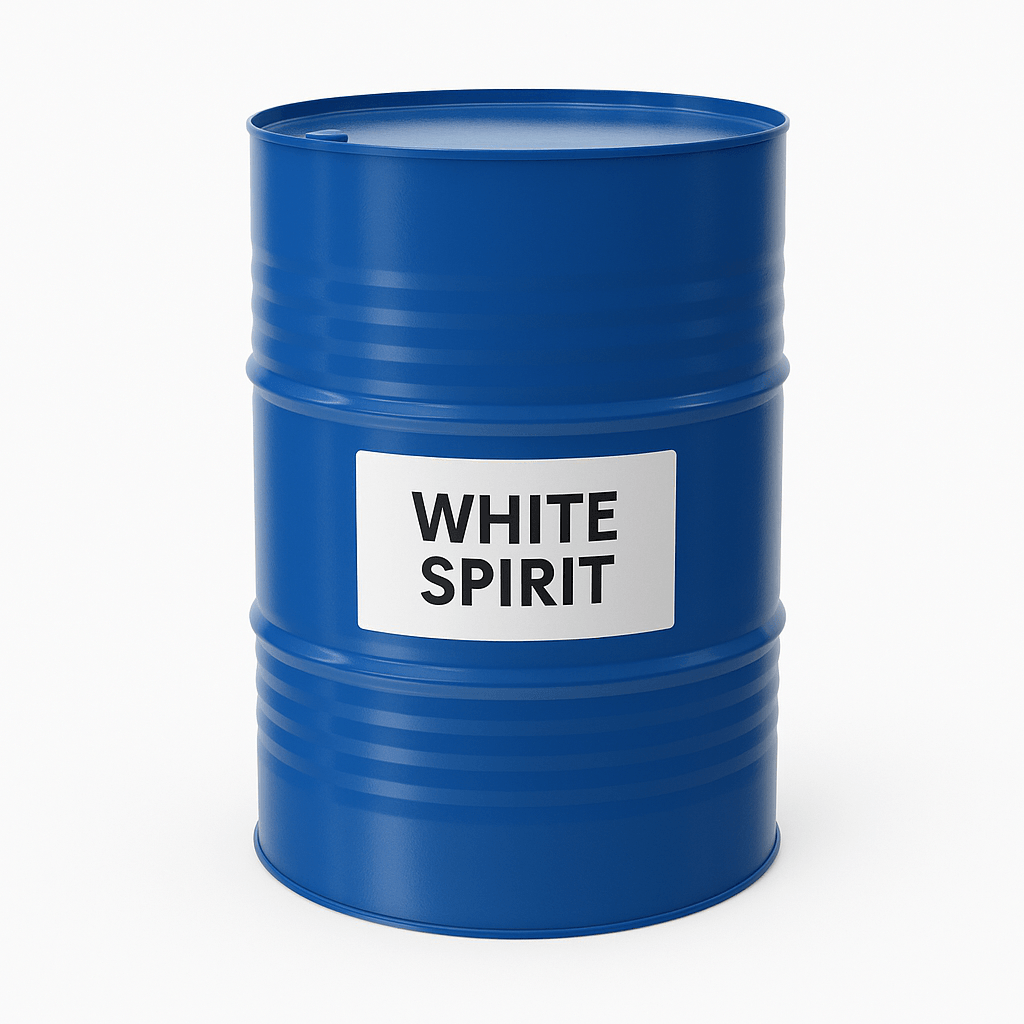
White Spirit Supplier in Kenya | Mineral Turpentine – Olinc Chemical Suppliers
Welcome to Olinc Chemical Suppliers, your industrial chemical supply partner in Nairobi, Kenya. We welcome enquiries from paint manufacturers, coating companies, furniture manufacturers, workshops, hardware suppliers, paint-thinner producers and other businesses looking for White Spirit for their industrial and commercial applications.
White Spirit, also known as Mineral Turpentine, Mineral Spirits, Stoddard Solvent or Turpentine Substitute, is a petroleum-derived hydrocarbon solvent widely used in the paint, coatings, cleaning and maintenance industries.
It is valued for its ability to dissolve or thin compatible oil-based paints, alkyd resins, varnishes, oils, waxes and other organic materials. It is also commonly used for cleaning paintbrushes, rollers, painting equipment and selected metal components.
For businesses involved in paint production, construction finishing, furniture manufacturing and industrial maintenance, White Spirit is an important solvent for various production and cleaning processes.
Whether you require White Spirit for paint thinning, varnish formulation, brush cleaning, degreasing or other compatible industrial applications, selecting the correct grade and specification is essential.
Olinc Chemical Suppliers welcomes White Spirit enquiries in Nairobi, Kenya. Contact us with your required quantity, intended application, preferred grade and packaging requirements.
What Is White Spirit?
White Spirit is a petroleum-derived solvent made from a mixture of hydrocarbon compounds. It is produced through the refining and processing of petroleum fractions.
Unlike single-compound chemicals such as Acetone, Toluene or Ethanol, White Spirit does not have one fixed molecular formula. Its composition varies according to the refining process, aromatic content, distillation range and grade.
It generally contains a mixture of:
- Aliphatic hydrocarbons
- Branched-chain hydrocarbons
- Cycloaliphatic or naphthenic hydrocarbons
- Varying amounts of aromatic hydrocarbons, depending on grade
White Spirit is normally a clear, colourless liquid with a characteristic petroleum or kerosene-like smell. It has low water solubility and is compatible with many organic materials.
Its solvent properties make it especially useful in oil-based paint and coating systems.
Chemical Identification and Product Information
| Property | Description |
|---|---|
| Product name | White Spirit |
| Other names | Mineral Turpentine, Mineral Spirits, Xylene-free status must be confirmed by specification |
| Common related name | Stoddard Solvent |
| Chemical type | Petroleum hydrocarbon mixture |
| Chemical formula | No single fixed molecular formula |
| Common CAS number | 8052-41-3 for Stoddard Solvent; other White Spirit grades have different CAS numbers |
| Typical hydrocarbon range | Commonly C7–C12, depending on grade |
| Appearance | Clear, colourless liquid |
| Odour | Characteristic petroleum odour |
| Water solubility | Very low; practically insoluble |
| Main industrial function | Solvent and paint thinner |
Important identification note: White Spirit is a mixture, so its CAS number depends on the exact product type. Other commonly encountered identifiers include CAS 64742-88-7, 64742-82-1 and 64742-48-9 for different petroleum solvent fractions. Customers should check the manufacturer’s SDS rather than assuming all White Spirit products have the same CAS number.
Other Names of White Spirit
White Spirit is sold and described under several alternative names in different markets.
Common names include:
- Mineral Turpentine
- Mineral Spirits
- White Spirits
- Stoddard Solvent
- Turpentine Substitute
- Petroleum Spirits
- Mineral Solvent
- Paint Thinner (in some commercial contexts)
- Petroleum Hydrocarbon Solvent
- Solvent Naphtha (a related but broad petroleum-solvent description)
The names may overlap commercially, but they do not always refer to products with identical compositions or specifications.
For example, Stoddard Solvent is a recognised petroleum solvent closely related to White Spirit, while Turpentine is a different solvent traditionally obtained from pine resin. White Spirit is often used as a turpentine substitute, but the two are not chemically identical.
Physical and Chemical Properties of White Spirit
White Spirit has properties that make it useful in paint formulation, cleaning and industrial maintenance.
Appearance
White Spirit is normally a clear, colourless liquid. A suitable commercial product should meet the supplier’s appearance and contamination specifications.
Solvent Properties
White Spirit dissolves or thins many compatible oil-based materials, including selected alkyd resins, oils, waxes, varnishes and paint ingredients.
This makes it useful in paint manufacturing, paint thinning and cleaning operations.
Evaporation Rate
White Spirit generally evaporates more slowly than highly volatile solvents such as Acetone.
Its evaporation characteristics can provide a suitable working time in compatible paint and coating applications. Actual drying time depends on the grade, temperature, ventilation, coating thickness and formulation.
Water Solubility
White Spirit has very low solubility in water. It does not readily mix with water and is mainly used in oil-based and other compatible solvent systems.
Flammability
White Spirit is flammable or combustible depending on its grade and flash point. Its vapours can ignite when exposed to suitable ignition sources.
Safe handling, ventilation and appropriate storage are essential.
Typical Physical Properties
The following values are indicative for common regular-grade White Spirit. Different grades may have significantly different properties.
| Property | Typical reference value |
|---|---|
| Appearance | Clear, colourless liquid |
| Relative density | Approximately 0.77–0.80 at 15–20°C |
| Boiling range | Commonly around 145–200°C; grade dependent |
| Flash point | Often approximately 31–54°C for regular grades |
| Water solubility | Very low, generally less than 0.1% |
| Vapour density | Greater than air |
| Auto-ignition temperature | Varies by composition; commonly above 200°C |
| Odour | Petroleum or kerosene-like |
These are reference values, not guaranteed specifications for every White Spirit product. Always request the current Technical Data Sheet (TDS) and Safety Data Sheet (SDS) for the actual grade supplied.
Industrial Applications and Uses of White Spirit
White Spirit is widely used in industries that manufacture, apply or process oil-based coatings and other compatible organic materials.
Paint Manufacturing
One of the most important applications of White Spirit is in the paint manufacturing industry.
It is commonly used as a solvent in compatible oil-based paint formulations, particularly those based on alkyd resins.
Its functions may include:
- Dissolving compatible resin components
- Adjusting paint viscosity
- Helping achieve the required application consistency
- Supporting the formulation of solvent-based coatings
- Providing suitable evaporation characteristics during application
It may be used in the production of:
- Oil-based paints
- Synthetic enamel paints
- Gloss paints
- Selected metal paints
- Wood paints
- Alkyd-based primers
- Selected protective coatings
White Spirit is not suitable for every paint formulation. Water-based paints and many specialised coatings require different solvent systems.
Paint Thinners
White Spirit is widely used as a thinner for compatible oil-based paints.
It can help reduce paint viscosity, making certain products easier to apply using brushes, rollers or approved spraying equipment.
Typical applications include thinning selected:
- Synthetic enamel paints
- Oil-based gloss paints
- Alkyd paints
- Compatible primers
- Selected varnishes
The amount of thinner required depends on the paint manufacturer’s instructions. Excessive thinning can affect film thickness, coverage, gloss, drying and final coating performance.
Cleaning Paintbrushes and Painting Equipment
White Spirit is commonly used to clean brushes, rollers and other equipment after using compatible oil-based paints and varnishes.
It can help dissolve and remove wet paint residues before they harden.
Applications include cleaning:
- Paintbrushes
- Compatible rollers and painting tools
- Selected spray equipment components
- Mixing equipment
- Certain painting accessories
Always check the equipment manufacturer’s cleaning instructions and ensure the material is compatible with the solvent.
Varnishes and Wood Finishes
White Spirit is used in selected varnish and wood-finish formulations.
It can help dissolve compatible ingredients and adjust the consistency of certain solvent-based wood treatments.
Potential applications include:
- Wood varnishes
- Furniture finishes
- Selected wood stains
- Oil-based wood coatings
- Certain wood preservatives
Furniture manufacturers, carpenters and wood-finishing workshops may therefore be relevant customer segments.
Industrial Degreasing and Metal Cleaning
White Spirit can dissolve certain oils, grease, waxes and organic residues.
It is used in selected industrial cleaning and degreasing applications involving compatible metal components and equipment.
Potential applications include:
- Cleaning certain machine components
- Removing compatible oily residues
- Cleaning selected metal tools
- Maintenance of industrial equipment
- Removing certain wax and polish residues
It should not be used indiscriminately on plastics, rubber, painted surfaces or sensitive materials because it may cause swelling, softening or surface damage.
Furniture and Woodworking Industry
Furniture manufacturers and woodworking workshops may use White Spirit during finishing and maintenance operations.
Applications can include:
- Thinning compatible oil-based wood finishes
- Cleaning brushes used with solvent-based varnishes
- Removing selected wax and oily residues
- Preparing compatible surfaces for finishing
The suitability of the solvent depends on the wood treatment and manufacturer’s instructions.
Polishes and Wax Formulations
White Spirit is used in some polish and wax formulations because it can dissolve compatible waxes and oily ingredients.
Potential applications include selected:
- Furniture polishes
- Floor polishes
- Wax-based products
- Industrial maintenance polishes
- Surface-care formulations
The exact solvent requirements depend on the final product formulation.
Printing and Industrial Coatings
White Spirit may be used in selected specialty coating and printing-related applications where its solvent properties are suitable.
Its use depends on the resin, ink or coating system. It should not be assumed to be suitable for all printing inks.
Dry Cleaning and Textile-Related Applications
Specialised petroleum solvents, including Stoddard Solvent, have been used in professional dry-cleaning operations and spot-cleaning processes.
These applications require suitable equipment, controlled exposure and compliance with relevant safety requirements.
Not every commercial White Spirit grade is suitable for professional dry cleaning.
Industrial Maintenance
White Spirit can be used in selected maintenance operations involving compatible oils, waxes, coatings and organic residues.
Workshops and maintenance departments may use it for specific cleaning and preparation tasks, provided that the material, equipment and working environment are suitable.
Types and Grades of White Spirit
White Spirit is available in different types and grades. The main differences relate to aromatic content, refining treatment, distillation range and flash point.
Regular Grade White Spirit
Regular-grade White Spirit is widely associated with general paint-thinning and cleaning applications.
Potential uses include:
- Thinning compatible oil-based paints
- Cleaning paintbrushes
- Varnish and wood-finish applications
- Selected industrial cleaning
- Solvent-based formulations
The exact composition and flash point must be checked against the product specification.
Low-Aromatic White Spirit
Low-aromatic White Spirit is processed to reduce its aromatic hydrocarbon content.
It may be selected for formulations where reduced aromatic content, odour or specific solvent characteristics are required.
Its suitability depends on the required solvency and the formulation.
High-Aromatic White Spirit
Certain White Spirit grades contain higher proportions of aromatic hydrocarbons.
These grades may have different solvent strength and formulation behaviour compared with low-aromatic grades.
Customers should check the actual aromatic content and technical specification before purchase.
Low-Flash-Point White Spirit
Low-flash grades generally have lower flash points and can present greater fire risks during storage and handling.
They may have different evaporation and distillation characteristics from regular or high-flash grades.
High-Flash-Point White Spirit
High-flash grades have higher flash points and are selected for certain applications where their volatility and handling characteristics are suitable.
A higher flash point does not mean the solvent is non-flammable or safe to handle without precautions.
Stoddard Solvent
Stoddard Solvent is a recognised refined petroleum solvent closely associated with mineral spirits and White Spirit.
It has been used in professional cleaning and dry-cleaning applications as well as certain industrial solvent processes.
Customers should confirm whether the requested product is specifically Stoddard Solvent or another White Spirit grade.
Important Quality Specifications to Check Before Purchasing White Spirit
For paint manufacturers and other industrial users, the quality of White Spirit can influence the performance of the final formulation.
Important parameters include:
| Parameter | Why it matters |
|---|---|
| Appearance | Helps identify contamination or unusual product condition |
| Colour | Important for formulations requiring a clear solvent |
| Density | Supports product identification and consistency checks |
| Flash point | Important for fire-risk assessment and storage |
| Initial boiling point | Helps establish volatility characteristics |
| Final boiling point | Helps establish the distillation range |
| Aromatic content | Influences solvency, odour and formulation behaviour |
| Benzene content | Important impurity to assess for health and product-quality reasons |
| Sulphur content | May be relevant to particular industrial specifications |
| Non-volatile residue | Helps assess the possibility of unwanted residues |
| Water content | Relevant to moisture-sensitive formulations |
Where available, request a Certificate of Analysis (COA) to verify batch-specific results.
A Technical Data Sheet (TDS) describes the product’s properties and intended applications, while the Safety Data Sheet (SDS) provides important hazard, handling, storage and emergency information.
White Spirit Compared with Other Industrial Solvents
White Spirit is sometimes compared with Toluene, Xylene, Turpentine and Kerosene. Although these products have overlapping applications, they are not identical.
| Product | Chemical type | Main distinction |
|---|---|---|
| White Spirit | Petroleum hydrocarbon mixture | Commonly used for thinning compatible oil-based paints and cleaning painting equipment |
| Toluene | Aromatic hydrocarbon | Stronger aromatic solvent used in selected coatings, adhesives and chemical processes |
| Xylene | Aromatic hydrocarbon mixture or individual isomer | Used in selected industrial coatings, inks and chemical manufacturing |
| Turpentine | Mainly terpene hydrocarbons | Traditional solvent used in selected paints, varnishes and artistic applications |
| Kerosene | Petroleum hydrocarbon mixture | Mainly used as a fuel, with selected cleaning and industrial applications |
White Spirit is commonly selected for compatible alkyd and oil-based paint systems. Toluene and Xylene have different solvent characteristics and are used in other formulation requirements.
The products should not be substituted for one another without checking the manufacturer’s formulation instructions.
Packaging and Supply Information
White Spirit should be packaged in suitable, compatible and properly sealed containers designed for petroleum solvents.
Depending on the manufacturer’s supply arrangements, packaging may include:
- Suitable small chemical containers
- Metal drums
- Approved bulk containers
- Other manufacturer-approved packaging
Actual packaging sizes, materials and availability should be confirmed when requesting a quotation from Olinc Chemical Suppliers.
For bulk orders, customers should provide the required quantity, preferred packaging and delivery location.
Storage Requirements for White Spirit
White Spirit should be stored carefully because its vapours can ignite and prolonged exposure can affect health.
Recommended storage practices include:
- Store in a cool, dry and well-ventilated designated chemical storage area.
- Keep containers tightly closed when not in use.
- Keep away from open flames, sparks, hot surfaces and other ignition sources.
- Use appropriate storage arrangements for flammable or combustible liquids.
- Avoid excessive heat and direct exposure to conditions that could damage containers.
- Keep away from strong oxidising agents.
- Prevent unauthorised access.
- Protect containers from damage and leakage.
- Maintain suitable spill-control and fire-protection equipment.
- Follow the product’s current SDS and applicable local chemical-storage requirements.
Do not store White Spirit in food or beverage containers.
Safety Precautions When Handling White Spirit
White Spirit is a petroleum solvent and must be handled with appropriate precautions.
Health Hazards
Exposure may occur through inhalation, skin contact or accidental ingestion.
Possible health effects include:
- Headache
- Dizziness
- Drowsiness
- Nausea
- Respiratory irritation
- Skin dryness and irritation
- Eye irritation
- Impaired coordination following significant exposure
Repeated or prolonged exposure may cause more serious health effects depending on the product’s composition and exposure level.
Swallowing White Spirit creates a serious aspiration hazard. If the liquid enters the lungs, it can cause chemical pneumonitis and serious lung injury.
Personal Protective Equipment
Depending on the task and exposure assessment, appropriate protective equipment may include:
- Chemical-resistant gloves selected for the actual product
- Chemical splash goggles
- Suitable protective clothing
- Safety footwear
- Appropriate respiratory protection where required
The glove material and respirator selection should be based on the manufacturer’s SDS and workplace risk assessment.
Ventilation
Use effective ventilation when handling White Spirit.
Avoid breathing concentrated vapours, especially when working in enclosed or poorly ventilated areas.
Fire Prevention
White Spirit vapours can ignite when exposed to suitable ignition sources.
- Keep away from flames, sparks and hot surfaces.
- Prohibit smoking in storage and handling areas.
- Use suitable equipment for flammable-liquid handling.
- Control static electricity during transfer.
- Keep appropriate fire-extinguishing equipment available.
First Aid Considerations
- Inhalation: Move the affected person to fresh air without exposing rescuers to vapours. Seek medical advice if symptoms occur.
- Eye contact: Rinse cautiously with clean water for several minutes and obtain medical advice if irritation continues.
- Skin contact: Remove contaminated clothing and wash the affected skin thoroughly with soap and water.
- Ingestion: Do not induce vomiting. Seek urgent medical attention because of the risk of aspiration into the lungs.
Always consult the actual product SDS and follow local emergency procedures.
Environmental Considerations
White Spirit is a petroleum-derived solvent. Uncontrolled release can contaminate soil and water and contribute to air pollution through evaporation.
Spills should be handled by trained personnel using suitable protective equipment and spill-control procedures.
Prevent the product from entering drains, surface water, soil and groundwater.
Collect contaminated absorbents and waste in suitable labelled containers for disposal through an authorised waste-management route.
Do not pour unused White Spirit into drains or dispose of it with ordinary household waste.
Transport and Regulatory Information
White Spirit transport classification depends on the exact product composition, flash point and applicable dangerous-goods rules.
Some petroleum solvent products are classified under entries such as UN 1300 (Turpentine substitute) or UN 1268 (Petroleum distillates, n.o.s.), depending on the product and classification.
Customers should not assume a transport number from the commercial name alone. The correct UN number, hazard class, packing group and labelling must be taken from the current SDS for the specific product.
Businesses importing, distributing, storing or using White Spirit should comply with applicable Kenyan chemical safety, occupational health, environmental and transport requirements.
Companies and Industries That May Use White Spirit in Kenya
White Spirit is particularly relevant to manufacturers of solvent-based paints, alkyd coatings, gloss paints, enamels, varnishes and paint thinners.
For Olinc Chemical Suppliers, these industries offer useful business-to-business customer segments to research and approach.
The following Nairobi-based businesses operate in relevant sectors and may be worth approaching. Their inclusion does not establish that they currently purchase White Spirit or use it in their formulations. Their procurement requirements should be confirmed directly.
Paint and Coating Manufacturers
Potential prospects include:
- Crown Paints Kenya PLC
- Kansai Plascon East Africa
- Glory Paints (Nasib Industrial Products Limited)
- Galaxy Paints & Coatings Limited
- United Paints Limited
- Novel Paints Limited
- Ideal Manufacturing Company Limited
- Maroo Polymers Limited
- Basco Products (K) Limited
- Shivam Enterprises Limited
These companies manufacture or supply paints and coatings. The most relevant enquiries would concern their requirements for compatible solvent-based paints, alkyd products, thinners and related formulations.
Paint Thinner and Solvent Manufacturers
Manufacturers and blenders of paint thinners and industrial solvent mixtures are another important customer segment.
They may require White Spirit as a raw material for producing compatible thinner products and solvent blends.
Furniture and Woodworking Companies
Furniture manufacturers, carpentry workshops and wood-finishing businesses may use White Spirit for selected varnish, oil-based finish and cleaning applications.
Metal Fabrication and Maintenance Workshops
Some metal workshops and industrial maintenance departments may use White Spirit for cleaning compatible oily residues and equipment components.
Hardware and Paint Distributors
Hardware shops and paint retailers may purchase White Spirit for resale to painters, contractors, furniture workshops and other professional users.
How to Approach Potential White Spirit Customers
When contacting a prospective buyer, Olinc Chemical Suppliers can ask:
- Do you require regular-grade, low-aromatic or another White Spirit specification?
- Is the product intended for paint manufacturing, thinning, cleaning or another application?
- What quantity do you purchase?
- What packaging size do you prefer?
- Do you require a particular flash point or distillation range?
- Do you require a COA, TDS or SDS?
These questions help establish the customer’s exact requirements before preparing a quotation.
Why Choose Olinc Chemical Suppliers for White Spirit Enquiries?
Olinc Chemical Suppliers welcomes enquiries from businesses seeking industrial chemicals in Nairobi, Kenya.
We understand that different manufacturing processes require different solvent specifications. Customers are therefore encouraged to share their application and technical requirements when making an enquiry.
When requesting White Spirit, provide:
- Required quantity
- Intended application
- Preferred grade
- Required technical specification
- Preferred packaging
- Delivery location
- Any documentation requirements
This information helps establish whether the product specification is appropriate for the customer’s intended use.
Frequently Asked Questions About White Spirit
What is White Spirit mainly used for?
White Spirit is mainly used as a petroleum-based solvent in paint manufacturing, paint thinning, varnish production, cleaning paintbrushes, selected industrial degreasing and compatible wood-finishing applications.
What is another name for White Spirit?
White Spirit is also known as Mineral Turpentine, Mineral Spirits, Stoddard Solvent and Turpentine Substitute. The exact chemical composition may differ depending on the product grade.
Does White Spirit have a chemical formula?
No single fixed chemical formula applies to White Spirit because it is a mixture of different petroleum-derived hydrocarbons.
What is the CAS number of White Spirit?
The CAS number depends on the exact type of petroleum solvent. CAS 8052-41-3 is commonly associated with Stoddard Solvent, while other White Spirit grades may use different CAS numbers.
Is White Spirit used in paint manufacturing?
Yes. White Spirit is widely used in compatible solvent-based paint formulations, especially certain alkyd and oil-based paints.
Can White Spirit be used as a paint thinner?
Yes. It is commonly used to thin compatible oil-based paints, synthetic enamels and selected varnishes. Always follow the paint manufacturer’s thinning instructions.
Can White Spirit clean paintbrushes?
Yes. White Spirit is commonly used to clean brushes and painting equipment after applying compatible oil-based paints and varnishes.
Is White Spirit the same as Turpentine?
No. White Spirit is a petroleum-derived hydrocarbon mixture, while traditional Turpentine is mainly composed of terpene hydrocarbons obtained from pine resin. White Spirit is often used as a substitute in selected applications, but the products are not identical.
Is White Spirit the same as Kerosene?
No. Both are petroleum-derived mixtures, but they have different specifications, compositions and intended applications. They should not automatically be substituted for one another.
Is White Spirit water-soluble?
White Spirit has very low water solubility and is practically insoluble in water.
Is White Spirit flammable?
White Spirit can be flammable or combustible depending on its grade and flash point. It should be stored and handled away from ignition sources.
Which industries use White Spirit?
Industries that may use White Spirit include paint and coatings manufacturing, paint-thinner production, furniture finishing, woodworking, industrial maintenance, cleaning and selected dry-cleaning operations.
What is the difference between regular-grade and high-flash White Spirit?
Regular-grade White Spirit has a different distillation and flash-point range from high-flash grades. High-flash grades generally have higher flash points and different volatility characteristics. The correct selection depends on the application.
What documents should I request when buying White Spirit?
Customers should request the Safety Data Sheet (SDS), Technical Data Sheet (TDS) and, where available, the Certificate of Analysis (COA). These documents help confirm the product’s composition, technical properties and safety requirements.
Where can I enquire about White Spirit in Nairobi, Kenya?
You can contact Olinc Chemical Suppliers in Nairobi for White Spirit enquiries, product specifications, packaging information and supply arrangements.
Request a White Spirit Quotation from Olinc Chemical Suppliers
Are you looking for a White Spirit supplier in Nairobi, Kenya?
Olinc Chemical Suppliers welcomes enquiries from paint manufacturers, coating companies, paint-thinner producers, hardware distributors, furniture manufacturers, woodworking workshops and other industrial users.
Contact us with your required quantity, intended application, preferred grade and packaging requirements so that we can discuss your enquiry.
Olinc Chemical Suppliers
Location: Enterprise Road, Avon Business Center, Nairobi, Kenya
Phone / WhatsApp: 0793062849
Alternative phone: 0743657810
Email: sales@olincinchemicals.com
Website: www.olincchemicalsl.com
Contact Olinc Chemical Suppliers for White Spirit enquiries in Nairobi, Kenya.

Reviews
There are no reviews yet.