
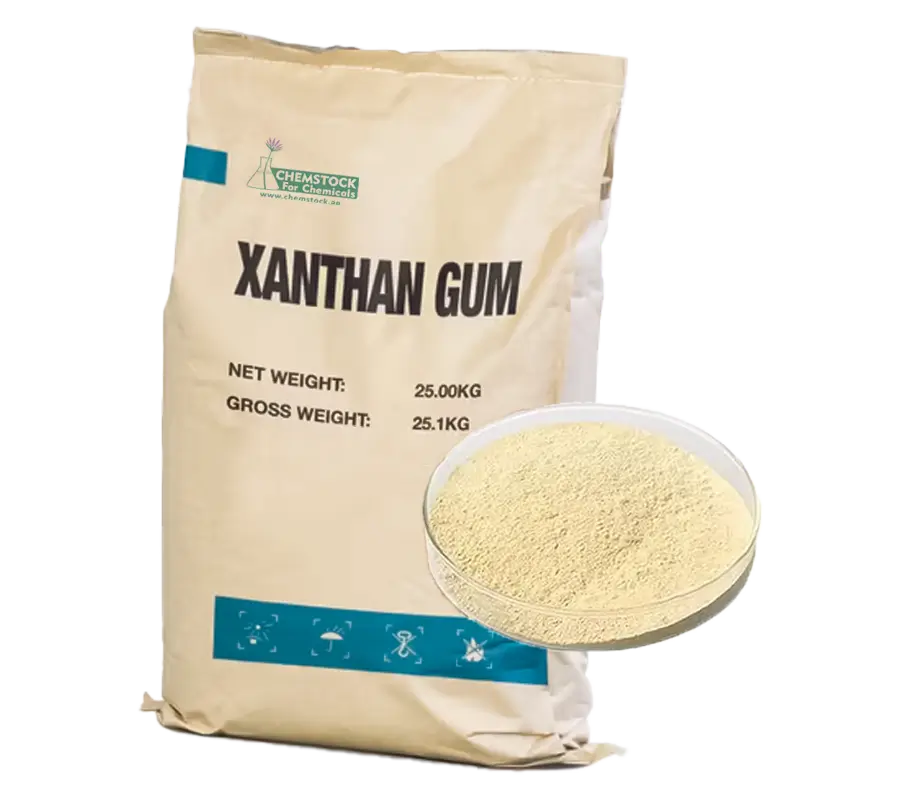
Xanthan Gum Supplier in Kenya | Olinc Chemical Suppliers
Welcome to Olinc Chemical Suppliers, your chemical supply partner in Nairobi, Kenya.
Are you looking for high-quality Xanthan Gum for food manufacturing, baking, cosmetics, personal-care products, pharmaceuticals or industrial formulations? Xanthan Gum is a versatile thickening, stabilising and suspending agent valued for its ability to improve the consistency, texture and stability of different products.
It is particularly popular among food manufacturers because it can produce significant thickening at relatively low concentrations. It helps prevent ingredients from separating, keeps particles suspended and gives products a smooth, consistent texture.
Whether you manufacture sauces, salad dressings, beverages, ice cream, bakery products, lotions, shampoos, toothpaste or detergents, Xanthan Gum can play an important role in achieving the desired product performance.
At Olinc Chemical Suppliers, we welcome enquiries from manufacturers, bakeries, cosmetic producers, food processors, wholesalers and other businesses looking for Xanthan Gum in Kenya.
Contact us for information about available grades, product specifications, packaging and supply arrangements.
What Is Xanthan Gum?
Xanthan Gum is a natural-origin polysaccharide produced commercially through the controlled fermentation of carbohydrates using a microorganism known as Xanthomonas campestris. Following fermentation, the material is recovered, purified, dried and milled into a fine powder.
It is widely used as a hydrocolloid, meaning it interacts with water to form viscous solutions and help control the texture and stability of formulations.
Unlike some ordinary thickeners, Xanthan Gum can produce a thick, stable consistency even when used in relatively small quantities. It also has distinctive flow properties: a formulation can become thinner when stirred, pumped or poured and regain much of its thickness when left undisturbed.
This behaviour makes it particularly useful in products that need to remain thick in storage but still be easy to dispense, spread or pour.
Xanthan Gum is available in different grades and particle sizes depending on its intended application.
Chemical Identification and General Properties
| Property | Description |
|---|---|
| Product name | Xanthan Gum |
| Chemical name | Xanthan polysaccharide |
| Chemical formula | (C₃₅H₄₉O₂₉)ₙ, commonly used as a representative repeating-unit expression |
| CAS number | 11138-66-2 |
| EC number | 234-394-2 |
| E-number | E415 |
| INS number | INS 415 |
| Chemical category | High-molecular-weight polysaccharide |
| Source | Carbohydrate fermentation |
| Producing microorganism | Xanthomonas campestris |
| Appearance | White to cream-coloured powder |
| Solubility | Soluble in water |
| Main functions | Thickener, stabiliser and suspending agent |
| Molecular weight | High and variable; commonly described as approximately one million or more, depending on measurement and product |
Xanthan Gum is not a simple small-molecule chemical with one fixed molecular weight. It is a high-molecular-weight polymer, so its molecular characteristics and performance depend on the manufacturing process and product grade.
Other Names for Xanthan Gum
Xanthan Gum may appear under several alternative names in chemical catalogues, technical documents and ingredient databases.
Common names include:
- Xanthan Gum
- Xanthan
- Gum Xanthan
- Xanthan Polysaccharide
- Polysaccharide B-1459
- Bacterial Xanthan Gum
- Corn Sugar Gum
- Gummi Xanthanum
- E415
- INS 415
- XC Polymer, particularly in some oilfield applications
These names are associated with Xanthan Gum, although XC Polymer is often used to describe its oilfield or drilling-fluid application.
When ordering, confirm the CAS number, intended application and required grade to ensure that the product is suitable for your formulation.
How Does Xanthan Gum Work?
Xanthan Gum works by hydrating in water and forming a viscous solution. Its long polymer chains interact with water and create a structure that increases the resistance of the formulation to flow.
Its main functional properties include:
Thickening
Xanthan Gum increases the viscosity of liquids and semi-liquid products. It is effective at relatively low concentrations, making it useful in sauces, creams, lotions, detergents and other formulations requiring controlled thickness.
Stabilisation
It helps maintain a consistent mixture by reducing the tendency of ingredients to separate during storage.
For example, it can help stabilise salad dressings, sauces and cosmetic emulsions.
Suspension
Xanthan Gum helps keep solid particles suspended in liquids. This is useful in beverages containing pulp, sauces containing spices and industrial formulations containing dispersed solids.
Shear-Thinning Behaviour
One of the most valuable characteristics of Xanthan Gum is its pseudoplastic or shear-thinning behaviour.
This means that its viscosity decreases when the product is stirred, pumped, shaken or squeezed. When the force is removed, the formulation recovers much of its original thickness.
This makes it useful in:
- Pourable sauces
- Liquid detergents
- Shampoos
- Toothpaste
- Cosmetic creams
- Industrial coatings
Temperature and pH Stability
Xanthan Gum is known for maintaining useful thickening performance across a relatively wide range of temperatures and pH conditions.
This makes it suitable for many acidic foods, heated formulations and products exposed to changing storage conditions. However, performance depends on the grade, concentration and overall formulation.
Main Applications and Uses of Xanthan Gum
Xanthan Gum is used across several manufacturing industries because of its thickening, stabilising and suspending properties.
Food and Beverage Manufacturing
Food processing is one of the most important applications of Xanthan Gum.
It helps improve texture, consistency, stability and mouthfeel in different food products.
Common applications include:
Sauces and dressings
- Tomato sauce
- Ketchup
- Mayonnaise-style dressings
- Salad dressings
- Chilli sauce
- Barbecue sauce
- Gravy
- Cooking sauces
- Marinades
In these products, Xanthan Gum helps provide the desired thickness, stabilise mixtures and keep spices or other particles evenly distributed.
Beverages
- Fruit juices
- Fruit drinks
- Flavoured beverages
- Protein drinks
- Nutritional beverages
- Cocoa-based drinks
- Beverage concentrates
It can help suspend pulp and other particles, improve mouthfeel and reduce settling.
Dairy products
- Yoghurt
- Flavoured milk
- Ice cream
- Milkshakes
- Dairy desserts
- Cream-based products
- Dairy toppings
In dairy formulations, it can help improve body, texture and stability.
Bakery products
- Bread
- Cakes
- Muffins
- Pastries
- Gluten-free bread
- Gluten-free cakes
- Bakery fillings
Xanthan Gum is particularly useful in gluten-free baking because it helps provide structure, improve dough handling and contribute to the texture that gluten would otherwise help create.
Other food applications
- Jams and fruit preparations
- Frozen desserts
- Confectionery fillings
- Syrups
- Meat and poultry products
- Instant food mixes
- Powdered food preparations
The suitability of Xanthan Gum depends on the food category, formulation and applicable food additive requirements.
Cosmetic and Personal-Care Manufacturing
Xanthan Gum is widely used in cosmetic and personal-care products because it helps improve viscosity, texture and product stability.
Applications include:
Lotions and creams: It helps control thickness and stabilise the formulation, contributing to a smooth and consistent product.
Shampoos and conditioners: It can improve viscosity and help suspend certain ingredients.
Liquid soaps and body washes: It can help produce a thicker, more controlled consistency.
Toothpaste: It acts as a thickener and stabiliser, helping maintain a uniform paste.
Facial cleansers: It helps improve texture and product flow.
Gels and serums: It can create a smooth gel-like consistency and help keep ingredients evenly distributed.
Hair-care products: It may be used in styling gels, conditioning formulations and other personal-care products.
For cosmetic manufacturing, the grade should meet the applicable quality and purity requirements for personal-care use.
Pharmaceutical Manufacturing
Pharmaceutical-grade Xanthan Gum is used in selected formulations where viscosity control, suspension and stabilisation are required.
Applications may include:
- Oral suspensions
- Liquid medicines
- Topical gels
- Creams and ointments
- Controlled-release tablet formulations
- Certain ophthalmic or specialised formulations where the appropriate grade and specifications are established
It can help keep insoluble ingredients evenly distributed in liquid preparations and improve the consistency of topical products.
Pharmaceutical applications require appropriate grade selection, quality documentation and compliance with the relevant pharmacopeial and regulatory standards.
Detergent and Cleaning Product Manufacturing
Xanthan Gum is used in selected cleaning and detergent formulations to control viscosity and improve the suspension of ingredients.
Applications may include:
- Liquid detergents
- Dishwashing liquids
- Toilet cleaners
- Household cleaning gels
- Surface-cleaning products
- Industrial cleaning formulations
Its performance depends on compatibility with surfactants, salts, solvents and other ingredients in the cleaning formulation. Not every detergent system is suitable for every Xanthan Gum grade.
Paints and Coatings
In paints and coatings, Xanthan Gum can act as a rheology modifier and suspending agent.
It helps control flow, reduce settling of solid particles and improve application characteristics in selected water-based formulations.
Applications may include:
- Water-based paints
- Decorative coatings
- Protective coatings
- Pigment dispersions
- Selected printing inks
Oil and Gas Industry
Specialised oilfield-grade Xanthan Gum is used in drilling fluids and related oilfield systems.
Its viscosity and suspension properties help maintain solids in suspension and support fluid performance.
It may be used in:
- Drilling muds
- Water-based drilling fluids
- Completion fluids
- Selected well-servicing fluids
Oilfield-grade Xanthan Gum has different technical requirements from food-grade material. Buyers should specify the relevant oilfield standard and application.
Agricultural Formulations
Xanthan Gum can be used in selected agricultural chemical formulations as a thickener and suspending agent.
Applications may include:
- Liquid fertiliser formulations
- Crop-protection suspensions
- Agricultural spray mixtures
- Seed-treatment formulations
The appropriate grade and compatibility must be established for the particular formulation.
Textile and Industrial Applications
Other uses include:
- Textile printing pastes
- Ceramic glazes
- Water-based inks
- Paper-related formulations
- Industrial suspensions
- Speciality chemical formulations
Its ability to control viscosity and suspend particles makes it useful in many water-based industrial systems.
Why Do Manufacturers Choose Xanthan Gum?
Manufacturers choose Xanthan Gum because it provides several useful formulation benefits.
High thickening efficiency
It can create substantial viscosity at relatively low concentrations compared with many conventional thickeners.
Excellent stabilising properties
It helps reduce separation and maintain uniformity in suitable formulations.
Effective suspension
It helps prevent solid particles from settling too quickly in liquid products.
Good performance in different temperatures
It retains useful thickening properties under a variety of processing and storage conditions.
Wide pH tolerance
It performs well in many acidic and alkaline formulations, although the exact operating conditions should be checked against the product grade.
Shear-thinning behaviour
It allows products to become easier to pour, pump, spread or squeeze while maintaining thickness at rest.
Useful in gluten-free baking
It helps improve structure and texture in baked products that do not contain conventional gluten-forming wheat proteins.
Compatibility with other hydrocolloids
It can work in combination with ingredients such as guar gum and locust bean gum to achieve particular textures and viscosity profiles.
Different Grades and Types of Xanthan Gum
Xanthan Gum is manufactured in different grades to meet the requirements of different industries.
Food Grade Xanthan Gum
Food-grade Xanthan Gum is intended for use in food and beverage products where its use is permitted.
It is commonly used in:
- Sauces
- Dressings
- Beverages
- Dairy products
- Ice cream
- Bakery products
- Gluten-free foods
- Food fillings
Food-grade products should meet the applicable food additive specifications and have appropriate documentation.
Cosmetic Grade Xanthan Gum
Cosmetic-grade Xanthan Gum is used in personal-care and cosmetic formulations.
It is suitable for applications such as:
- Lotions
- Creams
- Shampoos
- Liquid soaps
- Toothpaste
- Gels
- Serums
The product should meet the relevant quality and purity requirements for the intended cosmetic application.
Pharmaceutical Grade Xanthan Gum
Pharmaceutical-grade material is intended for selected pharmaceutical and healthcare formulations.
It requires appropriate quality controls and supporting documentation. Confirm whether the material complies with the particular pharmacopeial requirements needed for your application.
Industrial Grade Xanthan Gum
Industrial-grade Xanthan Gum is used in non-food manufacturing applications such as:
- Paints and coatings
- Detergents
- Textile printing
- Industrial suspensions
- Selected agricultural formulations
It should not be used in food or pharmaceutical production unless the supplier’s documentation specifically confirms suitability for that purpose.
Oilfield Grade Xanthan Gum
Oilfield-grade Xanthan Gum is designed for drilling and other oilfield fluid applications.
Its specifications may include specialised viscosity testing, salt tolerance and other performance parameters relevant to drilling-fluid standards.
It is not interchangeable with food-grade Xanthan Gum simply because both products have the same chemical identity.
Particle Sizes and Specialised Xanthan Gum Types
In addition to application grades, Xanthan Gum is supplied in different particle sizes and specialised formulations.
Fine mesh Xanthan Gum: A finer powder that can offer convenient dispersion and hydration when properly incorporated.
Coarse or regular mesh Xanthan Gum: A larger particle-size material used in applications where the manufacturer’s processing characteristics are suitable.
Clear-solution grade: Designed for formulations where solution clarity is particularly important.
Rapidly dispersible grade: Designed to improve dispersion and reduce lump formation during mixing.
Dust-controlled grade: Manufactured to reduce dust during handling.
Salt-tolerant grade: Designed for formulations containing higher levels of salts or electrolytes.
Acid-stable grade: Designed for applications requiring suitable performance under acidic conditions.
These specialised properties vary by manufacturer. Ask for the product’s technical data before selecting a grade.
Typical Technical Specifications of Xanthan Gum
The following table provides a general reference for evaluating commercial food-grade Xanthan Gum. Individual manufacturers may have different specifications.
| Parameter | Typical description or reference |
|---|---|
| Appearance | White to cream-coloured free-flowing powder |
| CAS number | 11138-66-2 |
| E-number | E415 |
| Solubility | Soluble in water |
| pH of 1% solution | Often around 6.0–8.0, depending on grade |
| Loss on drying | Food additive specifications commonly allow a maximum of 15% |
| Total ash | Food additive specifications commonly allow a maximum of 16% on an anhydrous basis |
| Pyruvic acid | Common food additive specification: not less than 1.5% |
| Viscosity | Grade- and test-method-dependent |
| Particle size | Available in different mesh sizes |
| Microbiological quality | Must comply with the relevant food-grade specification |
Important: Xanthan Gum viscosity values cannot be compared reliably unless the concentration, temperature, solution composition, instrument and test speed are the same. Always compare the supplier’s actual TDS and COA rather than relying on a single viscosity number.
How to Use Xanthan Gum in Formulations
Correct incorporation is important because Xanthan Gum can form lumps when powder is added too quickly to water.
A suitable manufacturing procedure depends on the formulation, equipment and grade.
General processing guidance includes:
- Measure the required quantity according to the validated formulation.
- Ensure the mixing vessel and equipment are clean.
- Start agitation before adding the powder.
- Sprinkle the Xanthan Gum gradually into the liquid rather than adding it all at once.
- Maintain sufficient mixing to distribute the powder evenly.
- Allow time for complete hydration.
- Check the final viscosity and consistency before making any formulation adjustments.
Another common method is to premix Xanthan Gum with other dry ingredients, such as sugar or flour, before adding the mixture to water. This can help separate the particles and improve dispersion.
For industrial production, high-shear mixing or specialised powder-induction equipment may be used, depending on the formulation.
Factors Affecting Performance
- Concentration of Xanthan Gum
- Particle size
- Water temperature
- Mixing speed and duration
- Salt concentration
- pH of the formulation
- Other thickeners and stabilisers
- Quality and specification of the supplied grade
Always conduct small-scale trials before introducing a new grade into full production.
Recommended Usage Levels
The amount of Xanthan Gum required varies considerably between applications.
Some commercial food formulations use concentrations in the approximate range of 0.05% to 0.5%, although certain applications may require different levels.
The following are illustrative formulation starting ranges only, not universal recommendations or legal limits.
| Application | Illustrative starting range |
|---|---|
| Beverages | 0.05–0.20% |
| Salad dressings and sauces | 0.10–0.50% |
| Dairy products | 0.05–0.20% |
| Gluten-free baking | 0.20–0.80% |
| Confectionery fillings | 0.10–0.50% |
| Selected meat products | 0.10–0.30% |
Actual use must be determined through product development trials, the supplier’s instructions and applicable food regulations. These ranges should not be treated as approved maximum levels for every food category or market.
Xanthan Gum Compared with Other Thickeners
Manufacturers often compare Xanthan Gum with other gums and thickening agents when developing formulations.
| Product | Main function | Common applications |
|---|---|---|
| Xanthan Gum | Thickener, stabiliser and suspending agent | Sauces, beverages, cosmetics and detergents |
| Guar Gum | Thickener and water-binding agent | Food, bakery, dairy and industrial products |
| CMC (Carboxymethyl Cellulose) | Thickener, stabiliser and binder | Food, detergents, pharmaceuticals and industrial formulations |
| Carbomer | High-efficiency gel former and thickener | Cosmetics and personal-care products |
| Gelatin | Gelling and texturising agent | Desserts, confectionery and food |
| Locust Bean Gum | Thickener and stabiliser | Dairy, frozen desserts and food products |
Xanthan Gum vs Guar Gum
Both are hydrocolloids used for thickening and stabilisation. However, they have different hydration and rheological properties.
Xanthan Gum offers useful shear-thinning behaviour and good performance over a wide range of processing conditions. Guar Gum is also an effective thickener and is frequently used in combination with Xanthan Gum to create specific textures.
Xanthan Gum vs CMC
Both can thicken and stabilise water-based formulations. Their compatibility, viscosity behaviour and performance depend on the particular ingredients and processing conditions.
Xanthan Gum is especially valued for suspension and shear-thinning properties, while CMC is used in many applications requiring thickening, binding and stabilisation.
Neither product should be substituted for the other without testing the formulation.
Packaging of Xanthan Gum
Xanthan Gum is commonly supplied in sealed packaging designed to protect the powder from moisture and contamination.
Common commercial packaging formats include:
- 25 kg bags
- 20 kg bags or cartons
- Other manufacturer-specific industrial packs
Packaging varies by manufacturer, product grade and supplier. Confirm the available pack size before placing an order.
For food-processing applications, packaging should be suitable for food ingredients and should protect the product from moisture, dust and foreign materials.
For larger manufacturing operations, customers can enquire about bulk supply arrangements.
Storage and Handling of Xanthan Gum
Proper storage helps preserve the quality and performance of Xanthan Gum.
Recommended storage practices include:
- Store in a cool, dry and well-ventilated area.
- Keep the product in its original sealed packaging.
- Protect it from moisture and humidity.
- Avoid direct contact with water before use.
- Keep bags away from direct sunlight and excessive heat.
- Store away from strong odours and possible contaminants.
- Use clean and dry handling equipment.
- Reseal opened packaging properly.
- Follow the manufacturer’s storage instructions and SDS.
Because Xanthan Gum absorbs water and hydrates readily, moisture exposure can cause clumping and make handling more difficult.
For food production, store the product in a clean ingredient-storage area that meets the facility’s hygiene requirements.
Safety Precautions
Although Xanthan Gum is widely used in food and personal-care formulations, its powdered form should be handled carefully.
Recommended precautions include:
- Avoid inhaling airborne powder.
- Avoid creating excessive dust during handling.
- Wear suitable protective gloves when handling bulk quantities.
- Use safety glasses where dust exposure is possible.
- Use appropriate respiratory protection when indicated by the workplace risk assessment.
- Wash hands after handling.
- Keep packaging closed when not in use.
- Follow the product-specific Safety Data Sheet.
- Keep the product away from contamination and unsuitable chemicals.
For food applications, use only material supported by appropriate food-grade documentation.
Factors to Consider When Buying Xanthan Gum
Before purchasing Xanthan Gum, consider the following points to ensure that the product meets your production requirements.
Intended application
Explain whether you need it for food processing, baking, cosmetics, pharmaceuticals, detergents, paints or oilfield applications.
2. Grade
Choose food grade, cosmetic grade, pharmaceutical grade, industrial grade or oilfield grade according to your intended use.
3. Viscosity requirement
Different grades can produce different viscosity levels. Request the manufacturer’s viscosity specification and test method.
4. Particle size
Fine, regular and coarse powders can behave differently during mixing and hydration.
5. Product documentation
Request the relevant Technical Data Sheet, Certificate of Analysis and Safety Data Sheet. For food and pharmaceutical applications, confirm any additional compliance documents required.
6. Packaging
Confirm the available pack size and whether it suits your storage and production requirements.
7. Quantity
Indicate whether you require a single bag, several bags or regular bulk supply.
8. Delivery location
Provide your location so that transport and delivery arrangements can be discussed.
Xanthan Gum Supplier in Nairobi, Kenya
Are you searching for a Xanthan Gum supplier in Nairobi or elsewhere in Kenya?
Olinc Chemical Suppliers welcomes enquiries from food manufacturers, bakeries, cosmetic producers, pharmaceutical manufacturers, detergent manufacturers and other businesses looking for chemical and ingredient supplies.
We understand that different manufacturers require different grades and technical specifications. That is why customers are encouraged to state their intended application and product requirements when making an enquiry.
Whether you need Xanthan Gum for sauce manufacturing, gluten-free baking, cosmetic creams, shampoo production or industrial thickening, contact Olinc Chemical Suppliers for product and supply information.
Why Contact Olinc Chemical Suppliers?
- Nairobi-based chemical supplier.
- Product enquiries for food-processing and industrial applications.
- Support for customers seeking grade and specification information.
- Convenient communication through phone, email and WhatsApp.
- Enquiries welcome for different commercial quantities.
We also welcome enquiries from customers in other parts of Kenya and businesses in Uganda and Tanzania seeking supply arrangements.
Frequently Asked Questions About Xanthan Gum
What is Xanthan Gum mainly used for?
Xanthan Gum is mainly used as a thickener, stabiliser and suspending agent. It is used in sauces, dressings, beverages, dairy products, bakery products, cosmetics, pharmaceuticals, detergents and industrial formulations.
What is the E-number of Xanthan Gum?
The food additive number for Xanthan Gum is E415. Its international numbering system designation is INS 415.
What is the CAS number of Xanthan Gum?
The CAS number of Xanthan Gum is 11138-66-2.
Is Xanthan Gum soluble in water?
Yes. Xanthan Gum is soluble in water and forms a viscous solution. It can hydrate in both cold and hot water when properly dispersed.
Can Xanthan Gum be used in food?
Yes. Food-grade Xanthan Gum is used in permitted food applications as a thickener, stabiliser and suspending agent. Manufacturers must follow the applicable food additive requirements.
Can Xanthan Gum be used in baking?
Yes. It is used in various bakery products, particularly gluten-free bread and cakes, where it helps improve structure, texture and moisture management.
Can Xanthan Gum be used in cosmetics?
Yes. Cosmetic-grade Xanthan Gum is used in creams, lotions, shampoos, gels, liquid soaps and toothpaste to improve viscosity and stability.
Is Xanthan Gum a preservative?
No. Its main functions are thickening, stabilising and suspending. It is not a substitute for a suitable antimicrobial preservative system in food or cosmetics.
Does Xanthan Gum form lumps?
It can form lumps if added too quickly to water. Gradual addition under suitable agitation or premixing it with dry ingredients can improve dispersion.
What is the difference between food-grade and industrial-grade Xanthan Gum?
Food-grade material is manufactured and controlled for permitted food applications. Industrial-grade material is intended for non-food uses and may not meet food safety or purity requirements. They should not be treated as interchangeable.
Can Xanthan Gum be mixed with Guar Gum?
Yes. Xanthan Gum and Guar Gum are often used together to achieve particular thickening and textural effects. The best ratio depends on the desired formulation and should be established through testing.
What packaging is available?
Common commercial formats include 20 kg and 25 kg packs, depending on the manufacturer and grade. Contact the supplier to confirm actual packaging options.
Where can I buy Xanthan Gum in Kenya?
You can contact Olinc Chemical Suppliers in Nairobi, Kenya, for enquiries about Xanthan Gum, including product grades, specifications, packaging and supply arrangements.
What documents should I request before purchasing?
Ask for the current Technical Data Sheet, Certificate of Analysis and Safety Data Sheet. For food or pharmaceutical applications, also confirm the documentation needed to establish suitability for your intended use.
Request a Quote for Xanthan Gum from Olinc Chemical Suppliers
Are you looking for Xanthan Gum in Nairobi, Kenya, for food manufacturing, bakery production, cosmetics, pharmaceuticals, detergents or industrial applications?
Olinc Chemical Suppliers welcomes your enquiry.
Contact us with your required grade, quantity and intended application so that we can discuss the relevant product specifications, packaging and supply arrangements.
Company: Olinc Chemical Suppliers
Location: Enterprise Road, Avon Business Center, Nairobi, Kenya
Phone / WhatsApp: 0793062849
Alternative Phone: 0743657810
Email: sales@olincinchemicals.com
Website: www.olincchemicalsl.com
Looking for a Xanthan Gum supplier in Kenya? Contact Olinc Chemical Suppliers for product enquiries and supply information.


Reviews
There are no reviews yet.