
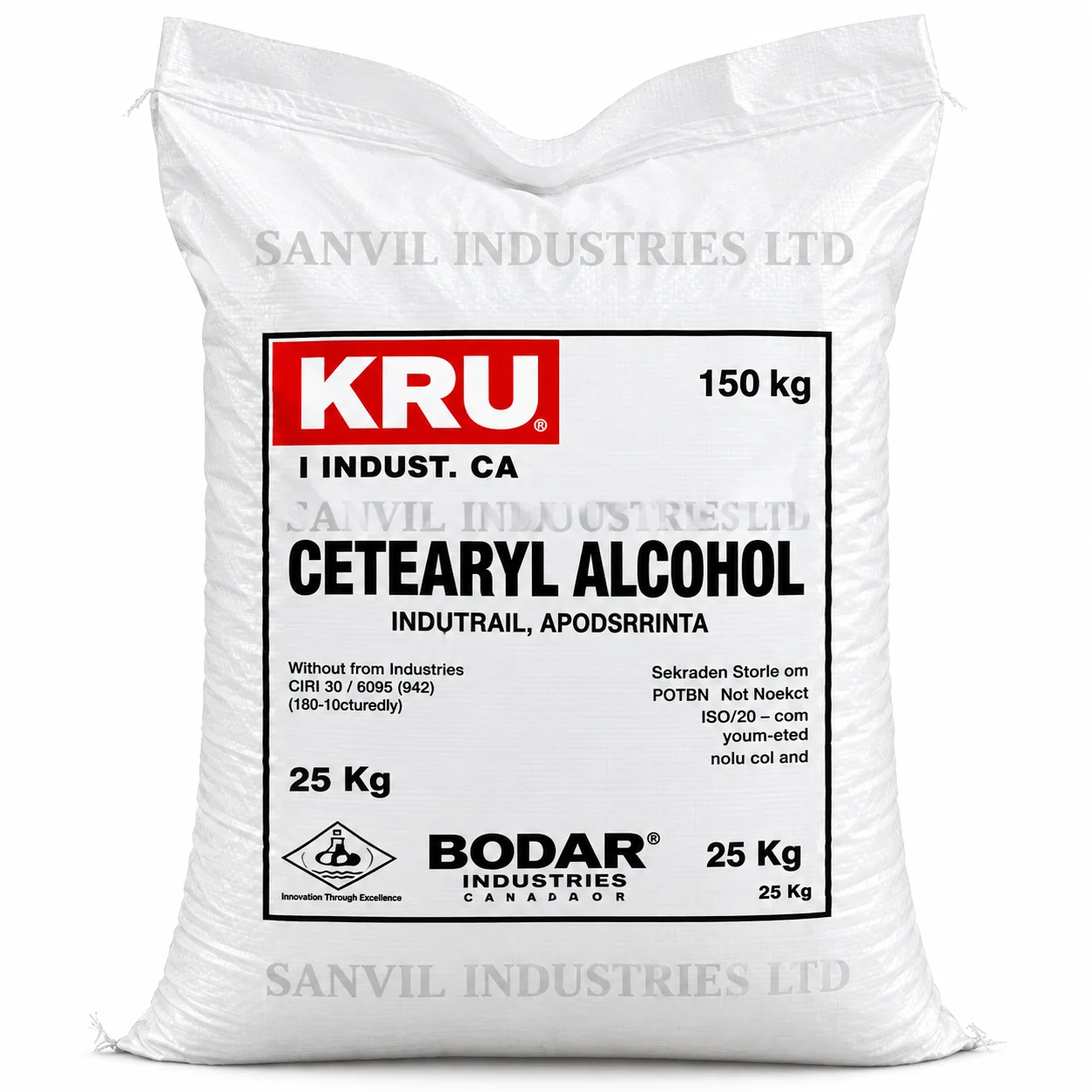
Cetyl Stearyl Alcohol (CSA) Supplier in Kenya | Olinc Chemical Suppliers
What Is Cetyl Stearyl Alcohol (CSA)?
Cetyl Stearyl Alcohol (CSA), commonly known as Cetearyl Alcohol, is a fatty alcohol blend mainly consisting of cetyl alcohol (C16) and stearyl alcohol (C18). It is a versatile non-ionic cosmetic and industrial raw material widely used in the manufacture of lotions, creams, hair conditioners, shampoos, body butters, moisturising products and other personal-care formulations.
Unlike ordinary alcohols such as ethanol and isopropyl alcohol, Cetyl Stearyl Alcohol is a waxy fatty alcohol. It does not function primarily as a solvent or disinfectant. Instead, it acts as an emollient, thickening agent, co-emulsifier and consistency enhancer.
CSA is particularly valued in cosmetic manufacturing because it helps produce smooth, creamy and stable products. It improves the texture of creams and lotions, gives hair conditioners their rich consistency and helps prevent oil and water ingredients from separating when used in a suitable emulsifier system.
At Olinc Chemical Suppliers, we supply chemical raw materials to manufacturers, cosmetic producers, wholesalers and businesses looking for Cetyl Stearyl Alcohol in Nairobi, Kenya, with enquiries and supply arrangements for Uganda and Tanzania.
Other Names for Cetyl Stearyl Alcohol
When searching for this ingredient, you may come across several names and abbreviations.
-
Cetyl Stearyl Alcohol
-
Cetearyl Alcohol
-
Cetostearyl Alcohol
-
Cetyl-Stearyl Alcohol
-
CSA
-
C/S Alcohol
-
Cetyl Alcohol and Stearyl Alcohol Blend
-
Fatty Alcohol C16-C18
-
Hexadecanol and Octadecanol Blend
INCI name: Cetearyl Alcohol.
CAS numbers: 67762-27-0 is commonly associated with Cetearyl Alcohol; individual cetyl and stearyl alcohol components have separate CAS numbers.
These names are widely used in cosmetic and chemical trading. However, different suppliers may offer different ratios of cetyl and stearyl alcohol, so buyers should confirm the exact composition and grade before ordering.
Chemical Properties and Characteristics
Cetyl Stearyl Alcohol is valued for its physical properties and its ability to improve the texture and consistency of formulated products.
|
Property |
Typical description |
|---|---|
|
Chemical name |
Cetyl Stearyl Alcohol |
|
Common name |
Cetearyl Alcohol |
|
INCI name |
Cetearyl Alcohol |
|
CAS number |
67762-27-0 |
|
Chemical classification |
Fatty alcohol blend |
|
Appearance |
White flakes, beads or pastilles |
|
Physical state |
Solid at room temperature |
|
Odour |
Mild characteristic odour |
|
Solubility in water |
Insoluble |
|
Solubility in oils |
Soluble or dispersible in suitable oils when heated |
|
Main components |
Cetyl alcohol (C16) and stearyl alcohol (C18) |
|
Main functions |
Thickening, emollient, co-emulsifying and conditioning |
Specifications such as melting point, hydroxyl value, acid value, moisture and cetyl-to-stearyl ratio vary by commercial grade. Always refer to the actual manufacturer’s TDS and COA.
Main Uses and Applications of Cetyl Stearyl Alcohol
CSA is widely used in cosmetic, personal-care and selected industrial formulations. Its ability to thicken, soften and improve product texture makes it an important ingredient for manufacturers.
Body Lotion Manufacturing
It helps:
-
Give lotions a creamy and luxurious texture.
-
Improve the consistency of the finished product.
-
Provide emollient properties that soften the skin.
-
Support oil-in-water emulsions when combined with suitable emulsifiers.
-
Reduce the thin or watery feel of certain formulations.
It is suitable for manufacturers producing everyday moisturising lotions, body creams and skincare products.
Hair Conditioner Manufacturing
It helps:
-
Give conditioners a thick, creamy consistency.
-
Improve hair softness and manageability.
-
Reduce friction during combing.
-
Support conditioning emulsions.
-
Improve the smooth feel of the finished product.
It is frequently combined with conditioning agents such as BTMS and suitable cationic surfactants.
Hair Cream and Hair Butter Production
It helps manufacturers achieve:
-
A thicker product structure.
-
Improved spreadability.
-
A smooth and creamy finish.
-
Better consistency during storage.
-
An emollient feel.
Shampoo Manufacturing
It helps improve the texture and thickness of creamy shampoos and selected specialised hair-cleansing products.
It is particularly useful in formulations where a richer, creamier appearance is desired.
Face Cream and Moisturiser Manufacturing
Its functions include:
-
Improving cream thickness.
-
Providing emollient properties.
-
Supporting emulsion stability.
-
Improving skin feel and spreadability.
-
Creating a smooth, consistent finished product.
Body Butter and Hand Cream Manufacturing
It is particularly useful in formulations containing shea butter, cocoa butter and other vegetable oils.
Soap and Cream Cleanser Manufacturing
CSA can be incorporated into selected cream cleansers, cleansing lotions and specialised soap-based cosmetic products to improve their thickness and texture.
It should be used with a compatible emulsifier and surfactant system.
Pharmaceutical and Topical Formulations
It helps provide consistency, emolliency and structure to topical formulations. The grade must meet the relevant pharmaceutical specifications.
Sunscreen and Cosmetic Cream Manufacturing
CSA is used in selected sunscreen and cosmetic cream formulations to improve product consistency, texture and emollient properties.
It supports the formation of smooth, spreadable creams when combined with suitable emulsifiers and UV-filter ingredients.
Industrial Creams and Emulsions
Beyond personal-care products, Cetyl Stearyl Alcohol can be used in selected industrial emulsions and specialty formulations where a waxy thickener, consistency modifier or emollient is required.
Why Is Cetyl Stearyl Alcohol Important in Cosmetic Manufacturing?
For cosmetic manufacturers, CSA performs several important functions that help improve the quality of finished products.
Thickening agent
CSA increases the viscosity of creams, lotions and conditioners, helping manufacturers achieve their desired consistency.
Emollient
It helps soften and smooth the skin by leaving an emollient feel. This makes it valuable in moisturisers, body creams and hand lotions.
Co-emulsifier
It supports emulsifier systems by improving the structure and stability of oil-and-water formulations. It is not generally a complete standalone emulsifier.
Consistency enhancer
It gives creams, conditioners and other cosmetic products a richer, more uniform texture.
Hair conditioning support
It improves the smoothness and manageability of hair products, especially when combined with appropriate conditioning agents.
Improves product appearance
It helps manufacturers produce creamy, smooth and professionally finished cosmetic products.
How to Use Cetyl Stearyl Alcohol in Cosmetic Formulations
Cetyl Stearyl Alcohol is normally incorporated into the oil phase of a formulation because it is not soluble in water.
A typical manufacturing process involves:
-
Weigh the required quantity of CSA according to the formulation.
-
Add it to the oil phase together with compatible oils, butters and oil-soluble ingredients.
-
Heat the oil phase, commonly to approximately 70–75°C, until the fatty alcohol has completely melted.
-
Prepare and heat the water phase separately to a similar temperature.
-
Slowly combine the phases under suitable mixing or homogenisation.
-
Continue mixing while the emulsion forms and cools.
-
Add heat-sensitive ingredients, fragrance and suitable preservatives at the recommended temperatures.
-
Check the final product’s viscosity, pH, stability and appearance before packaging.
Recommended usage levels
The amount of CSA required depends on the product being manufactured, the desired thickness and the other ingredients in the formulation.
|
Application |
Typical starting range |
|---|---|
|
Body lotions |
1–3% |
|
Face creams |
1–5% |
|
Hair conditioners |
2–5% |
|
Body creams |
2–5% |
|
Hand creams |
2–5% |
|
Body butters |
3–8% |
|
Hair creams |
2–5% |
These are indicative formulation ranges, not fixed manufacturing instructions. Some formulations may require different concentrations.
Important: Higher concentrations generally produce a thicker, more structured product. However, the final result depends on the emulsifier, oils, butters, mixing conditions and other ingredients used.
Ingredients That Work Well with Cetyl Stearyl Alcohol
CSA is often combined with other cosmetic raw materials to achieve specific formulation results.
|
Ingredient |
Role in formulation |
|---|---|
|
BTMS |
Conditioning emulsifier for hair products |
|
Glycerine |
Humectant that attracts and retains moisture |
|
Shea Butter |
Emollient and moisturising ingredient |
|
Cocoa Butter |
Provides richness and emollient properties |
|
Stearic Acid |
Thickening and consistency-building agent |
|
Cetyl Alcohol |
Fatty alcohol used for thickening and emolliency |
|
Emulsifying Wax |
Helps form and stabilise oil-and-water emulsions |
|
Dimethicone |
Silicone conditioning and skin-feel ingredient |
The correct combination depends on whether you are manufacturing a lotion, conditioner, body butter, face cream or another cosmetic product.
Difference Between Cetyl Alcohol, Stearyl Alcohol and Cetearyl Alcohol
This is a common question among cosmetic manufacturers.
Although the three ingredients are closely related, they are not exactly the same.
Cetyl Alcohol
Stearyl Alcohol
Cetyl Stearyl Alcohol (Cetearyl Alcohol)
Which one should you buy?
If you are manufacturing body creams, lotions, hair conditioners or cosmetic butters and want a blend of C16 and C18 fatty alcohols, Cetearyl Alcohol is commonly the appropriate choice. Always check the formulation requirements before substituting one grade for another.
Available Grades and Quality Specifications
Cetyl Stearyl Alcohol is available in different grades and commercial specifications.
When purchasing CSA, consider the following:
-
Cosmetic grade: Intended for cosmetic and personal-care manufacturing.
-
Pharmaceutical grade: Must meet the relevant pharmaceutical quality requirements.
-
Industrial grade: Intended for suitable industrial applications.
Important specifications to request from your supplier include:
|
Specification |
Why it matters |
|---|---|
|
Cetyl/stearyl ratio |
Determines the composition of the blend |
|
Melting point range |
Affects processing and formulation |
|
Hydroxyl value |
Helps characterise fatty alcohol composition |
|
Acid value |
Indicates free fatty acid content |
|
Moisture content |
Helps assess product quality |
|
Appearance |
Confirms physical condition |
|
Odour |
Helps identify unusual product characteristics |
For manufacturers supplying commercial cosmetics, obtaining a Technical Data Sheet (TDS), Safety Data Sheet (SDS) and Certificate of Analysis (COA) is recommended.
Packaging and Supply Options
Cetyl Stearyl Alcohol is commonly supplied as white flakes, beads or pastilles in sealed packaging.
-
1 kg packs for small-scale cosmetic manufacturers.
-
5 kg packs for small production requirements.
-
25 kg bags or cartons for commercial manufacturing.
-
Larger bulk packaging subject to supplier availability.
Actual packaging, available quantities and grade should be confirmed with Olinc Chemical Suppliers when requesting a quotation.
Storage and Handling of Cetyl Stearyl Alcohol
Proper storage helps maintain the quality of CSA before it is used in manufacturing.
Recommended storage practices:
-
Store in a cool, dry and well-ventilated location.
-
Keep the product in its original sealed packaging.
-
Protect it from moisture and contamination.
-
Keep away from excessive heat and direct sunlight.
-
Avoid mixing with incompatible materials.
-
Keep packaging properly closed after opening.
-
Follow the manufacturer’s recommended storage conditions.
Safety precautions
Although Cetyl Stearyl Alcohol is widely used in cosmetic products, concentrated raw material should still be handled appropriately.
-
Wear suitable gloves when handling.
-
Use protective eyewear where dust or splashing is possible.
-
Avoid unnecessary inhalation of dust.
-
Maintain good workplace hygiene.
-
Consult the product-specific SDS before handling.
-
Avoid contact with hot melted material, which can cause thermal burns.
Why Buy Cetyl Stearyl Alcohol from Olinc Chemical Suppliers?
When manufacturing cosmetics, hair products and personal-care formulations, the quality of your raw materials directly influences the consistency of your finished products.
Olinc Chemical Suppliers is a chemical supplier in Nairobi, Kenya, serving businesses, manufacturers, wholesalers and customers with industrial and specialty chemical requirements.
Why contact Olinc?
-
Convenient location at Avon Business Center, Enterprise Road, Nairobi.
-
Chemical sourcing support for cosmetic and personal-care manufacturers.
-
Enquiries for different quantities and packaging requirements.
-
Assistance in identifying the required chemical and grade.
-
Pricing and availability information on request.
-
Supply enquiries from Kenya, Uganda and Tanzania.
Whether you are producing lotions, hair conditioners, body creams, shampoos or cosmetic butters, contact Olinc Chemical Suppliers for your Cetyl Stearyl Alcohol requirements.
Frequently Asked Questions About Cetyl Stearyl Alcohol (CSA)
What is Cetyl Stearyl Alcohol used for?
It is used as a thickening agent, emollient, co-emulsifier and consistency enhancer in lotions, creams, hair conditioners, shampoos and other personal-care products.
Is Cetyl Stearyl Alcohol the same as Cetearyl Alcohol?
Yes. Cetearyl Alcohol is the standard INCI name commonly used for a blend of cetyl and stearyl alcohol.
Is CSA suitable for making body lotion?
Yes. It helps improve body lotion thickness, texture, spreadability and emulsion structure.
Can I use CSA to make hair conditioner?
Yes. It is widely used in hair conditioners to provide a creamy consistency and support conditioning performance when combined with suitable conditioning agents.
Does Cetyl Stearyl Alcohol thicken liquid soap?
It is not generally used as a conventional thickener for ordinary water-based liquid hand soap. It is more suitable for emulsified creams, lotions and creamy cleansing formulations.
Is CSA soluble in water?
No. Cetyl Stearyl Alcohol is water-insoluble. It is normally melted into the oil phase during formulation.
Can CSA be mixed with glycerine?
Yes, it can be used in formulations containing glycerine. However, glycerine belongs in the water phase, while CSA is normally melted into the oil phase.
What is the difference between CSA and emulsifying wax?
CSA is primarily a fatty alcohol thickener, emollient and co-emulsifier. Emulsifying wax contains an emulsifying system designed to help combine oil and water. CSA alone should not be relied upon to stabilise every oil-and-water formulation.
How much CSA should I use in body cream?
A typical starting range is 2–5%, depending on the desired thickness and the other ingredients in the formulation.
Can CSA be used in shampoo?
Yes, selected creamy shampoo formulations use CSA as a consistency enhancer. Its suitability depends on the surfactant system and formulation design.
Does Cetyl Stearyl Alcohol moisturise the skin?
It provides emollient properties that help soften and smooth the skin. It is not a humectant like glycerine.
Is Cetyl Stearyl Alcohol safe for cosmetics?
Appropriately specified cosmetic-grade cetearyl alcohol is widely used in personal-care formulations. The manufacturer should use the correct grade and comply with applicable cosmetic regulations.
What does CSA stand for?
In this product context, CSA refers to Cetyl Stearyl Alcohol, also commonly called Cetearyl Alcohol or Cetostearyl Alcohol.
Where can I buy Cetyl Stearyl Alcohol in Nairobi?
You can contact Olinc Chemical Suppliers at Avon Business Center, Enterprise Road, Nairobi, for product availability, quotations and packaging information.
Can Olinc supply CSA to Uganda and Tanzania?
Customers from Uganda and Tanzania can contact Olinc Chemical Suppliers to enquire about supply quantities, pricing and delivery arrangements.
Order Cetyl Stearyl Alcohol from Olinc Chemical Suppliers
Are you looking for a reliable Cetyl Stearyl Alcohol supplier in Nairobi, Kenya?
Olinc Chemical Suppliers caters to cosmetic manufacturers, skincare businesses, haircare producers, wholesalers and other businesses requiring quality chemical raw materials.
We welcome enquiries for Cetyl Stearyl Alcohol for:
-
Body lotion and moisturiser production.
-
Hair conditioner manufacturing.
-
Face cream and body butter production.
-
Shampoo and hair cream manufacturing.
-
Cosmetic and personal-care formulations.
Contact Olinc Chemical Suppliers today for current prices, available grades, packaging and bulk supply enquiries.
Contact details:
-
Company: Olinc Chemical Suppliers
-
Location: Avon Business Center, Enterprise Road, Nairobi, Kenya
-
Phone/WhatsApp: 0793062849
-
Email: sales@olincinchemicals.com
-
Website: www.olincinchemicalsl.com


Reviews
There are no reviews yet.