
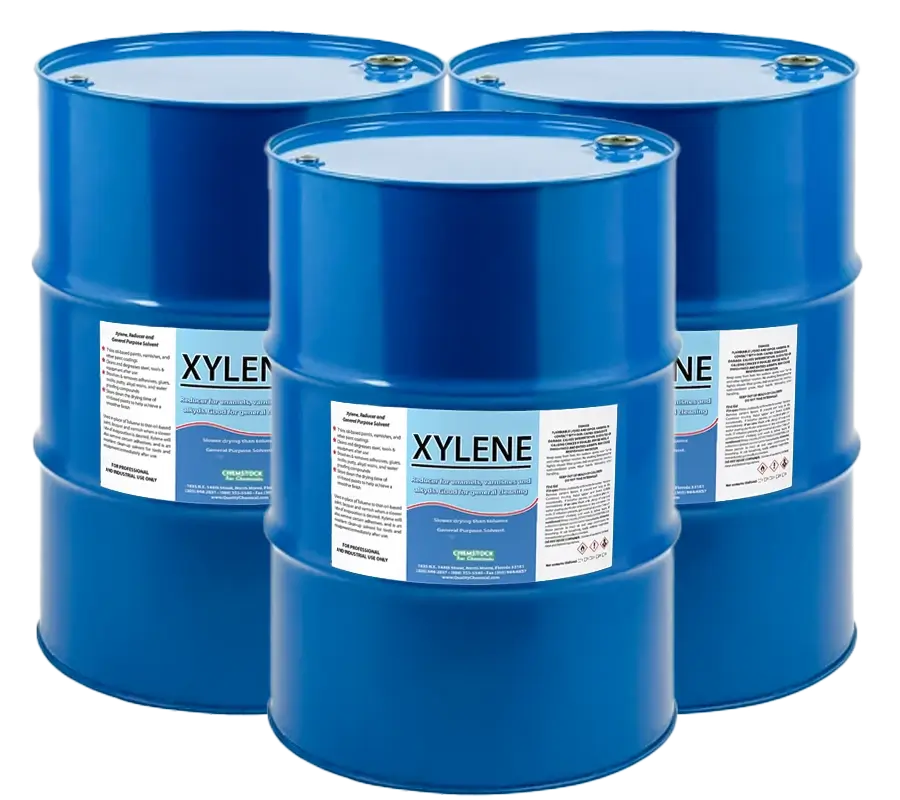
Xylene Supplier in Kenya | Olinc Chemical Suppliers
What is Xylene?
Xylene is a colourless, flammable aromatic hydrocarbon solvent with a characteristic sweet, gasoline-like odour. It is widely used in industrial manufacturing because of its excellent solvent properties, particularly its ability to dissolve or dilute many resins, paints, coatings, adhesives, inks and other organic materials.
Also known as Dimethylbenzene, Xylol or Xylene Solvent, this chemical is an important raw material in the chemical, paint, printing, petroleum, rubber and manufacturing industries.
Xylene is a petroleum-derived aromatic hydrocarbon consisting of a benzene ring with two methyl groups attached. Its chemical formula is C₈H₁₀.
Commercial xylene is commonly supplied as a mixture of three isomers:
-
Ortho-xylene (o-xylene)
-
Meta-xylene (m-xylene)
-
Para-xylene (p-xylene)
These isomers have the same molecular formula but differ in the positions of their methyl groups. They also have different physical properties and industrial applications.
Xylene is particularly valued for its ability to dissolve many organic substances, its relatively fast evaporation rate and its usefulness in paint and coating formulations.
At Olinc Chemical Suppliers, we welcome enquiries for industrial chemicals and solvents from manufacturers, paint producers, printing companies, workshops, distributors and other commercial buyers in Nairobi and across Kenya, Uganda and Tanzania.
Whether you need Xylene for paint manufacturing, thinning, cleaning, resin dissolution or other suitable industrial processes, it is important to select the correct grade for your application.
Alternative names and chemical identification
Customers may search for Xylene using different commercial and chemical names. Including these variations helps improve the product page’s search visibility.
Common alternative names:
-
Xylene
-
Xylol
-
Dimethylbenzene
-
Xylene Solvent
-
Mixed Xylene
-
Mixed Xylol
-
Aromatic Solvent
-
Dimethylbenzene Solvent
-
Ortho-Xylene
-
Meta-Xylene
-
Para-Xylene
-
O-Xylene
-
M-Xylene
-
P-Xylene
Chemical identification:
| Property | Description |
|---|---|
| Product name | Xylene |
| Chemical name | Dimethylbenzene |
| Common name | Xylol |
| Molecular formula | C₈H₁₀ |
| Molecular weight | 106.17 g/mol |
| CAS number (mixed isomers) | 1330-20-7 |
| CAS number (o-xylene) | 95-47-6 |
| CAS number (m-xylene) | 108-38-3 |
| CAS number (p-xylene) | 106-42-3 |
| Chemical family | Aromatic hydrocarbons |
| Physical state | Liquid |
| Appearance | Clear, colourless liquid |
| Odour | Characteristic aromatic odour |
| Water solubility | Slightly soluble |
Important: Mixed Xylene and individual xylene isomers are not identical products. Buyers should confirm which type is being supplied before ordering.
Physical and chemical properties of Xylene
Understanding Xylene’s physical and chemical properties helps manufacturers determine its suitability for their production processes.
| Property | Description |
|---|---|
| Appearance | Clear, colourless liquid |
| Odour | Sweet, aromatic odour |
| Molecular formula | C₈H₁₀ |
| Molecular weight | 106.17 g/mol |
| Density | Approximately 0.86–0.88 g/cm³ at 20°C |
| Boiling point | Approximately 137–144°C, depending on isomer |
| Flash point | Approximately 25–32°C, depending on isomer |
| Water solubility | Slightly soluble |
| Solubility in organic solvents | Good |
| Evaporation | Relatively fast, depending on grade and conditions |
| Chemical nature | Aromatic hydrocarbon |
| Flammability | Highly flammable liquid and vapour |
| Viscosity | Low-viscosity liquid |
Xylene is generally compatible with many organic solvent systems and can dissolve various resins, oils, waxes and other organic substances.
Its exact technical properties depend on whether the supplied product is mixed Xylene or an individual isomer.
Types of Xylene available in the chemical industry
Xylene exists in three main isomer forms. Although they share the same chemical formula, their physical properties and industrial uses differ.
Also called 1,2-Dimethylbenzene. It is used mainly as a chemical intermediate in the production of phthalic anhydride, which is used in manufacturing plasticisers, resins and other chemical products.
CAS: 95-47-6
B. Meta-Xylene (M-Xylene)
Also called 1,3-Dimethylbenzene. It is an important chemical intermediate used in the production of isophthalic acid, which is used in polyester resins, coatings and specialty plastics.
CAS: 108-38-3
C. Para-Xylene (P-Xylene)
Also called 1,4-Dimethylbenzene. It is primarily used in producing purified terephthalic acid (PTA), a major raw material for polyester fibres, PET plastic bottles and polyester films.
CAS: 106-42-3
Mixed Xylene
Mixed Xylene is a commercial blend containing different proportions of ortho-, meta- and para-xylene, commonly alongside ethylbenzene.
It is widely used as an industrial solvent, particularly in:
-
Paint and coating manufacturing.
-
Paint thinning.
-
Printing inks.
-
Adhesives and sealants.
-
Rubber and leather processing.
-
Industrial chemical formulations.
-
General solvent applications.
For customers looking for Xylene as a paint solvent or industrial thinner, mixed Xylene is an important product to enquire about.
The precise composition varies by manufacturer and grade. Always confirm the specification and composition using the supplier’s COA.
Industrial applications and uses of Xylene
Xylene is a versatile industrial solvent because it can dissolve a wide range of organic materials, including certain resins, oils, waxes and polymers.
Paint and coating manufacturing
One of the major applications of Xylene is in the paint and coatings industry.
It is used as a solvent in selected paint formulations to dissolve or disperse resin systems and help achieve the required application properties.
Applications include:
-
Industrial paint production.
-
Protective coatings.
-
Metal coatings.
-
Automotive refinishing products.
-
Enamel paints.
-
Varnishes and lacquers.
-
Certain epoxy and polyurethane coating systems, where compatible.
-
Specialty coating formulations.
Why paint manufacturers use Xylene:
-
It dissolves many organic resins used in coating formulations.
-
It helps adjust viscosity in compatible solvent-based systems.
-
It contributes to the flow and application characteristics of certain coatings.
-
Its evaporation characteristics can help manufacturers achieve desired drying and film-forming properties.
-
It is useful in selected industrial coating formulations.
Xylene is not automatically compatible with every paint or resin. Manufacturers should confirm compatibility with the specific resin system.
B. Paint thinning and industrial painting
Xylene is commonly used as a solvent or thinner for certain solvent-based paints and coatings.
It can help adjust paint consistency where the paint manufacturer specifies Xylene as an appropriate thinner.
It is used in selected applications involving:
-
Industrial metal painting.
-
Protective steel coatings.
-
Machinery coatings.
-
Certain automotive coatings.
-
Industrial maintenance painting.
-
Solvent-based enamel coatings.
Important: Xylene should not be treated as a universal paint thinner. Water-based paints and certain specialty coatings require different compatible solvents.
Printing ink manufacturing
Xylene is used in selected printing ink formulations as a solvent.
It helps dissolve or carry certain ink components, including compatible resins and other organic ingredients.
Its applications include:
-
Industrial printing inks.
-
Selected packaging ink formulations.
-
Specialty printing products.
-
Certain printing and coating processes.
The appropriate solvent depends on the ink chemistry, printing equipment and drying requirements.
Adhesives and sealant manufacturing
Xylene is used in some solvent-based adhesive and sealant formulations.
It can help dissolve compatible polymers and resins and contribute to the desired application consistency.
Potential applications include:
-
Solvent-based adhesives.
-
Industrial bonding products.
-
Certain rubber-based adhesives.
-
Resin-based adhesive formulations.
-
Selected sealant products.
It is particularly important to check polymer compatibility before selecting Xylene for adhesive production.
Rubber and tyre manufacturing
Xylene has applications in selected rubber and elastomer manufacturing processes.
It can serve as a solvent for compatible rubber compounds, resins and specialty formulations.
Applications include:
-
Rubber processing.
-
Rubber-based adhesive manufacturing.
-
Selected elastomer formulations.
-
Rubber coating products.
-
Industrial rubber processing aids.
Leather processing industry
Xylene is used in certain solvent-based leather treatment and finishing formulations.
Potential applications include:
-
Leather finishing products.
-
Selected protective coatings.
-
Specialty leather treatment formulations.
-
Solvent-based finishing preparations.
Its use depends on the formulation and the applicable workplace and environmental requirements.
Chemical manufacturing
Xylene is an important chemical intermediate in the manufacture of other chemicals.
The individual xylene isomers are used to manufacture:
-
Phthalic anhydride from ortho-xylene.
-
Isophthalic acid from meta-xylene.
-
Terephthalic acid from para-xylene.
These intermediates are important in producing polyester resins, plasticisers, PET plastics, synthetic fibres and other industrial materials.
Laboratory and histology applications
Xylene is used in certain laboratory procedures, particularly in histology and pathology laboratories.
Applications include:
-
Tissue processing.
-
Tissue clearing.
-
Removal of paraffin wax from prepared tissue sections.
-
Certain staining and slide preparation procedures.
Laboratories should use the appropriate laboratory-grade product and follow their approved chemical handling procedures.
Oil, petroleum and industrial processing
Xylene is used in selected petroleum and industrial processing applications as an aromatic solvent and chemical feedstock.
Its applications include:
-
Petroleum-related chemical processing.
-
Solvent-based industrial formulations.
-
Selected extraction processes.
-
Manufacture of aromatic chemical intermediates.
Other industrial applications
Depending on its grade and the specific process, Xylene may also be used in:
-
Specialty chemical production.
-
Certain cleaning and degreasing formulations.
-
Selected coatings and varnishes.
-
Printing and packaging industries.
-
Industrial resin processing.
-
Chemical research and development.
These applications require suitable solvent specifications and appropriate exposure controls.
Why manufacturers choose Xylene
Xylene offers several properties that make it valuable in industrial manufacturing.
1. Good solvent power
It dissolves many organic substances, including compatible resins, oils, waxes and polymers.
2. Useful evaporation characteristics
Its evaporation rate makes it suitable for selected solvent-based paint, coating and ink formulations.
3. Excellent resin compatibility in suitable systems
It can dissolve a range of aromatic-soluble resins used in industrial formulations.
4. Versatile industrial applications
It is used in paint production, adhesives, printing, rubber, leather and chemical manufacturing.
5. Chemical intermediate value
Its different isomers are important raw materials for producing other industrial chemicals.
6. Low water solubility
Its limited solubility in water makes it suitable for certain organic solvent systems.
7. Commercial availability in different compositions
Manufacturers can select mixed Xylene or a particular isomer according to their requirements.
Xylene versus other industrial solvents
Customers sometimes confuse Xylene with other aromatic and organic solvents. Although these products may have similar applications, they have different chemical properties and should not automatically be substituted for one another.
| Feature | Xylene | Toluene | Acetone | Ethyl Acetate |
|---|---|---|---|---|
| Chemical family | Aromatic hydrocarbon | Aromatic hydrocarbon | Ketone | Ester |
| Formula | C₈H₁₀ | C₇H₈ | C₃H₆O | C₄H₈O₂ |
| Appearance | Clear liquid | Clear liquid | Clear liquid | Clear liquid |
| Water solubility | Low | Very low | Miscible | Limited |
| Evaporation | Moderate | Faster than typical mixed Xylene | Fast | Relatively fast |
| Common applications | Paints, coatings, resins | Paints, coatings, adhesives | Cleaning, coatings, manufacturing | Inks, coatings, adhesives |
Xylene vs Toluene
Both are aromatic hydrocarbon solvents.
However, Xylene has two methyl groups attached to the benzene ring, while Toluene has one.
Xylene generally has a higher boiling point and slower evaporation than Toluene, depending on the particular grades being compared.
Xylene vs Acetone
Xylene is an aromatic hydrocarbon, whereas Acetone is a ketone solvent.
Acetone is miscible with water and evaporates much faster than typical mixed Xylene.
They are used in different solvent systems and are not universally interchangeable.
Xylene vs Ethyl Acetate
Xylene is an aromatic hydrocarbon, while Ethyl Acetate is an ester.
Both are used in coatings, inks and adhesives, but their solvent properties and evaporation characteristics differ.
Technical specifications and quality requirements
When buying Xylene, customers should pay attention to the grade and technical specifications rather than relying on the product name alone.
Important specifications include:
| Specification | What it tells the buyer |
|---|---|
| Purity / Xylene content | Percentage of xylene isomers in the product |
| Isomer composition | Proportions of ortho-, meta- and para-xylene |
| Ethylbenzene content | Amount of ethylbenzene present |
| Density | Helps identify and verify the product grade |
| Boiling range | Indicates evaporation and distillation characteristics |
| Flash point | Important for fire-risk assessment |
| Colour | Helps establish visual quality |
| Water content | Indicates moisture contamination |
| Acidity | Helps assess chemical quality |
| Distillation range | Helps verify product consistency |
Buyers should request a Certificate of Analysis (COA) to confirm the actual batch specifications.
The exact specifications depend on whether the required product is mixed Xylene, an individual isomer, technical grade or a higher-purity laboratory product.
Available grades of Xylene
Xylene is available in different grades depending on the manufacturing process and intended use.
| Grade | Common application |
|---|---|
| Technical / Industrial grade | Paints, coatings, adhesives and industrial solvent applications |
| Mixed Xylene | General solvent and manufacturing applications |
| High-purity Xylene | Specialised chemical manufacturing and laboratory use |
| Laboratory grade | Analytical and laboratory procedures |
| Individual isomer grade | Chemical manufacturing and specialised industrial processes |
Choosing the correct grade: If you are purchasing Xylene for paint manufacturing, industrial thinning or resin processing, communicate your specific application so that the appropriate composition and grade can be confirmed.
Do not assume laboratory-grade, industrial-grade and mixed Xylene have identical specifications.
Packaging and supply information
Xylene is commonly supplied in sealed containers suitable for flammable liquid storage and transportation.
Depending on the manufacturer and supplier, typical packaging options may include:
-
5-litre containers.
-
20-litre containers.
-
25-litre containers.
-
200-litre drums.
-
210-litre drums.
-
Bulk industrial containers.
Actual packaging sizes and availability depend on the product grade and supplier.
For commercial buyers, the appropriate packaging depends on the required quantity, storage facilities and intended production volume.
When requesting a quotation from Olinc Chemical Suppliers, please specify:
-
Required quantity in litres or drums.
-
Whether you require mixed Xylene or a specific isomer.
-
Intended application.
-
Preferred packaging.
-
Delivery location.
This helps us understand your requirements and confirm the appropriate product and supply arrangements.
Storage and handling instructions
Xylene is a flammable industrial solvent. Proper storage and handling are essential to protect workers, facilities and the surrounding environment.
Recommended storage practices
-
Store in approved, tightly closed containers.
-
Keep in a cool, dry and well-ventilated designated chemical storage area.
-
Keep away from flames, sparks, hot surfaces and other ignition sources.
-
Use appropriate equipment designed for flammable liquids.
-
Protect containers from excessive heat and direct sunlight.
-
Keep away from strong oxidising agents and incompatible chemicals.
-
Keep containers properly labelled.
-
Use suitable secondary containment to manage accidental leaks.
-
Store separately from food, beverages and animal feed.
Safety precautions when handling Xylene
-
Wear chemical-resistant gloves selected according to the product SDS.
-
Use appropriate eye and face protection.
-
Ensure effective ventilation and suitable vapour controls.
-
Avoid inhaling vapours.
-
Avoid prolonged or repeated skin contact.
-
Do not eat, drink or smoke in chemical handling areas.
-
Use suitable respiratory protection where workplace exposure assessments require it.
-
Ensure appropriate fire protection and spill response arrangements are available.
Health and exposure considerations
Exposure to Xylene can occur through inhalation, skin contact or accidental ingestion.
Potential effects include:
-
Eye and skin irritation.
-
Nose and throat irritation.
-
Headaches.
-
Dizziness.
-
Nausea.
-
Drowsiness.
-
Effects on the central nervous system at high exposure levels.
Repeated or prolonged exposure may also affect the nervous system and other organs.
If exposure occurs, move the affected person away from the contaminated area where it is safe to do so, follow the product SDS and obtain appropriate medical attention.
Important: Xylene is not a harmless general-purpose cleaning liquid. It should be handled by trained personnel using appropriate industrial safety controls. Always consult the manufacturer’s Safety Data Sheet (SDS) before use.
How to select the right Xylene for your application
Before purchasing Xylene, consider these important factors.
1. Identify your application
Are you manufacturing paint, producing adhesives, making printing inks, processing rubber or conducting laboratory work?
The intended application determines the required solvent grade.
2. Confirm the type
Determine whether you need mixed Xylene, ortho-Xylene, meta-Xylene or para-Xylene.
3. Check purity
Different industrial and laboratory processes require different levels of purity.
4. Review technical specifications
Confirm the density, distillation range, flash point, composition and other relevant parameters.
5. Check compatibility
Make sure the solvent is compatible with your resin, coating, adhesive or other formulation ingredients.
6. Confirm packaging
Choose packaging that suits your production requirements and approved flammable-liquid storage facilities.
7. Request product documentation
Ask for the COA, TDS and SDS before purchasing where applicable.
Why buy Xylene from Olinc Chemical Suppliers?
At Olinc Chemical Suppliers, we understand that sourcing the correct industrial solvent is important for maintaining production quality and efficiency.
We welcome enquiries from manufacturers, wholesalers, distributors, contractors and other industrial buyers looking for Xylene in Nairobi and across Kenya, Uganda and Tanzania.
Why contact Olinc Chemical Suppliers?
-
Industrial chemical sourcing: Get assistance with your Xylene requirements.
-
Product information: Understand the different types, grades and applications before purchasing.
-
Quotation support: Request pricing based on your required quantity and packaging.
-
Bulk enquiries: Discuss larger commercial and industrial supply requirements.
-
Multiple chemical products: Source other industrial solvents and manufacturing chemicals from one supplier.
-
Customer support: Get assistance identifying the specifications appropriate for your intended application.
Whether you are a paint manufacturer, printing company, adhesive producer, chemical distributor or industrial contractor, we welcome your enquiry.
Who uses Xylene?
Xylene is purchased by businesses operating in various manufacturing and industrial sectors.
Our target customers include:
-
Paint and coating manufacturers.
-
Automotive paint manufacturers and refinishing businesses.
-
Printing ink manufacturers.
-
Adhesive and sealant manufacturers.
-
Rubber processing companies.
-
Leather processing companies.
-
Chemical manufacturing companies.
-
Industrial solvent distributors.
-
Petroleum and petrochemical businesses.
-
Laboratories and research facilities.
-
Polyester and plastics manufacturers.
-
Industrial maintenance companies.
If your business requires an aromatic hydrocarbon solvent or a xylene-based chemical intermediate, contact Olinc Chemical Suppliers to discuss your requirements.
Frequently asked questions about Xylene
What is Xylene used for?
Xylene is used as an industrial solvent in paints, coatings, printing inks, adhesives, rubber processing, leather manufacturing and chemical production. It is also used as a raw material for producing other chemicals.
What is another name for Xylene?
Xylene is also called Xylol or Dimethylbenzene. These names commonly refer to the same chemical family.
What is the chemical formula of Xylene?
The molecular formula of Xylene is C₈H₁₀. It has a molecular weight of approximately 106.17 g/mol.
Is Xylene a solvent?
Yes. Xylene is an aromatic hydrocarbon solvent used to dissolve compatible resins, oils, waxes, polymers and other organic materials.
Is Xylene used in paint manufacturing?
Yes. It is widely used in selected solvent-based paint and coating formulations as a solvent and viscosity-adjusting ingredient.
Can Xylene be used as a paint thinner?
Yes, where the paint manufacturer specifies Xylene as a compatible thinner. It is commonly used with certain solvent-based industrial paints and coatings. It should not be used indiscriminately with water-based or incompatible paints.
What is the difference between Xylene and Toluene?
Both are aromatic hydrocarbon solvents. Xylene contains two methyl groups attached to a benzene ring, while Toluene contains one. Xylene generally has a higher boiling point and different evaporation characteristics.
Is Xylene soluble in water?
No. Xylene has very low water solubility. It is primarily used in organic solvent systems.
What are the three types of Xylene?
The three main isomers are ortho-Xylene, meta-Xylene and para-Xylene. They have the same chemical formula but different molecular arrangements and industrial applications.
What is Mixed Xylene?
Mixed Xylene is a commercial mixture containing different proportions of the three Xylene isomers, commonly with some ethylbenzene. It is widely used as an industrial solvent.
What is the CAS number of Xylene?
The commonly used CAS number for Mixed Xylene is 1330-20-7. Individual isomers have different CAS numbers.
Is Xylene flammable?
Yes. Xylene is a flammable liquid and produces vapours that can ignite when exposed to an ignition source. It must be stored and handled using appropriate fire-safety precautions.
Can Xylene dissolve resin?
Yes. Xylene can dissolve many compatible organic resins. However, its suitability depends on the resin chemistry and formulation requirements.
Is Xylene used in rubber manufacturing?
Yes. It has applications in selected rubber processing, solvent-based rubber adhesives and compatible rubber formulations.
Is Xylene used in laboratory applications?
Yes. It is used in certain histology and pathology procedures, including tissue clearing and paraffin wax removal from prepared tissue sections.
What is the difference between industrial Xylene and laboratory-grade Xylene?
Industrial Xylene is intended for suitable manufacturing and industrial applications, while laboratory-grade Xylene is supplied to meet more specific purity and quality requirements for laboratory procedures.
How is Xylene packaged?
Depending on the supplier, Xylene may be available in smaller containers, 20- or 25-litre containers, industrial drums and bulk packaging.
Where can I buy Xylene in Nairobi, Kenya?
You can contact Olinc Chemical Suppliers in Nairobi to enquire about Xylene, its available grade, packaging, quantity and current pricing.
Does Olinc Chemical Suppliers supply Xylene to Uganda and Tanzania?
We welcome enquiries from customers in Uganda and Tanzania. Contact our sales team to discuss product requirements, quantities, quotations and delivery arrangements.
Can I buy Xylene in bulk?
Bulk supply enquiries are welcome. Share your required quantity, product type and preferred packaging to confirm available supply arrangements.
Order Xylene from Olinc Chemical Suppliers
Are you looking for a reliable supplier of Xylene in Nairobi, Kenya, Uganda or Tanzania?
Olinc Chemical Suppliers welcomes enquiries from manufacturers, distributors, wholesalers and industrial businesses requiring Xylene for suitable commercial and manufacturing applications.
Contact us for:
-
Xylene prices and quotations.
-
Mixed Xylene enquiries.
-
Product grades and specifications.
-
Available packaging options.
-
Bulk quantity enquiries.
-
Product documentation.
-
Stock and delivery information.
Olinc Chemical Suppliers
Location: Nairobi, Enterprise Road, Avon Business Center.
Email: sales@olincinchemicals.com
Phone/WhatsApp: 0793062849
Website: www.olincinchemicalsl.com
Contact Olinc Chemical Suppliers today to request a quotation for Xylene and discuss your industrial solvent requirements

Reviews
There are no reviews yet.