
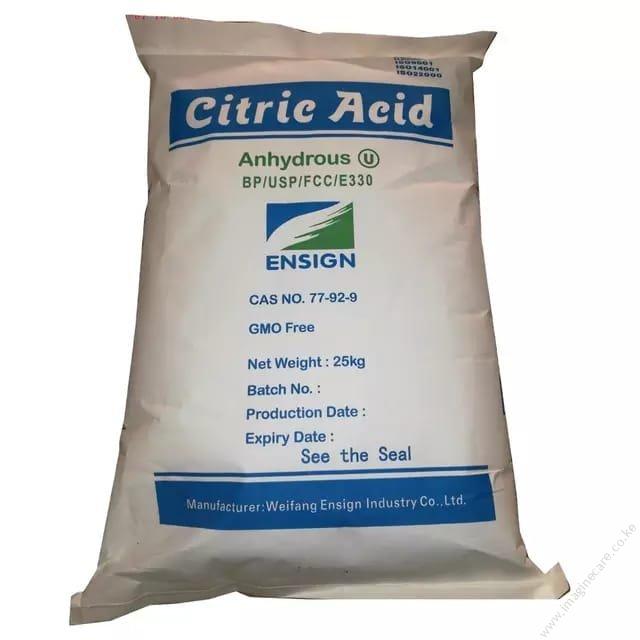
Citric Acid Anhydrous Supplie
High-Quality Citric Acid Anhydrous for Food Processing, Pharmaceuticals, Cosmetics and Industrial Applications
Are you looking for a reliable supplier of Citric Acid Anhydrous in Nairobi, Kenya or elsewhere in East Africa? Olinc Chemical Suppliers provides product information and supply enquiries for Citric Acid Anhydrous, a widely used organic acid valued for its acidity-regulating, pH-adjusting, chelating and formulation properties.
Citric Acid Anhydrous is an important raw material in food and beverage manufacturing, pharmaceutical production, cosmetics, detergents, cleaning products and several industrial processes. It helps manufacturers control acidity, improve product formulations, bind certain metal ions and achieve consistent product quality.
Whether you manufacture beverages, confectionery, pharmaceutical preparations, personal-care products, detergents or industrial formulations, understanding the correct grade and specifications of citric acid is essential when selecting a suitable raw material.
At Olinc Chemical Suppliers, we assist customers seeking Citric Acid Anhydrous in Kenya by providing product information and handling enquiries based on the required application, grade, quantity and specifications.
What Is Citric Acid Anhydrous?
Citric Acid Anhydrous is a naturally occurring organic acid that is commercially produced through fermentation processes, commonly using carbohydrate-based raw materials. It is widely recognised for its sour taste, excellent water solubility and ability to regulate acidity in different formulations.
The term anhydrous means that the citric acid crystal structure does not contain water of crystallisation. This distinguishes it from Citric Acid Monohydrate, which contains one molecule of water of crystallisation for each molecule of citric acid.
Both forms provide citric acid functionality, but they differ in their water content and molecular weight. This distinction is important when calculating formulation quantities, preparing solutions and comparing product specifications.
Citric Acid Anhydrous is commonly supplied as a white crystalline powder or granules. It is used in applications where manufacturers require citric acid with a lower moisture content.
Chemical Identity and General Information
| Property | Description |
|---|---|
| Product name | Citric Acid Anhydrous |
| Chemical name | 2-Hydroxypropane-1,2,3-tricarboxylic acid |
| Common name | Anhydrous citric acid |
| Molecular formula | C₆H₈O₇ |
| Molecular weight | 192.12 g/mol |
| CAS number | 77-92-9 |
| EC number | 201-069-1 |
| Appearance | White crystalline powder or granules |
| Odour | Odourless |
| Taste | Strongly sour |
| Solubility | Freely soluble in water |
| Chemical classification | Organic tricarboxylic acid |
| Water of crystallisation | None in the anhydrous form |
The CAS number 77-92-9 identifies citric acid. When purchasing, customers should still confirm that the supplier’s documentation identifies the product as the anhydrous form.
Other Names of Citric Acid Anhydrous
Citric Acid Anhydrous may be listed under several alternative names in chemical catalogues, technical documents and product specifications.
Common names include:
- Anhydrous Citric Acid
- Citric Acid, Anhydrous
- 2-Hydroxypropane-1,2,3-tricarboxylic acid
- 2-Hydroxy-1,2,3-propanetricarboxylic acid
- 2-Hydroxytricarballylic acid
- 3-Carboxy-3-hydroxypentanedioic acid
- 2-Hydroxypropane tricarboxylic acid
- E330 (food additive designation for citric acid where permitted)
Important: Citric Acid Monohydrate and Citric Acid Anhydrous are related forms of the same chemical but are not identical products. Buyers should specify the required form when requesting a quotation.
Difference Between Citric Acid Anhydrous and Citric Acid Monohydrate
One of the most common questions from customers is whether anhydrous and monohydrate citric acid can be used interchangeably.
Both forms perform similar functions in many applications, including acidity regulation, pH adjustment and chelation. However, their water content and molecular weights differ.
| Feature | Citric Acid Anhydrous | Citric Acid Monohydrate |
|---|---|---|
| Chemical formula | C₆H₈O₇ | C₆H₈O₇·H₂O |
| Molecular weight | 192.12 g/mol | 210.14 g/mol |
| Water of crystallisation | None | One molecule |
| Appearance | White crystals or powder | White crystals or powder |
| Water solubility | Freely soluble | Freely soluble |
| Typical use | Food, pharmaceutical and industrial formulations | Food, pharmaceutical and industrial formulations |
| Moisture content | Lower, subject to specification | Contains water of crystallisation |
The anhydrous form contains more citric acid by mass than the monohydrate form. Consequently, equal weights of the two products do not contain exactly the same amount of citric acid on a molar basis.
When replacing one form with the other in a formulation, manufacturers should calculate the required adjustment based on molecular weight, purity and the intended application.
Key Properties of Citric Acid Anhydrous
Citric Acid Anhydrous is valued for several properties that make it useful in manufacturing and formulation processes.
Acidity Regulation
Citric acid is a weak organic acid that helps reduce and control the pH of formulations. It is commonly used in beverages, foods, cosmetics, pharmaceutical preparations and cleaning products.
Excellent Water Solubility
It dissolves readily in water, making it suitable for aqueous formulations and processes where an acid needs to be distributed throughout a liquid product.
Chelating Ability
Citric acid can bind certain metal ions, including calcium, magnesium and iron. This property helps control the effects of metal ions in different formulations.
Sour Taste
It provides a clean, sour taste that makes it particularly useful in beverages, sweets, confectionery and other food products.
Biodegradability
Citric acid is generally considered readily biodegradable under appropriate environmental conditions. Its environmental impact still depends on concentration, quantity released and the receiving environment.
Low Moisture Content
Unlike citric acid monohydrate, the anhydrous form does not contain water of crystallisation. This can be advantageous in dry blends, powders and formulations where moisture control is important.
Industrial and Commercial Applications of Citric Acid Anhydrous
Citric Acid Anhydrous is used across a wide range of industries. Its functions depend on the formulation, product grade and manufacturing requirements.
Food and Beverage Manufacturing
Citric acid is widely used in food and beverage processing because of its sour taste and ability to regulate acidity.
Applications include:
- Soft drinks and carbonated beverages
- Fruit juices and juice concentrates
- Flavoured water and beverage mixes
- Energy and sports drink formulations
- Sweets and confectionery
- Gummies and jelly products
- Jam and fruit preparations
- Sauces, dressings and condiments
- Processed foods
- Powdered drink mixes
- Baking and confectionery formulations
In food production, citric acid may help establish the desired acidity, improve flavour balance and support product stability. It can also contribute to controlling certain oxidation-related quality changes by binding metal ions.
Food-grade citric acid should be used for food applications. Industrial-grade material should not be substituted for food-grade material.
Pharmaceutical Manufacturing
Citric Acid Anhydrous is used in pharmaceutical formulations as an acidifying agent, buffering component and formulation ingredient.
Potential applications include:
- Effervescent tablet formulations
- Powdered pharmaceutical preparations
- Oral solutions
- Certain syrups and liquid formulations
- Pharmaceutical buffer systems
- Selected medicinal preparations
In effervescent formulations, citric acid reacts with an appropriate carbonate or bicarbonate ingredient in the presence of water to release carbon dioxide.
Pharmaceutical applications require material that meets the relevant pharmacopoeial and manufacturer specifications. Customers should confirm whether BP, USP, Ph. Eur. or another applicable standard is required.
Cosmetics and Personal-Care Manufacturing
Citric acid is commonly used in personal-care products where pH adjustment and formulation stability are important.
Applications include:
- Shampoos
- Hair conditioners
- Liquid soaps
- Body washes
- Facial cleansers
- Creams and lotions
- Bath products
- Certain skincare formulations
- Personal-care cleansing products
It helps manufacturers adjust the pH of formulations to achieve the required product characteristics. It can also bind certain metal ions that may affect formulation stability.
The correct concentration should be established through formulation testing because excessive acidity may irritate skin or affect product performance.
Detergent and Cleaning Product Manufacturing
Citric Acid Anhydrous is useful in household and industrial cleaning formulations.
Applications include:
- Household cleaning powders
- Descaling products
- Bathroom cleaners
- Kitchen cleaning formulations
- Dishwashing products
- Washing-machine descalers
- Industrial cleaning compounds
- Hard-water stain removers
- Mineral deposit removal formulations
Its acidity helps dissolve certain mineral deposits, including limescale and calcium-based residues. Its ability to bind some metal ions also contributes to its usefulness in cleaning formulations.
Citric acid should not be assumed to be a disinfectant or substitute for a registered antimicrobial ingredient.
Water Treatment and Water Conditioning
Citric acid is used in selected water-treatment and cleaning processes where pH control, metal-ion binding or mineral deposit removal is required.
Potential applications include:
- pH adjustment in suitable treatment processes
- Cleaning of selected equipment
- Removal of certain mineral deposits
- Chelation of selected metal ions
- Industrial system cleaning
Its suitability depends on water chemistry, treatment objectives, equipment materials and the overall treatment programme.
Textile Manufacturing
In textile processing, citric acid may be used in selected processes involving pH adjustment and formulation control.
Applications can include:
- Textile finishing processes
- Dyeing and processing baths
- pH adjustment
- Selected textile treatment formulations
The actual use depends on the fibre type, dye system and process specifications.
Metal Cleaning and Surface Treatment
Citric acid is used in selected metal-cleaning and surface-treatment processes.
Its ability to bind metal ions and dissolve certain deposits makes it useful in some cleaning applications. It may be considered for descaling and cleaning selected metal surfaces, subject to compatibility testing.
Manufacturers should assess the metal type and operating conditions before using citric acid because acidic solutions may affect certain metals and finishes.
Industrial and Chemical Manufacturing
Citric Acid Anhydrous is also used as a formulation ingredient and processing aid in different chemical manufacturing operations.
Its applications may include:
- Manufacture of specialised cleaning compounds
- Preparation of acid-based formulations
- Chemical processing
- Formulation of industrial additives
- Production of selected specialty products
Available Grades of Citric Acid Anhydrous
Choosing the correct grade is essential because products intended for different industries may have different purity, testing and documentation requirements.
Food Grade
Food-grade Citric Acid Anhydrous is intended for approved food and beverage applications. It is commonly identified as food additive E330 in relevant regulatory systems.
It may be used in beverages, confectionery, processed foods, sauces and other food formulations, subject to applicable food regulations.
Pharmaceutical Grade
Pharmaceutical-grade citric acid is manufactured and tested against appropriate pharmaceutical quality requirements.
Customers may request compliance with standards such as:
- USP – United States Pharmacopeia
- BP – British Pharmacopoeia
- Ph. Eur. – European Pharmacopoeia
The applicable standard should be confirmed against the supplier’s certificate of analysis and product documentation.
Industrial Grade
Industrial-grade Citric Acid Anhydrous is used in suitable non-food manufacturing and industrial applications, including selected cleaning, descaling and chemical formulations.
It should not be used in food or pharmaceutical production unless the product is specifically certified and approved for that purpose.
When requesting Citric Acid Anhydrous from Olinc Chemical Suppliers, specify the intended application and required grade so that the appropriate product specification can be confirmed.
Typical Product Specifications
The exact specifications depend on the manufacturer, grade and product batch. The following are common quality parameters buyers may encounter when evaluating Citric Acid Anhydrous.
| Parameter | Typical specification or description |
|---|---|
| Appearance | White crystalline powder or crystals |
| Identification | Conforms to citric acid identification tests |
| Assay | Commonly around 99.5–100.5% on an anhydrous basis, depending on the applicable standard |
| Molecular weight | 192.12 g/mol |
| CAS number | 77-92-9 |
| Water content | Low; tested against the applicable grade specification |
| Oxalate | Controlled according to relevant quality standard |
| Sulphated ash/residue on ignition | Controlled according to relevant quality standard |
| Heavy metals/elemental impurities | Must comply with the relevant application and standard |
| Solubility | Freely soluble in water |
| Odour | Odourless |
These values are indicative, not a guaranteed specification for every available product. Buyers should request the manufacturer’s current Technical Data Sheet (TDS) and Certificate of Analysis (COA) for the actual material being supplied.
Packaging and Supply Information
Citric Acid Anhydrous is commonly supplied in moisture-protective packaging designed to maintain product quality during storage and transportation.
Common commercial packaging formats may include:
- 25 kg bags
- 25 kg lined bags
- Other manufacturer-approved bulk packaging options
Actual packaging availability should be confirmed when requesting a quotation.
When placing an enquiry, customers should provide:
- Required quantity in kilograms or metric tonnes
- Preferred packaging size
- Intended application
- Required grade
- Delivery location
- Any special quality or documentation requirements
Whether you need a small quantity for production trials or a larger quantity for commercial manufacturing, providing these details helps establish the appropriate supply requirements.
Storage Requirements for Citric Acid Anhydrous
Proper storage helps maintain product quality and prevents contamination or moisture absorption.
Recommended storage practices include:
- Store in a cool, dry and well-ventilated area.
- Keep the packaging tightly sealed when not in use.
- Protect the product from moisture and excessive humidity.
- Store away from incompatible chemicals, particularly strong bases and strong oxidising agents.
- Keep away from direct sunlight and excessive heat.
- Avoid storing directly on damp floors.
- Use clean, dry equipment when handling the material.
- Follow the manufacturer’s recommended storage conditions and shelf life.
Because the anhydrous form is intended to have low water content, protecting it from moisture is particularly important.
Safety and Handling Precautions
Citric Acid Anhydrous is widely used in food and industrial manufacturing, but concentrated powder and solutions should still be handled responsibly.
Possible exposure effects include:
- Eye irritation, particularly from dust or concentrated solutions
- Skin irritation after prolonged or repeated contact
- Respiratory irritation if airborne dust is inhaled
- Discomfort if significant quantities are swallowed
Recommended precautions include:
- Wear suitable protective gloves.
- Use safety goggles to protect the eyes.
- Avoid creating or inhaling dust.
- Work in a well-ventilated area.
- Wash hands after handling.
- Avoid contact with the eyes.
- Keep the product in its original labelled packaging.
- Consult the Safety Data Sheet (SDS) before use.
In case of eye contact, rinse cautiously with clean water for several minutes and seek medical advice if irritation persists. If inhaled, move to fresh air if respiratory irritation occurs. Follow the product SDS and workplace emergency procedures.
Factors to Consider When Buying Citric Acid Anhydrous in Kenya
Before purchasing Citric Acid Anhydrous, it is important to establish whether the material meets your production requirements.
Confirm the Correct Form
Make sure you are purchasing Citric Acid Anhydrous rather than Citric Acid Monohydrate. The difference affects moisture content and formulation calculations.
Select the Correct Grade
Food manufacturers should request food-grade material. Pharmaceutical manufacturers should confirm the required pharmacopoeial standard. Industrial users should select a grade suitable for their process.
Check Product Purity
Confirm the assay and other relevant quality parameters using the manufacturer’s COA.
Request Technical Documentation
Depending on the application, request:
- Technical Data Sheet (TDS)
- Safety Data Sheet (SDS)
- Certificate of Analysis (COA)
- Applicable food-grade or pharmacopoeial documentation
Confirm Packaging
Choose packaging suitable for your consumption rate, storage conditions and production requirements.
Consider Quantity and Delivery
Provide the required quantity and delivery location when requesting a quotation. This helps the supplier assess the appropriate supply arrangements.
Why Choose Olinc Chemical Suppliers?
Olinc Chemical Suppliers serves customers looking for industrial and specialty chemical products in Nairobi and the wider Kenyan market.
When enquiring about Citric Acid Anhydrous, customers can provide their intended application, required grade and quantity so that the relevant product details can be established.
We aim to support customers by providing:
- Product information for informed purchasing decisions
- Guidance on the distinction between anhydrous and monohydrate forms
- Enquiry support for different commercial quantities
- Information on available grades and specifications
- Assistance with packaging and delivery enquiries
Whether you are a food processor, detergent manufacturer, pharmaceutical producer, cosmetics manufacturer or industrial user, contact Olinc Chemical Suppliers to discuss your Citric Acid Anhydrous requirements.
Frequently Asked Questions About Citric Acid Anhydrous
What is Citric Acid Anhydrous used for?
Citric Acid Anhydrous is used in food and beverage processing, pharmaceutical manufacturing, cosmetics, personal-care products, detergents, cleaning compounds, water treatment and selected industrial processes. Its main functions include acidity regulation, pH adjustment, chelation and mineral deposit removal.
What is the difference between Citric Acid Anhydrous and Monohydrate?
Citric Acid Anhydrous contains no water of crystallisation, while Citric Acid Monohydrate contains one molecule of water for each citric acid molecule. Their molecular weights are approximately 192.12 g/mol and 210.14 g/mol respectively.
Is Citric Acid Anhydrous food grade?
Citric Acid Anhydrous is available in food-grade quality. However, not every product sold as citric acid is automatically suitable for food manufacturing. Always confirm the grade and supporting documentation before use.
Is Citric Acid Anhydrous soluble in water?
Yes. It is freely soluble in water, making it suitable for many liquid formulations, cleaning solutions and manufacturing processes.
Can Citric Acid Anhydrous be used in detergent manufacturing?
Yes. It is used in selected detergent and cleaning formulations for pH adjustment, chelation and removal of certain mineral deposits.
Can it be used in cosmetics and skincare products?
Yes. It is used in suitable cosmetic formulations, particularly as a pH adjuster and chelating ingredient. The concentration must be carefully controlled and tested for the intended product.
Is Citric Acid Anhydrous the same as lemon acid?
Citric acid is naturally present in citrus fruits, including lemons. It is sometimes informally called lemon acid, but commercial Citric Acid Anhydrous is a purified manufactured ingredient rather than simply dried lemon juice.
What is the CAS number of Citric Acid Anhydrous?
The CAS number is 77-92-9.
How should Citric Acid Anhydrous be stored?
Store it in a cool, dry place, in tightly sealed moisture-protective packaging. Keep it away from damp conditions and follow the manufacturer’s storage instructions.
What packaging is available?
Common commercial packaging includes 25 kg bags, although actual packaging options should be confirmed at the time of enquiry.
What information should I provide when requesting a quotation?
Provide the required quantity, grade, intended application, preferred packaging and delivery location. If you have a required specification or standard, include it in your enquiry.
Where can I buy Citric Acid Anhydrous in Kenya?
You can contact Olinc Chemical Suppliers in Nairobi, Kenya, to enquire about Citric Acid Anhydrous, its available grade, specifications, packaging and supply arrangements.
Request a Quotation for Citric Acid Anhydrous in Kenya
Are you looking for Citric Acid Anhydrous in Nairobi, Kenya, Uganda or Tanzania for your manufacturing or industrial requirements?
Contact Olinc Chemical Suppliers with your required quantity and application. Our team can assist with product enquiries and information on the relevant grade, specifications and packaging.
Olinc Chemical Suppliers
- Location: Enterprise Road, Avon Business Center, Nairobi, Kenya
- Phone: 0793062849
- Alternative phone: 0743657810
- Email: sales@olincinchemicals.com
- Website: www.olincchemicalsl.com
Contact us today to enquire about Citric Acid Anhydrous in Kenya and discuss your chemical supply requirements.

Reviews
There are no reviews yet.